
MOONTHING Crashes 93% After $183K Volume Spike — Inside Solana's Latest Textbook Rug Pull
Everything To Moon went everywhere but up. A 75% single-wallet concentration, $183K in exit liquidity volume, and a token now worth $2,600. Here's exactly how it happened.
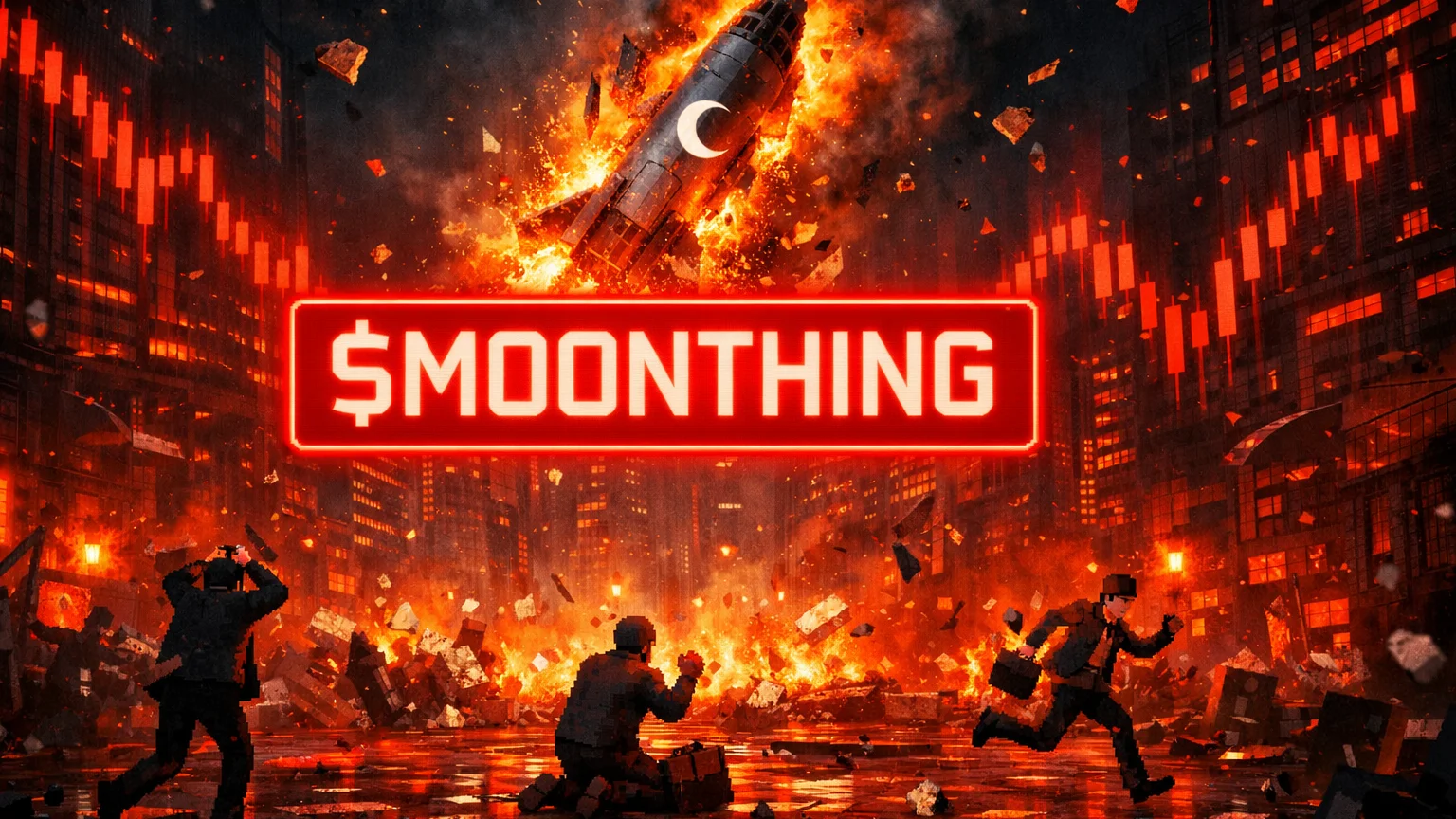
Everything To Moon — ticker MOONTHING — lasted about as long as its name deserved. The pump.fun-launched Solana token spiked hard enough to generate $183K in 24-hour volume, then cratered 93% to a market cap of $2,677. What's left is a ghost chart, a Telegram link to nowhere, and $4,193 in liquidity that exists mostly as a monument to what was taken. This is how it went down.
- → MOONTHING dropped 92.76% after a brief volume spike — market cap now sits at $2,677
- → A single wallet controlled 75.66% of total supply — the definition of concentrated dump risk
- → Combined top-3 wallet concentration exceeded 100% of circulating supply, suggesting overlapping LP positions and token recycling
How It Went Down
MOONTHING launched on pump.fun with the most generic meme coin pitch imaginable: "Everything To Moon." No website. No team. No whitepaper. Just a ticker, a community X page, and the implicit promise that number would go up. The token cleared pump.fun's bonding curve and hit DexScreener's new pairs feed, where it caught enough attention to generate $183K in trading volume — a respectable number for a micro-cap that suggested real retail interest.
But the volume wasn't what it looked like. The vast majority of that $183K was concentrated exit flow — large sell orders against thin liquidity that drained the pool while smaller buyers provided the other side. The chart tells the story in a single candle: a sharp spike followed by a vertical drop. No consolidation, no bounce, no second wave. Just extraction.
The Red Flags Everyone Missed
This one was screaming from the rooftop, and the rooftop was on fire. A single wallet held 75.66% of the entire token supply. Let that number sink in — three-quarters of every MOONTHING token in existence sat in one address. The second-largest holder had 27.39%, and the third held 18.89%. The combined top-3 concentration was 121.9% of supply, which sounds impossible until you understand how pump.fun liquidity works: tokens can be simultaneously held in wallets and locked in LP positions, creating apparent concentrations above 100%.
In practical terms, this meant the entire market was a puppet show. One wallet could — and did — crash the token at will. There was no distributed holder base, no organic accumulation, no community of buyers creating real price discovery. The $183K volume was retail money flowing into a funnel controlled by a single entity.
The other flags were textbook: no website, no doxxed team, generic name with zero creative effort, and a community X page with no content beyond the token announcement. The only social presence was a community X page that served as a price-tracking beacon rather than any genuine community hub. Every experienced meme coin trader knows these signals. But in the heat of a DexScreener trending moment, "Everything To Moon" was catchy enough to override the pattern recognition that would have saved people money.
The Receipts
The on-chain evidence is damning in its simplicity. The deployer wallet (GmfncvuWZLBjZPGoKk2PATmW1eJaS8yg4xqjqSwjnrA2) is a first-time creator with zero remaining balance — they launched, distributed, and exited. The dominant holder at address DuL7SzThVK62un76tJc6iDxxgppoGX4qtE2XJbYeE2dt accumulated 75.66% of supply, likely through the bonding curve phase when tokens were cheapest, then sold into the post-graduation retail flow.
The rug score of 24 on Rugcheck was technically in the "low risk" range — no freeze authority, no mint authority. But rug scores measure technical exploit risk, not economic concentration risk. A token can be perfectly "safe" from a contract perspective while being economically designed to extract money from latecomers. MOONTHING didn't need a malicious contract. It just needed one patient wallet and enough retail curiosity to provide exit liquidity.
Lessons for Degens
First: check holder concentration before you ape. Every time. DexScreener shows you the chart, but it doesn't show you the wallet distribution that determines whether that chart is real or manufactured. Tools like Rugcheck, Birdeye, and Solscan will show you top holders in seconds. If one wallet holds more than 30% of supply, you're not trading a token — you're providing exit liquidity for a whale. At 75%, you're donating.
Second: volume is not validation. MOONTHING generated $183K in 24-hour volume on a token that was never worth more than a few thousand dollars in market cap. That volume wasn't organic price discovery — it was the sound of money changing hands in one direction. High volume on a micro-cap with no community, no content, and no narrative is a sell signal, not a buy signal.
Third: the name test. "Everything To Moon" is the meme coin equivalent of naming your restaurant "Good Food Here." It's so generic it signals zero creative investment from the creator. Compare this to tokens that succeed on name virality — they have specificity, absurdity, or cultural reference baked in. A name that could apply to literally any token probably belongs to one that was created to extract, not to build.
Fourth: the absence of a website isn't just a yellow flag — in the context of all other signals, it's confirmation. Legitimate meme coins, even the most ridiculous ones, typically invest something in presentation. A $5 domain and a one-page site. A Twitter account with actual memes. MOONTHING had none of this because none of it was needed. The play was always short-term extraction, and short-term extraction doesn't need a website.
🔴 Confirmed Rug Pull — MOONTHING was dead on arrival for anyone who checked the on-chain data. A 75.66% single-wallet concentration isn't a risk factor — it's a guarantee. The token existed to convert retail curiosity into one wallet's profit, and it executed that function precisely. The $183K in volume was the price tag of the lesson. No freeze authority and a low rug score meant the contract itself wasn't malicious, but the economic structure was designed for extraction from the first block. If you bought MOONTHING, the only recovery is the knowledge: always check top holders before you ape. Always.
What happened to MOONTHING crypto?
MOONTHING (Everything To Moon) crashed 93% after a dominant wallet holding 75.66% of supply sold into retail buy pressure. The token's market cap dropped from its peak to just $2,677, with only $4,193 in remaining liquidity.
Was MOONTHING a rug pull?
Yes. While the smart contract itself had no malicious functions (no freeze or mint authority), the economic structure was a classic rug: one wallet accumulated three-quarters of supply during the bonding curve phase and dumped on retail traders who discovered the token through DexScreener trending.
How do you spot a rug pull on Solana?
Check top holder concentration on Rugcheck, Birdeye, or Solscan before buying. If one wallet holds more than 30% of supply, the risk of a coordinated dump is extreme. Also look for red flags like no website, generic names, no social media content, and volume that far exceeds market cap on a new token.
Can MOONTHING recover?
With a $2,677 market cap, $4,193 in liquidity, and the dominant holder having already exited, recovery is virtually impossible. There is no community, no development, and no catalyst that would attract new buyers to a confirmed rug pull.