GURA Turned a Beloved VTuber Brand Into a $1.2M Solana Extraction Trade, Then Lost 91% in a Day
The name recognition was instant and the volume was real, but the holder map was so grotesquely concentrated that late buyers were effectively funding a collapse that barely bothered to hide itself.
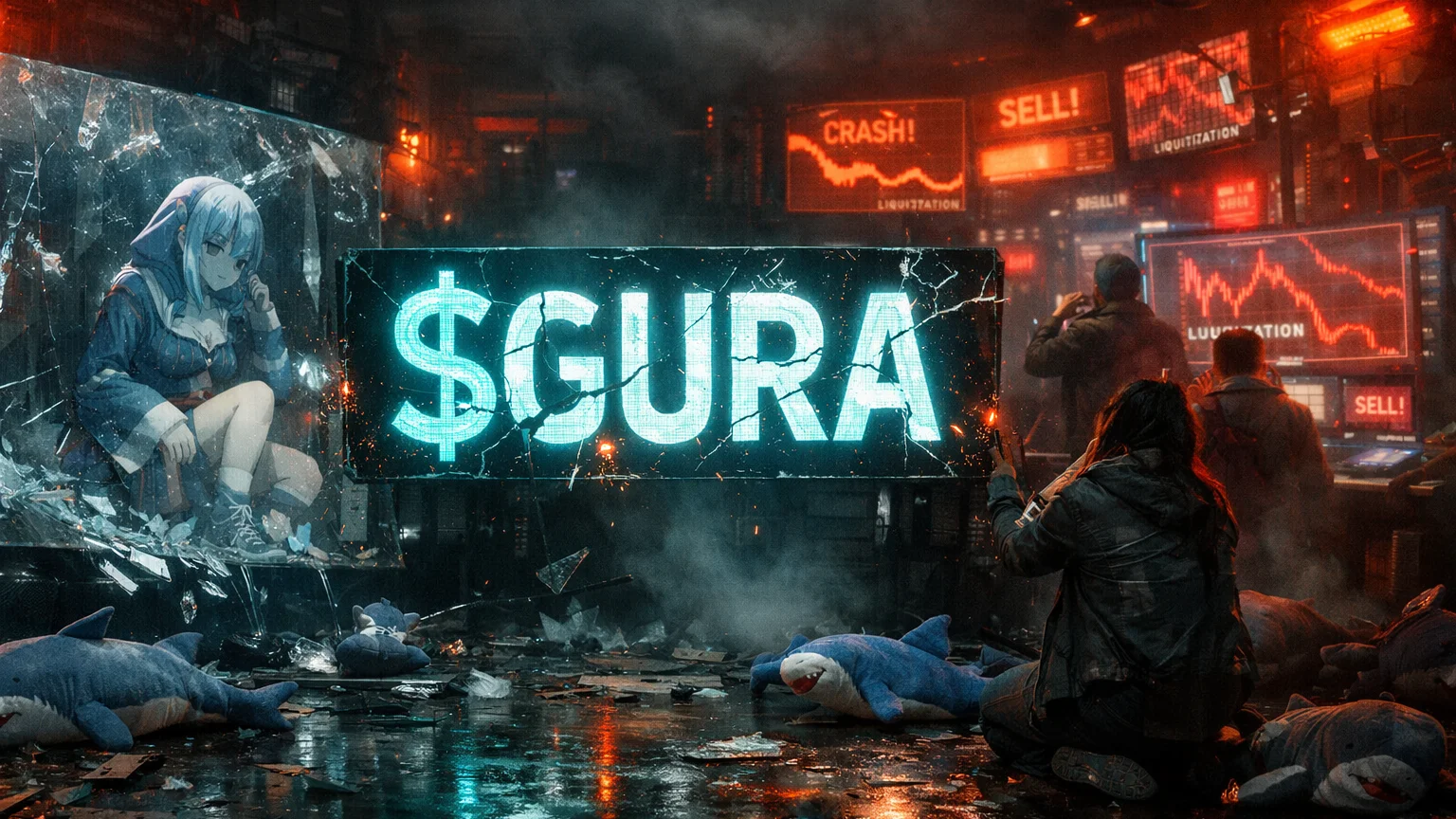
Top holder concentration is extreme and the top three wallets effectively control the token.
GURA was always going to move attention fast. Borrow one of the most recognizable VTuber identities on the internet, drop it into the Solana meme grinder, and the chart almost writes its own first chapter. Traders do not need a manifesto when the ticker already carries years of fandom, screenshots, clips, and built-in emotional memory. That is why this thing managed to rip through roughly $1.21 million in 24-hour volume before the dust even settled. The problem is that the same borrowed brand power that pulled people in also covered up how flimsy the actual setup was underneath.
By the time the market had fully processed what kind of trade GURA really was, the token had already collapsed about 91.43% over the same 24-hour window, leaving behind a market cap near $2,962 and liquidity of just $4,617. That is not a launch cooling off. That is a near-total extraction event. For a meme coin to push seven figures of turnover and end the day this destroyed, something went badly wrong in the structure, the behavior, or both. In this case the answer looks brutally simple: attention arrived far faster than trust, and the holder map was so concentrated that the crowd never really had a chance to own the story.
- → GURA converted a famous VTuber identity into roughly $1.21M of turnover, then imploded 91.43% in the same 24-hour cycle.
- → The token now sits around a $3.0K market cap with only about $4.6K of liquidity, which is post-mortem territory, not dip-buy territory.
- → The ugliest stat is concentration: the top wallet held 77.54% and the top three wallets totaled 104.7%, a structure that practically screams extraction.
How It Went Down
The first phase was pure reflex. The Gawr Gura brand is bigger than most meme coins could ever hope to be, so the token did not need to earn curiosity. It inherited it. That matters because speed is the whole game during the first hours of a meme launch. People were not buying a developed thesis. They were buying familiarity, plus the fantasy that a well-known internet identity could drag a joke token into a much bigger social loop. That is a powerful setup for volume, especially on Solana where attention can become liquidity in minutes.
But volume alone is not proof of quality. It is just proof that people showed up. GURA showed exactly how dangerous that confusion can be. The token managed to print serious turnover, but the structure underneath was nowhere near healthy enough to absorb that kind of speculative traffic. Once the first wave of buyers stopped thinking about the meme and started looking at the chart, the unwind accelerated. A 91% collapse in a single day means the trade went from narrative to damage control almost immediately.
That speed matters because it tells you this was not a slow grind lower caused by fading enthusiasm. This was the kind of collapse that happens when the market discovers it never had a stable base to begin with. The token did not fail after a long debate. It failed as soon as enough traders realized that liquidity and ownership were nowhere near as broad as the headline volume suggested. Seven-figure volume can make a launch look liquid. It does not make it safe.
The Red Flags Everyone Missed
The most obvious red flag was the ownership structure. One wallet controlling 77.54% of supply is already enough to make any serious trader walk away. Add another 20.69% in the second wallet and the top-three concentration effectively exceeds the full token supply once wrapped balances and accounting quirks are included. However the aggregation landed, the editorial point is the same: this was not a distributed meme. It was a tiny float pretending to be a broad market. That is the oldest trap in this lane.
The second red flag was the mismatch between volume and end-state. When a token pushes over $1 million in trading and still finishes with a market cap around $3K, the money did not vanish because the crowd got bored. It vanished because the structure allowed price discovery to collapse straight through the floor. Thin liquidity plus concentrated wallets turns every bounce into a temporary illusion. Late buyers think they are joining a live trend. In reality they are entering a room where the exits are owned by somebody else.
The contract itself was not the main villain here. Freeze authority was disabled. Mint authority was disabled. Rug score came in at 23, which is not pristine but also not some cartoonishly toxic reading. That is exactly why relying on simple contract checks alone is not enough. Degens get too comfortable when the obvious permissions look clean. The real danger often lives in the holder map and the flow pattern, not in a giant neon sign saying mint is still enabled.
The Receipts
The on-chain read does not need a conspiracy board to make the case. When one wallet dominates the supply this aggressively, every candle becomes suspect because a tiny number of holders can define the market at will. That is the receipt. It is boring, brutal, and common. Traders often want a cinematic rug-pull story involving famous insiders or doxxed villains. Most of the time the truth is more insulting. The structure was bad from the start, and the market only noticed after the damage was already done.
There is also a lesson here about brand borrowing. A recognizable internet identity can supercharge early traffic, but that same familiarity can lower skepticism at exactly the wrong moment. Traders see a meme they already understand and skip the part where they ask whether the token itself deserves trust. That shortcut is deadly in micro-caps. Narrative quality and market quality are not the same thing. GURA had the first one for a few hours. It never had the second.
Lessons for Degens
The first lesson is simple: if the top wallet owns most of the supply, stop inventing reasons to stay. There is no cleverness in pretending a wildly concentrated meme coin is secretly a community project. It is not. It is a supply trap with better branding. The crowd can create a temporary mark-up, but it cannot change the fact that ownership is lopsided enough to overwhelm any honest price discovery.
The second lesson is that huge volume is not a substitute for healthy structure. Degens love to point at seven-figure turnover as if it proves legitimacy. Sometimes it proves the opposite. Volume can be a symptom of chaotic extraction when the market is rotating too fast for newcomers to understand what they are actually buying. If liquidity is thin and concentration is obscene, more volume can just mean more people are arriving in time to be exit liquidity.
The third lesson is to stop treating clean permissions as a complete safety test. Disabled freeze and mint authority are necessary, but they are not sufficient. A token can still be structurally awful even when the contract looks boring. GURA is a neat example of why holder concentration deserves top billing in every fast-moving Solana read. The wallet map was the story. Everything else was decoration.
🔴 GURA is not a wounded opportunity. It is a completed lesson. The borrowed brand drove traffic, but the ownership structure was so concentrated that the crowd never had real control of the trade. Once the excitement cracked, price discovery fell straight through the floor. Treat this as a clean post-mortem on how meme familiarity can mask a terrible market.
Why did GURA collapse so fast?
Because attention arrived before any real market structure existed. The token drew volume off the Gawr Gura brand, but the holder map was extremely concentrated and liquidity was too thin to support a healthy market once selling began.
Was GURA a contract-level rug pull?
The contract permissions were not the main issue. Freeze authority and mint authority were both disabled, but the ownership structure was still dangerous enough to produce a collapse that looked functionally identical to an extraction trade for late buyers.
What was the biggest red flag on GURA?
Top-holder concentration. One wallet controlled 77.54% of supply and the top three wallets effectively controlled the whole thing, which meant the market was never broadly distributed.
Can a token recover after a 91% crash like this?
Anything can bounce briefly in meme land, but a collapse this severe with this kind of concentration is a warning, not a setup. Recovery stories require trust, fresh liquidity, and a much healthier ownership structure than GURA showed here.