The '67 Kid' Pumped an Epstein-Themed Token to the Moon — Then It Crashed 96% and His Twitter Got Suspended
Community notes called scam. YouTube exposés are already live. $67EPSTEIN is the textbook anatomy of a KOL betrayal — and 3,868 transactions worth of degens learned the lesson the expensive way.
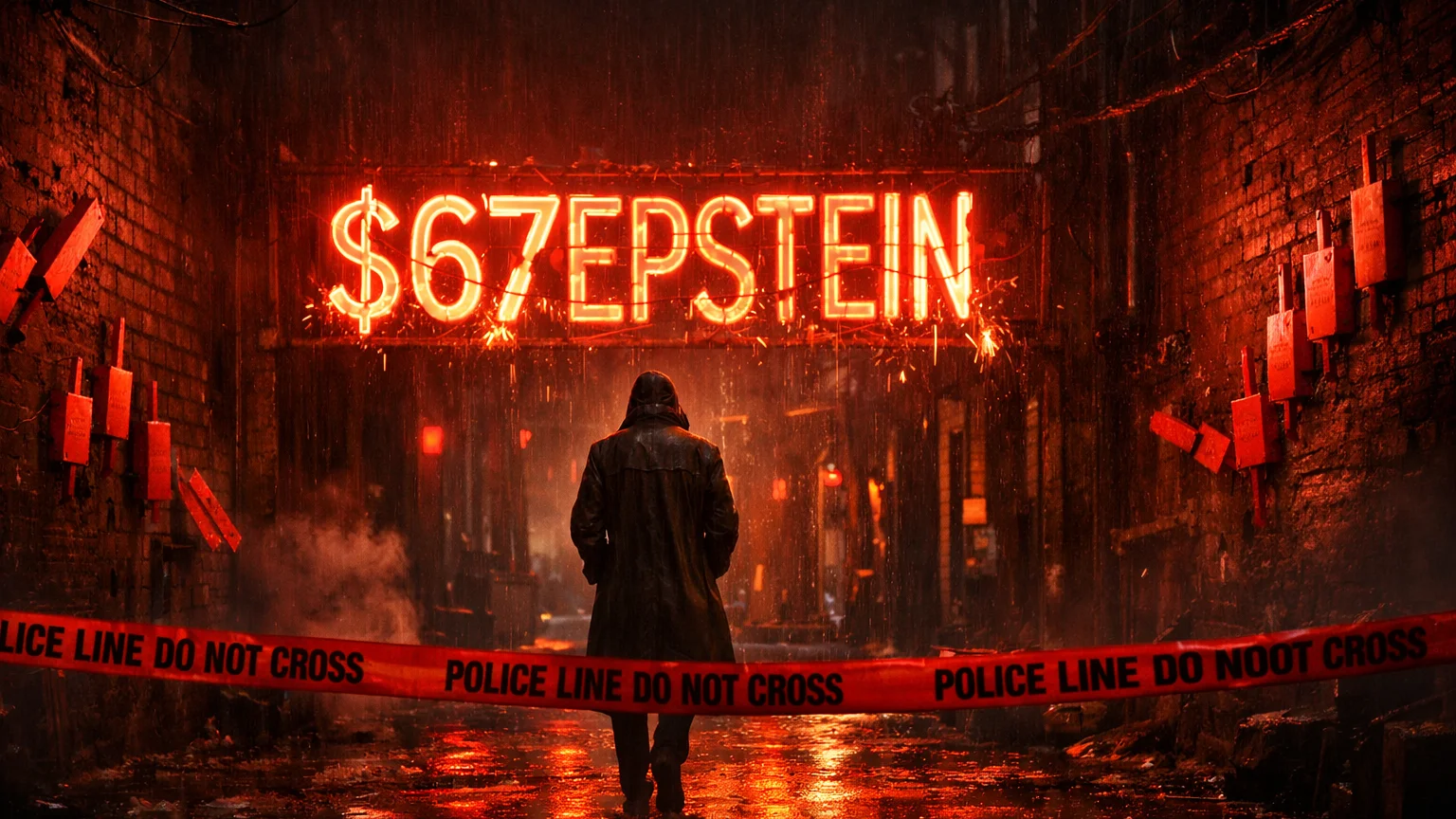
Here's the pitch: take one of the most controversial names in modern history, slap it on a Solana token, get a KOL known as the '67 kid' to pump it to his audience, and watch the money roll in. Here's what actually happened: a 96% crash, a suspended Twitter account, community notes plastered across every remaining post calling it a scam, and YouTube creators already uploading exposé content before the liquidity pool finished draining.
$67EPSTEIN — 'The Official 67 Epstein' — is dead. Market cap cratered from its peak to roughly $2,000. Liquidity sits at $4,000. The promoter's Twitter account is suspended. And 3,868 transactions worth of degens are staring at wallets that just got educated on the oldest trick in the meme coin playbook.
- → $67EPSTEIN crashed 96% after the '67 kid' promoter's Twitter was suspended — community notes had already flagged it as a scam
- → Market cap collapsed to $2K with only $4K liquidity remaining — this token is functionally dead
- → YouTube exposé content is already emerging — this rug is becoming a case study in KOL betrayal mechanics
How It Went Down
The playbook was textbook. A promoter — referred to across CT as the '67 kid' — built an audience through aggressive engagement farming and edgy content. The handle leaned into shock value, which is exactly the kind of account that can move micro-cap tokens because the audience self-selects for high-risk, low-diligence traders.
The token name itself was designed for maximum virality through controversy. Jeffrey Epstein's name carries instant recognition and guaranteed emotional reaction — rage, morbid curiosity, outrage. In the attention economy of meme coins, controversy IS liquidity. The '67 kid' knew this. The token launched, the promoter tweeted, the audience aped, and for a brief window the chart looked like every other micro-cap miracle on DexScreener.
Then it collapsed. 95.62% down. The kind of candle that looks like a cliff on a chart. And almost simultaneously, the promoter's Twitter account was suspended — whether by platform enforcement or self-deletion is unclear, but the timing tells you everything you need to know.
They didn't miss them. They saw them and aped anyway. That's the uncomfortable truth about KOL-promoted micro-cap meme coins — the red flags are visible from orbit, and traders treat them as features rather than warnings.
The fundamental problem with controversy tokens is temporal. Outrage has a half-life measured in hours, not days. Once the initial shock value wears off — once the screenshots have been shared and the 'can you believe this exists' tweets have been posted — there's nothing left to sustain demand. The token IS the joke, and jokes get old fast.
The KOL Betrayal Pattern
$67EPSTEIN fits a pattern that MemeDesk has documented across dozens of rug pulls: the Anonymous Promoter Pump-and-Exit. The mechanics are consistent:
Step one: build an audience through edgy, engagement-optimized content. Step two: accumulate a position in a micro-cap token (or create one). Step three: promote aggressively to the audience, creating buy pressure that pumps the price. Step four: sell into the liquidity your audience just provided. Step five: delete or abandon the account. The '67 kid' followed this script so precisely it could be a case study in a crypto fraud textbook.
The Twitter suspension adds a layer — whether it was platform-initiated (for promoting what community notes flagged as a scam) or strategic self-deletion (to avoid accountability), the result is identical. The promoter is unreachable. The money is gone. The audience is left holding bags worth fractions of pennies.
The Receipts
The buy/sell ratio at 52/48 during the crash tells an ugly story: even as the token was imploding, new buyers were still entering. Some were trying to catch the knife. Others likely hadn't seen the community notes yet. A few were probably bots running momentum strategies that don't check for suspended promoters. Every one of them got wrecked.
With $4K in remaining liquidity and a $2K market cap, $67EPSTEIN is functionally a dead token. There's no recovery path. No community to rally around. No promoter to relaunch the narrative. The DexScreener page will sit there as a monument to what happens when controversy meets exit liquidity.
Lessons for Degens
If the only reason a token exists is shock value, the only people who profit are the ones who created the shock. Controversy tokens don't build communities — they build audiences for a single promoter's exit liquidity event.
The checklist that would have saved every $67EPSTEIN buyer exactly zero effort to execute: Is the promoter anonymous with no verifiable history? Is the token name designed for outrage rather than community? Is there a single point of failure (one account, one narrative)? Does the token have any path to sustained relevance beyond the initial controversy cycle? If you answer yes to the first three and no to the last one, you're not investing — you're funding someone else's exit.
Community notes exist for a reason. When Twitter's own crowd-sourced fact-checking layer flags something as a scam, and you ape anyway because the chart looks good — that's not being early. That's being the exit liquidity.
MemeDesk Verdict
🔴 Shill Alert — $67EPSTEIN is a confirmed rug in every dimension that matters. A controversy-bait token promoted by a now-suspended anonymous account, crashed 96%, with $4K in remaining liquidity and zero recovery path. The '67 kid' followed the KOL betrayal playbook to the letter: build audience, pump token, extract liquidity, disappear. Community notes flagged it. YouTube is documenting it. The only value this token has now is as a cautionary tale. If you're still holding, there's nothing to salvage — the $4K liquidity pool won't even cover most positions' slippage. Learn the pattern. Recognize it next time. The promoters always leave first.
What happened to $67EPSTEIN token?
$67EPSTEIN crashed 95.62% after its primary promoter — known as the '67 kid' — had their Twitter account suspended. Community notes had already flagged the promotion as a scam. The token's market cap collapsed to approximately $2,000 with only $4,000 in remaining liquidity.
Who is the '67 kid' crypto promoter?
The '67 kid' was an anonymous Twitter account that built an audience through edgy, shock-value content. They promoted $67EPSTEIN to their followers before their account was suspended. No verified identity has been established.
Is $67EPSTEIN a rug pull?
All signs point to yes. The pattern — anonymous promoter, controversy-bait token name, rapid pump followed by a 96% crash, and the promoter's account disappearing — is consistent with a classic pump-and-dump scheme. Community notes and emerging YouTube exposés support this conclusion.
Can $67EPSTEIN recover?
Recovery is functionally impossible. With $2K market cap, $4K liquidity, and the sole promoter's account suspended, there is no catalyst for renewed interest. The token has no community, no utility, and no narrative beyond the initial controversy.
How to avoid meme coin rug pulls like $67EPSTEIN?
Key warning signs: anonymous single-promoter dependency, controversy-only narrative (no community value), extremely thin liquidity, no project infrastructure (website, Telegram, roadmap), and community notes or crowd-sourced warnings flagging it as suspicious. If the token's only appeal is shock value, you're likely the exit liquidity.