$WIREBUS Printed a Violent Solana First Leg, but the Next Read Is Mostly About Insider Overhang
At the 2026-06-24 04:33 UTC selection read, $WIREBUS was trading near a $194.7K market cap after roughly $339.5K in 24-hour volume with about $17.3K in liquidity. The tape is fast enough to get noticed, but a dev balance signal near 88.31% of supply makes the post-pump exhaustion angle much more important than the meme itself.
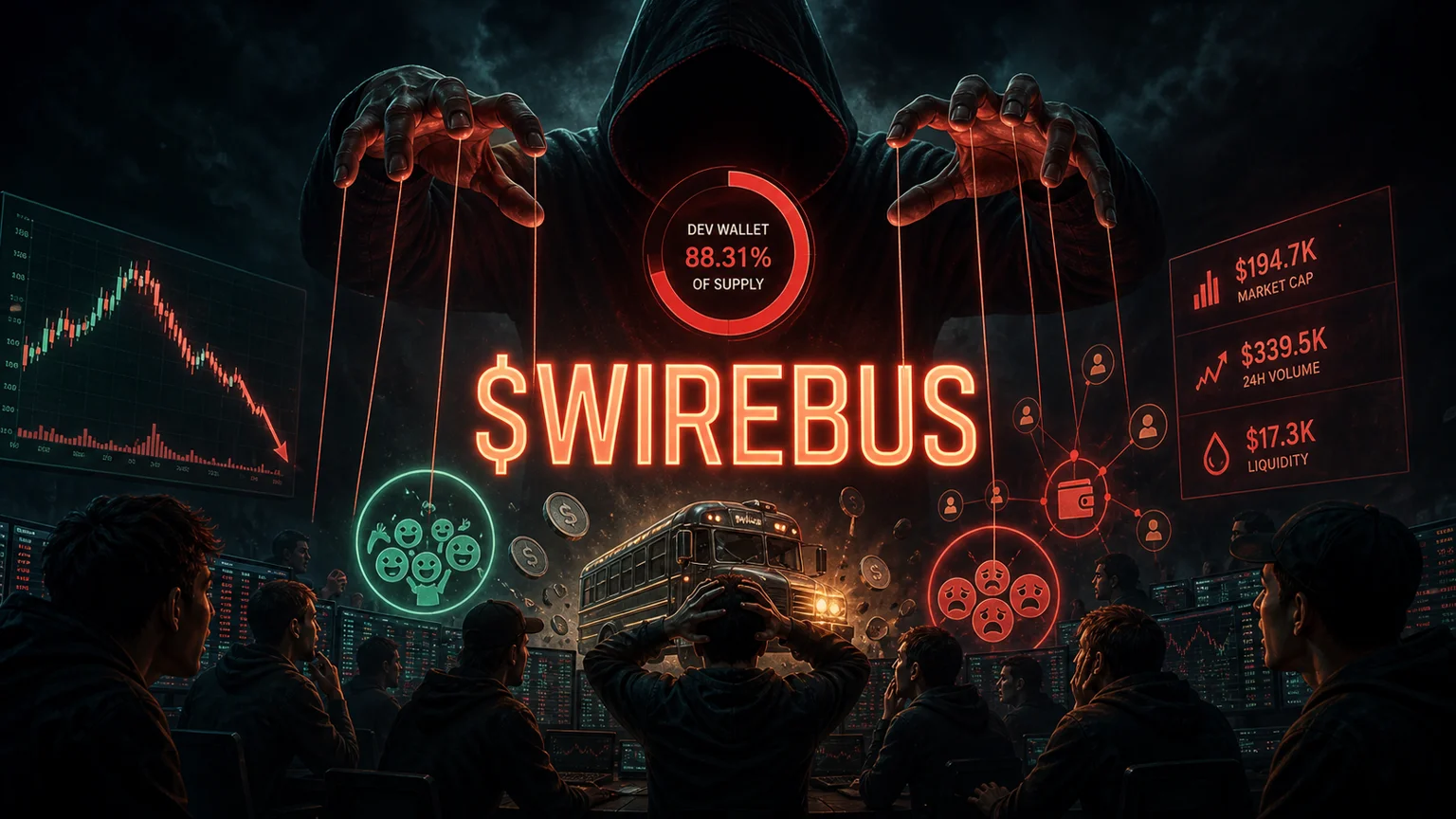
$WIREBUS looks simple at the contract level with freeze authority off, mint authority off, and a Rugcheck score of 1, but the ownership backdrop is much harsher than the shell suggests. The top visible wallet still controls 20.69%, the top three visible wallets control about 34.4%, and the dev profile points to roughly 88.31% of supply tied to the creator wallet, which leaves the entire move exposed to a single dominant source of supply.
The fastest charts on Solana often look the strongest right before they become the most fragile. That is the right starting point for $WIREBUS. By the 2026-06-24 04:33 UTC selection read, the token had already sprinted to roughly a $194.7K market cap on about $339.5K in 24-hour volume, with a 5,765.5% six-hour move packed into a pair that was only about 5.45 hours old. Those are violent numbers for a board that fresh. They tell you the market paid attention immediately.
They do not tell you whether the board deserves trust. The better editorial angle is post-pump exhaustion. $WIREBUS has enough turnover to count as a live launch, but the ownership structure underneath it is still dominated by a creator-linked supply signal near 88.31%. That kind of overhang changes the entire meaning of the first rally. Instead of asking whether the meme can keep spreading, traders have to ask whether the next buyer is walking into a market that is already too dependent on one source of inventory behaving well.
- → $WIREBUS was trading near a $194.7K market cap at the 2026-06-24 04:33 UTC read after roughly $339.5K in 24-hour volume, about $17.3K in liquidity, and a 5,765.5% six-hour move.
- → The narrow contract checks are not the problem: freeze authority is off, mint authority is off, and Rugcheck scored the token at 1, so the board does not fail on obvious permission risk.
- → The reason the read turns red is ownership pressure, with a 20.69% top wallet, 34.4% top-three concentration, and a creator-linked balance signal near 88.31% of supply hanging over a token with only about 672 holders.
How a Five-Hour Surge Becomes an Exhaustion Test
Fresh meme launches can survive on novelty for one clean rotation. They need something else to survive the next one. $WIREBUS got the first part. A simple name, quick chart recognition, and a six-hour percentage move big enough to force itself into scanners will always bring in speculative eyes. The issue is that the move happened before the holder base had time to widen into something that feels self-sustaining.
That is visible in the supporting numbers. About 672 holders is not nothing, but it is a much thinner social foundation than the headline move suggests. Roughly 6,122 total transactions and a buy ratio near 54.8% say the pair was active and buyers were pressing. At the same time, this is still the kind of launch where price can outrun trust by several hours. The tape can look legitimate because it is fast, while the cap table underneath it still looks like a single point of failure.
This is where post-pump exhaustion becomes a useful frame. Traders do not need to predict a crash to recognize that a token can be most dangerous after a spectacular first leg, not before it. A board with shallow liquidity and an enormous creator overhang does not have to rug to punish late buyers. It only has to stop finding fresh demand at the same speed it found the first wave.
What the On-Chain Data Shows
The technical shell is cleaner than the final rating. Freeze authority is off, which matters because the developer cannot freeze holder transfers into a panic. Mint authority is off too, so there is no live infinite-supply question hanging over the board. Rugcheck scored the token at 1. If the article only cared about permissions, $WIREBUS would look fine.
Permissions are not the problem. Ownership is. The top visible wallet already holds 20.69% of supply, and the next two visible wallets add another 8.53% and 5.19%, putting the visible top-three cluster at 34.4%. That alone would make the chart fragile. The much harsher number is the creator-linked balance signal near 88.31% of supply. Even if that reading compresses multiple linked pockets or liquidity-related inventory, it still means the market cannot honestly call this broad ownership yet.
Liquidity makes the same point from another angle. About $17.3K in liquidity is thin even for a fresh board, and it becomes especially thin once the market has already advertised a 5,765.5% six-hour move. That ratio invites exactly the wrong kind of late participation: traders see the candle first and the exit door second. If the token cannot keep refreshing bids, the chart can go from exciting to air-pocket fast.
The holder count explains why that risk is live. With only about 672 holders, the crowd has not yet had enough time to dilute the largest supply pockets into the background. The board may still find that broader audience later, but it does not own it now. Right now the on-chain story is simple: clean freeze and mint permissions, very shallow liquidity, and too much supply influence still anchored close to the creator profile.
Why the Liquidity Looks Better Than the Ownership
The easiest mistake with $WIREBUS is to let the chart do all the persuasion. A token can put together a serious first leg with only modest real depth if enough traders agree to chase the same candle. That is probably what happened here. The board found enough attention to turn roughly $339.5K of 24-hour volume through a pool of only about $17.3K. That can happen. It just does not mean the move is durable.
In practical terms, the chart is telling a cleaner story than the ownership. Liquidity and turnover say people were willing to trade the idea. The holder map says too few participants still control too much of the outcome. When those messages diverge, the safer read is to respect the uglier one. Meme boards do not fail because the early tape looked weak. They fail because the early tape looked strong enough for everybody to ignore who still owned the inventory.
$WIREBUS does not need an obvious contract exploit to become a painful late entry.
Freeze authority is off, mint authority is off, and Rugcheck scored the token at 1, yet a creator-linked balance signal near 88.31%, a 20.69% top wallet, and only about $17.3K in liquidity leave the entire chart sensitive to one-sided distribution.
If the first wave of demand cools before ownership broadens meaningfully, post-pump exhaustion can do the damage on its own.
Where the Exit Door Gets Crowded
This is the part of the trade late buyers usually discover too late. A spectacular first move creates social proof. Everybody sees that somebody else got paid and assumes the tape can absorb one more round of chasing. On a board like $WIREBUS, that assumption is doing all the work. The actual structure still depends on shallow liquidity and an ownership profile that has not earned complacency.
Could the token still bounce again? Of course. Fresh Solana boards can stay irrational longer than clean models expect. But the article is not trying to deny the possibility of another green candle. It is trying to price the risk honestly. Right now the honest read is that $WIREBUS already used a lot of its social momentum before it built a stable cap table. That leaves the next session looking less like clean continuation and more like a test of whether the board can survive its own first success.
$WIREBUS gets the red read because the ownership risk overwhelms the attractive parts of the chart. The token did enough volume to matter and the contract shell is not flashing obvious freeze or mint authority danger, but those positives do not cancel a creator-linked balance signal near 88.31%, a 20.69% top wallet, 34.4% top-three concentration, and only about $17.3K in liquidity. This is what post-pump exhaustion looks like before the market admits it. The first leg was real. The structure underneath it still looks too dependent on insiders not pressing the exit.
What is $WIREBUS on Solana?
$WIREBUS is a Solana meme token trading under contract address 4BftRTrkgTjQL7ybTmuu7bRrN8cM6gX9aN25Kbfqpump. At the 2026-06-24 04:33 UTC selection read, it was trading near a $194.7K market cap.
Why did $WIREBUS get attention so quickly?
The token put together a violent early chart, reaching roughly $339.5K in 24-hour volume with a 5,765.5% six-hour move while the pair was only about 5.45 hours old. That kind of first leg will always pull in short-term Solana attention.
Does $WIREBUS look safe on-chain?
The narrow contract shell looks cleaner than the final rating implies because freeze authority is off, mint authority is off, and Rugcheck scored the token at 1. The bigger issue is concentrated ownership rather than permissions.
What is the main risk on $WIREBUS right now?
The main risk is creator-linked supply pressure. The dev profile points to roughly 88.31% of supply tied to the creator wallet, while the top visible wallet holds 20.69% and liquidity is only about $17.3K. That is a fragile setup once early buyers start looking for exits.