
$WINGIT Ran 568% in Six Hours, but the Whole Trade Sits on a $29.6K Door
$WINGIT has the first-day speed degens chase, plus a cleaner authority check, but the liquidity base is still too small to ignore.
No major concentration risks in the first holder map.
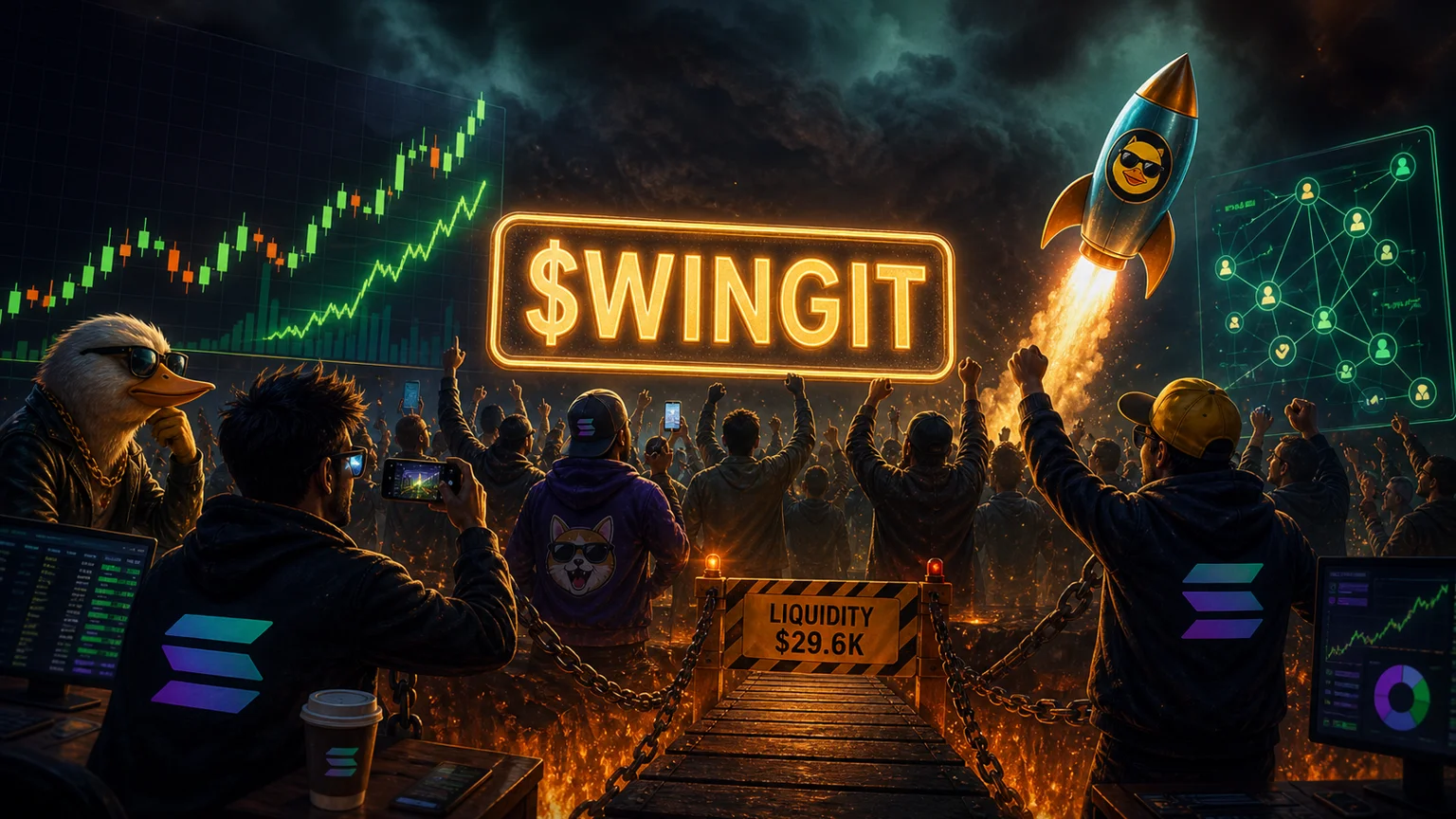
$WINGIT is the kind of pump.fun sprint that makes the market lean forward before it has enough history to be comfortable. The token was only about six hours old when it showed a 567.6% move, roughly $655.6K in volume, 11,120 transactions, and 3,665 holders. That is enough activity to make the launch worth covering. It is also exactly the kind of setup where the first read has to be stricter than the chart. A six-hour candle can look like culture while still trading through a door barely wider than one motivated exit.
The editorial angle is post-pump exhaustion through a thin liquidity base. $WINGIT is not flashing the obvious contract alarms that usually end the conversation. The authority checks are clean, the top holder map is not grotesque, and the dev wallet is not sitting on a visible supply pile in the supplied data. The problem is simpler: the token is already near a $599K market cap, but liquidity is only about $29.6K. That makes every continuation claim conditional. If the crowd keeps arriving, the sprint can extend. If the flow stalls, the same thin pool that helped the chart move can make the way down feel just as fast.
- → $WINGIT jumped about 568% in its first six-hour window while holding near a $599K market cap.
- → The token has 3,665 holders and 11,120 transactions, so the move is broader than a tiny one-wallet print.
- → The clean authority profile helps, but roughly $29.6K in liquidity keeps this in speculative territory.
The Six-Hour Sprint
The first thing to respect is the activity. $WINGIT did not get noticed because of a single lonely candle. The tape shows 743 buys and 458 sells in the most recent one-hour slice, a 61.9% buy ratio, and more than eleven thousand transactions across the 24-hour window used by the signal. That is real churn for a token this young. It means the market was actively debating the price instead of waiting for one wallet to drag it around. In meme trading, that matters because attention is the raw material. A token with no transaction density has to manufacture its next bid from pure promotion. $WINGIT at least has a crowd in the arena.
But speed is not the same as durability. A six-hour runner can collect holders quickly because the chart is moving, not because the meme has already found long-term believers. The 3,665 holder count is encouraging for reach, but early holders are often tourists, momentum wallets, and fast-flip traders. The question is whether the token can turn those first holders into a market that absorbs exits. A $655.6K volume print against $29.6K of liquidity tells you the pool has been working hard. It also tells you that slippage and crowd behavior matter more than the headline percentage now.
The Liquidity Problem
This is the heart of the $WINGIT read. The chart is exciting, the transaction count is active, and the holder base is already visible, but the pool is still small. At roughly $29.6K in liquidity, $WINGIT has enough depth for a low-cap launch to trade, not enough depth for traders to pretend the exit is automatic. Meme markets often confuse volume with safety. Volume says people are moving through the token. Liquidity says how much room they have when they all try to move through the same door. $WINGIT has the first part. The second part is still catching up.
That does not make the trade dead. Thin liquidity can be fuel when buy pressure keeps dominating, because each new wave moves price more sharply. That is how a launch turns a small pool into a viral chart. The same mechanic becomes dangerous when the flow reverses. A few impatient sellers can create a candle that looks worse than the underlying holder distribution, and that candle can scare new buyers away before the meme has time to mature. For $WINGIT, the cleanest bullish development would be simple: liquidity expanding while market cap holds, not just price stretching above the same shallow base.
What the On-Chain Data Shows
The on-chain profile is cleaner than the liquidity read. The supplied dev profile shows freeze authority disabled and mint authority disabled. That matters because the worst version of a tiny-pool launch is not just price risk; it is contract risk stacked on top of price risk. $WINGIT does not show that obvious authority problem in the current data. Rugcheck is listed with a score of 1, and the dev balance field is zero in the market enrichment. Those facts do not make the token safe, but they keep the risk conversation focused on market structure instead of a visible contract trap.
Holder concentration is also not the scary part yet. The top listed wallet is 4.97%, while the next two are 0.34% and 0.33%, giving the top three a combined 5.6% in the supplied dev profile. None of those top three are flagged as insiders. That is a better distribution than many launches at this age, especially one that already moved this hard. If $WINGIT breaks, the first cause is more likely to be exhaustion through thin liquidity than a single giant top holder smashing the market. That is useful information because it changes what traders should watch next.
The creator profile is quiet as well. Creator token count is listed at zero, with no creator-token history in the profile. There is no need to force a serial-deployer narrative where the data does not show one. The more honest read is that $WINGIT has a cleaner authority and holder map paired with a liquidity profile that has not caught up to the chart. That combination is not uncommon in early pump.fun winners. It is exactly why the token lands as speculative rather than clean. The warning is not that the contract looks broken. The warning is that the market can still break the trade by outrunning its own pool.
$WINGIT has cleaner authority and holder data than the average first-day sprint, but $29.6K liquidity is still thin for a token already doing six-figure volume.
What Would Make It Real
For $WINGIT to graduate from a sharp sprint into a sturdier meme bid, the next data has to show more than another green candle. Liquidity should rise meaningfully, the holder count should keep broadening without the top wallets swelling, and volume should remain active after the first novelty burst. The organic score is medium at 34.4, which fits the current read: there is activity, but not enough quality signal to call the move self-sustaining yet. A better organic profile would make the case stronger because it would suggest the token is trading on broader demand rather than short-window momentum.
The culture side also has work to do. The name $WINGIT is flexible and easy to repeat, which helps in meme markets because it can turn hesitation into a joke. But flexible memes can also be shallow if the community never sharpens the identity. The token needs a reason for holders to keep using the ticker after the first pump becomes old news. That could come from community output, stronger social velocity, better liquidity support, or simply continued price acceptance above the launch range. Without that second layer, the market may treat $WINGIT as a fun chart rather than a continuing rotation.
The Trade-Off
$WINGIT is a cleaner speculative watch than many thin-pool launches because the obvious on-chain danger signals are not dominating the read. That is important. It means the token deserves a different conversation than the usual rug-risk warning. The cleaner conversation is about execution risk. Traders chasing after a 568% move are no longer early; they are asking whether the crowd has another wave left. With liquidity below $30K, that question is not theoretical. It is the whole board.
The best version of $WINGIT from here is a controlled cooling phase: market cap holds, liquidity deepens, holders keep growing, and the token avoids the blow-off candle that turns every new launch into a post-pump autopsy. The worse version is just as clear: volume fades, the first holders rotate, and the liquidity door becomes the headline. For now, $WINGIT gets credit for clean authority data, low listed concentration, and strong early participation. It does not get a clean rating because the pool still has to prove it can carry the chart it helped create.
$WINGIT earns a speculative rating. The authority checks and holder concentration look better than expected for a six-hour pump.fun runner, but the liquidity base is too thin for a clean label after a 568% move. Watch whether liquidity rises with holder growth, or whether the chart starts leaning on the same shallow pool after the first wave cools.
Why is $WINGIT speculative instead of clean?
$WINGIT has clean authority checks and low listed top-holder concentration, but roughly $29.6K in liquidity is thin for a token that already moved 568% and traded more than $655K in volume.
What does the $WINGIT holder map show?
The supplied profile shows 3,665 holders, a top listed holder at 4.97%, and a top-three concentration of about 5.6%, with no insider flags on those top three wallets.
What should traders watch next for $WINGIT?
The key watch is liquidity growth. If liquidity expands while market cap holds and holders keep spreading out, the sprint gets healthier. If volume fades while liquidity stays thin, post-pump exhaustion becomes the main risk.