$US Reprices Hard, But The Tape Looks Like A Post-Pump Exhaustion Test
$US is five days old, up hard across the available window, and still pulling huge transaction count - but the sell pressure and low organic score make this a much messier read than the headline pump.
Authorities are disabled, but top-three holder concentration is materially higher than the cleaner runner profile.
$US looks like a clean slogan on the surface: WHY NOT US?, a five-day-old Solana meme that suddenly re-accelerated and forced itself back onto the launch-radar screen. The market data is loud. The token is around a $155K market cap, has roughly $133K in 24h volume, and printed a +134% one-hour move on the latest read. That is enough to make traders notice. It is not enough to make the tape clean.
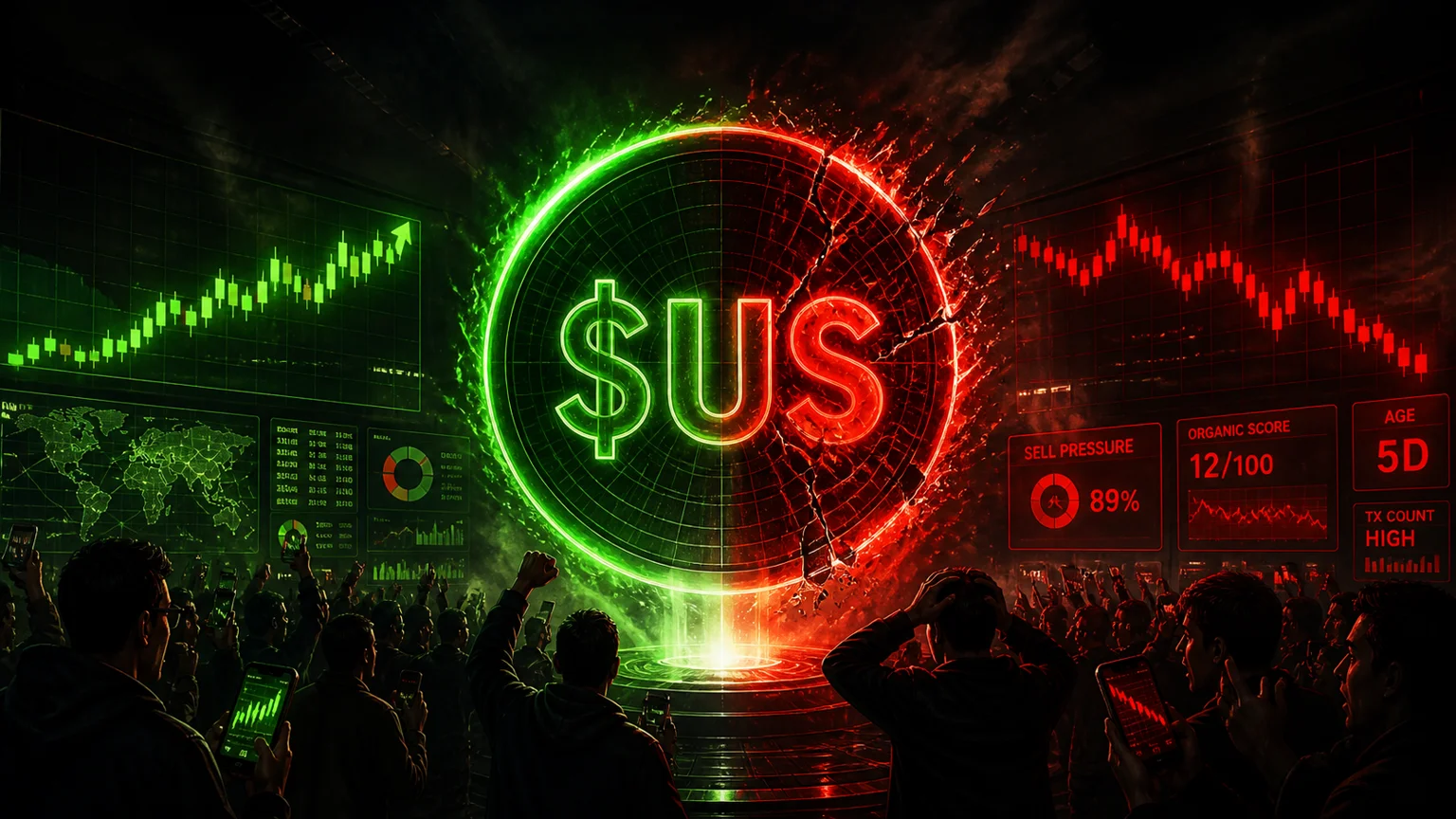
The better angle is post-pump exhaustion. $US has already moved more than +3,200% across the available 24h window and more than +1,700% across six hours, but the transaction split is ugly: 829 buys against 6,320 sells in the one-hour snapshot. That is not a normal demand skew. That is a token being actively traded, tested, and likely distributed while the headline percentage still looks heroic. A second-wave pump can survive that if new buyers keep absorbing supply. It can also fail suddenly when the absorption slows.
- → $US has a roughly $155K market cap with $133K in 24h volume, so the market is still turning over heavily relative to size.
- → The one-hour transaction split showed 829 buys and 6,320 sells, making sell pressure the central risk in the current read.
- → Mint and freeze authority are disabled and Rugcheck scores the profile at 1, but top-three holder concentration near 25.9% keeps the setup speculative.
Why This Pump Is Messy
The $US ticker has an obvious chant baked into the name. That matters for meme coins because simple rallying cries are easier to move than complicated lore. WHY NOT US? is broad enough for underdog trades, sports-style posting, political riffs, and generic risk-on CT energy. The problem is that meme flexibility does not cancel out market structure. When a five-day-old token rips this hard and the sell count dwarfs the buy count, the story becomes less about discovery and more about whether the market can keep digesting early exits.
This is why $US is not getting the same read as a cleaner first-session breakout. The token has more holders than many new pump.fun names, sitting around 1,467, and the 24h transaction count is massive at 16,819. But those numbers are not automatically bullish when the organic score is listed as low and the sell pressure is this visible. High transaction count can mean attention. It can also mean churn. In a thin pool, churn becomes dangerous when the market starts paying more for the slogan than the order book can support.
The Absorption Question
Every post-pump exhaustion test comes down to absorption. If $US buyers keep stepping in after each push, then heavy sell count becomes proof that supply is being transferred to a wider base. If bids thin out, the same data becomes a warning that the early holders are distributing into strength. The current numbers do not settle that argument. They make it the whole article.
$US has about $15.9K in liquidity. Against a $155K market cap, that is a narrow bridge for a token with this much volume. A trader can see the +134% one-hour move and think momentum. A better read starts with the pool. If liquidity does not expand, the next wave of sellers does not need to be huge to move price. A token can look alive on the transaction counter while becoming increasingly fragile under the chart.
What the On-Chain Data Shows
The contract-side profile is better than the trading tape. $US has mint authority disabled and freeze authority disabled, which removes two of the loudest Solana launch risks. Rugcheck shows a normalized score of 1, and the available dev profile does not show a creator-token history. The top three holders control about 25.9% combined, with the leading wallets at 11.37%, 9.67%, and 4.83%. None of those top three are marked as insiders in the provided profile.
That makes the on-chain read mixed rather than ugly. The authority settings are clean, and the deployer data does not currently point to a serial-launch pattern. But concentration is not trivial. A top-three holder map above a quarter of supply means the token can still be pushed around if those wallets change posture. The broader top-holder percentage from market data sits around 29.2%, and the bot-holder estimate is distorted enough that it should not be treated as a clean confidence signal. The data says contract risk is low; it does not say market risk is low.
What Bulls Need To Prove
The bull case for $US is that the five-day age gives it more room than a brand-new one-candle launch. It has survived long enough to re-accelerate, and the name has the kind of repeatable slogan that can become a broader culture trade if people keep using it. The market cap is still small enough that new attention can move it quickly. The holder count is also high enough to show it is not just a two-wallet theater piece.
But bulls need proof in the next UTC session. The buy side needs to close the gap against sells. Liquidity needs to climb. Holder growth needs to continue without the top wallets gaining more control. The organic score needs to stop looking like a warning label. If those pieces improve while price holds a higher base, $US can turn from a messy reprice into a real underdog meme bid.
Why Chasing Is Dangerous
The danger is that $US already gave traders the emotional headline they wanted. A +3,241% available-window move makes the chart feel early even when a lot of the easy displacement has already happened. When the sell count is this high, late buyers are not simply joining momentum; they may be providing liquidity to wallets that arrived before the repricing. That is the exact setup where a token can keep producing green candles until the book suddenly cannot.
The right read is disciplined attention. $US has enough volume and holder base to avoid being dismissed as a dead micro-cap. It also has enough exhaustion signals to avoid a clean badge. For a meme coin, that middle zone is often where the next move is violent in either direction. The token does not need a hidden rug mechanic to hurt late entries. It only needs the chant to fade while sellers keep showing up.
$US has clean authority data, but the active question is whether buyers are absorbing distribution or simply arriving late to a slogan that already paid early wallets.
$US earns a speculative launch-radar read. The contract profile is cleaner than the sell-heavy tape, and the slogan can still travel, but low organic scoring, thin liquidity, and a lopsided one-hour transaction split make this a post-pump exhaustion test first.
Why is $US being covered now?
$US re-accelerated with a +134% one-hour move, roughly $133K in 24h volume, and more than 16,800 transactions in the available 24h window.
What is the biggest $US risk?
The biggest risk is not the authority data. Mint and freeze authority are disabled. The current risk is sell pressure, thin liquidity, low organic scoring, and holder concentration near 25.9% for the top three wallets.
What would improve the $US signal?
A healthier buy/sell split, thicker liquidity, continued holder growth, and a stable base after the pump would make the read less dependent on short-term churn.