$UGANDA Turns a Fresh National Meme Into a Violent Solana Culture Bid
$UGANDA is only a few hours old, but the first-session tape already shows more than $1.5M in volume, a $272K market cap, and a cleaner holder profile than most pump.fun launches.
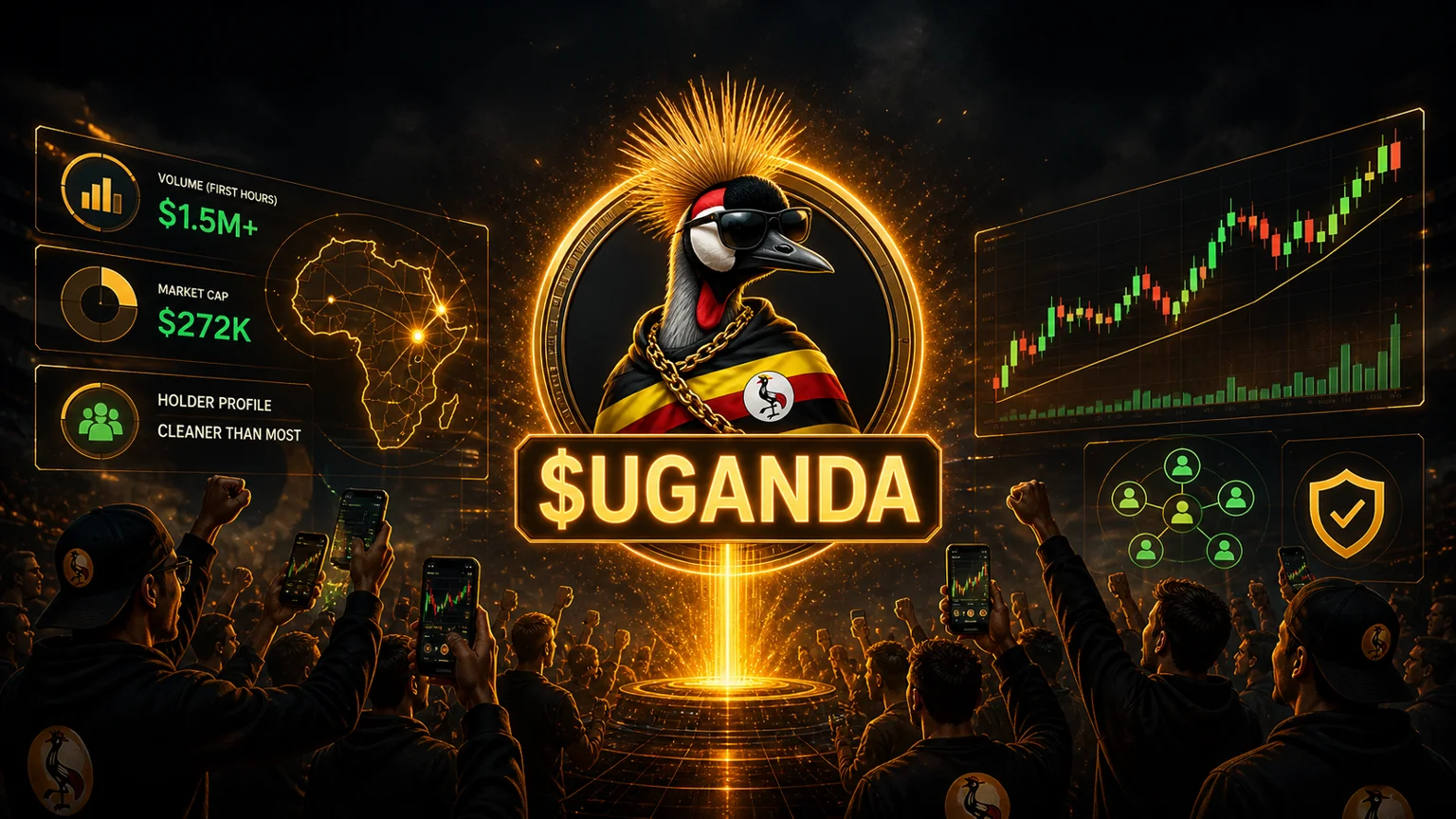
Top three listed holders control about 13.1%, with no freeze authority, no mint authority, and no listed Rugcheck risks.
$UGANDA is exactly the kind of fresh Solana tape that makes traders stop scrolling for a second. The token is barely a few hours into public trading, it is still sitting around a $272K market cap, and it has already printed roughly $1.57M in volume. That is not a quiet launch trying to warm up. That is a small-cap meme getting shoved into the fast lane before most of the market has even decided whether the ticker is a joke, a country meme, or just the next pump.fun wrapper with a flag on it.
The editorial angle here is culture-meme bid, not certainty. $UGANDA has not earned a victory lap, and no token this young should be treated like a finished trend. But the first read is unusually clean for something moving this hard. The launch has 1,660 holders, a medium organic score, no freeze authority, no mint authority, and a Rugcheck score of 1 in the current profile. Pair that with a +426% one-hour move and more than 21,000 transactions in the first listed 24-hour window, and the setup becomes simple: the chart is chaotic, but the early structure is not trash.
- → $UGANDA is trading around a $272K market cap after a +426% one-hour move and a +1,755% first listed 24-hour run.
- → The token has already pulled about $1.57M in volume, with 6,583 buys and 5,094 sells counted over the latest one-hour window.
- → The current on-chain profile shows 1,660 holders, no freeze authority, no mint authority, and about 13.1% held by the top three listed wallets.
Why This Ticker Caught a Bid
National and political-adjacent meme tickers can move faster than ordinary character memes because the market does not need much explanation. A ticker like $UGANDA is readable in one second. Traders understand the surface joke, the branding is obvious, and the chart becomes the story almost immediately. That does not make the meme durable, but it does make the opening window easier to spread. In meme markets, legibility is liquidity before the actual liquidity arrives.
That is what appears to be happening here. $UGANDA came out of pump.fun with a tiny base, then drew enough turnover to trade several times its market cap while still under $300K. The market is not pricing a polished project. It is pricing attention velocity. The important distinction is that attention velocity can reprice a microcap very quickly, but it can also vanish just as quickly once the joke feels crowded. The whole trade lives inside that gap.
The buy-sell mix keeps the signal alive for now. A 56% buy ratio is not absurdly one-sided, but it is enough to show that buyers are still absorbing supply rather than only reacting to an old candle. More than 11,000 one-hour buys and sells combined is heavy activity for a launch this young. The question is whether that traffic turns into broader ownership or whether it is mostly fast wallets flipping the same float back and forth.
The Numbers So Far
$UGANDA is trading near $0.000292 with a market cap and FDV both around $272K. Liquidity is about $23.9K, which is the most important risk number on the board. The token has enough liquidity to make a chart, but not enough to make exits painless if the crowd suddenly turns. That is normal for a first-session pump.fun meme, but it means the move should be read as fast tape, not deep market structure.
The volume is the loud part. Roughly $1.57M in 24-hour turnover against a $272K market cap means the token has already churned through a huge amount of relative activity. Sometimes that is a sign of early demand building around a meme. Sometimes it is a warning that the chart is being dominated by short attention spans and repeat rotations. The useful read is not that volume alone proves strength. It is that a token this small usually does not get this much volume unless enough traders believe the ticker can travel.
What the On-Chain Data Shows
The current on-chain profile is the reason $UGANDA gets a clean launch-radar read instead of a pure caution label. Rugcheck shows no freeze authority and no mint authority, which removes two of the most obvious contract-control problems. The score is 1, and the listed risk array is empty in the available profile. That is not a guarantee of anything in meme coins, but it means the immediate concern is market behavior rather than a glaring contract switch.
Holder concentration is also acceptable for this stage. The largest listed holder controls 7.97%, the second controls 2.94%, and the third controls 2.16%. Together, the top three listed wallets sit around 13.1%. That is not perfectly distributed, but it is far from the ugly first-session maps where one or two wallets can define the entire exit. The broader enrichment read puts top-holder concentration around 17.0%, still a number worth monitoring but not enough by itself to invalidate the launch.
The dev wallet read is quiet. The profile lists a dev wallet, but dev balance is shown as 0%, creator token count is 0, and no creator-token history is flagged. That matters because the worst fresh Solana launches often come with a serial-deployer footprint, hidden supply pressure, or authority settings that turn a green candle into a trap. $UGANDA does not show those specific problems in the current data.
There is one strange-looking metric in the enrichment set: the bot-holder percentage field is not reader-useful here because it comes through as an impossible value. The cleaner way to handle that is to ignore the malformed field and focus on the durable facts: holders, top-wallet concentration, authorities, liquidity, transaction count, and buy-sell balance. Those are enough to frame the risk without pretending every scanner number is equally meaningful.
The Liquidity Trap to Watch
The bear case is not complicated. $UGANDA has a massive volume-to-liquidity mismatch. A $23.9K pool supporting $1.57M in reported turnover can feel explosive while buyers are lined up, then become unforgiving when sellers press into the same thin market. That is the classic microcap liquidity trap: the candle looks liquid because everyone is trading, but the pool itself is still small.
This is where late buyers usually get punished. A token can be up more than 400% in an hour and still be early by market cap, but the entry quality changes after a move like that. If the next phase is a grind with liquidity expanding, holder count rising, and top wallets staying stable, the culture bid gets more credible. If the next phase is a vertical push on the same shallow pool, the risk shifts from discovery to exit management.
The transaction mix gives both sides of the argument. More than 6,500 buys in an hour is real activity. More than 5,000 sells in that same window is also real supply. That is not a sleepy accumulation profile. It is an active fight over whether the meme can keep attention long enough to build a second base. For fresh Solana memes, the first candle opens the door. The second base decides whether the ticker becomes a tradeable story or just another screenshot.
What Would Make the Signal Stronger
$UGANDA needs three things from here. First, liquidity has to grow. A culture meme can survive volatility, but a thin pool makes every rotation more dangerous than it needs to be. Second, the holder count needs to expand without the top wallets gaining control. The current concentration read is workable; it should not get worse. Third, the market cap has to hold a higher range after the first blow-off move instead of giving back the entire pump as soon as volume cools.
The clean version is a move through the next market-cap band with calmer candles, deeper liquidity, and continued organic turnover. That would suggest the meme is spreading beyond the fastest wallets. The weak version is just as obvious: volume stays huge, liquidity stays thin, and the chart becomes a sequence of sharp spikes and full retraces. In that version, the culture label becomes cover for churn.
$UGANDA has the kind of early tape that deserves attention: a legible ticker, violent first-session demand, medium organic score, and a clean contract-control read. The danger is that the pool is still too shallow for traders to treat the move like a settled trend.
The Bottom Line
$UGANDA is a fresh Solana culture meme with real first-session heat and a better-than-average on-chain profile. The market cap is still small, the volume is already loud, and the holder map does not show the kind of obvious single-wallet dominance that usually turns this type of launch into an immediate pass. That is why it belongs on the radar.
But the clean read has limits. A few hours of trading cannot prove durability, and $23.9K in liquidity is thin for a token moving this much volume. The next test is whether $UGANDA can convert first-session velocity into deeper liquidity and broader ownership. If it can, the national-meme angle has room to keep repricing. If it cannot, the same speed that made the launch attractive can turn into the reason the chart unwinds.
$UGANDA earns a clean launch-radar read because the early tape combines heavy volume, a low market cap, no freeze or mint authority, a low Rugcheck score, and manageable top-holder concentration. The setup remains high-risk because liquidity is shallow and the move is only a few hours old.
What is $UGANDA?
$UGANDA is the ticker for Uganda Official Coin, a fresh Solana meme token launched through pump.fun.
Why is $UGANDA moving?
$UGANDA is getting a fast culture-meme bid around a legible national ticker, with more than $1.5M in early volume and a sharp first-session price move.
What is the biggest risk for $UGANDA?
Liquidity is only about $23.9K, so large rotations can move the chart sharply even while reported volume looks high.