
$TRUSTY Turns A Wallet Mascot Joke Into A BSC Turnover Test
$TRUSTY has the recognizable brand-adjacent hook degens like, but the same tape showing $726K in volume is also showing a sharp intraday shakeout.
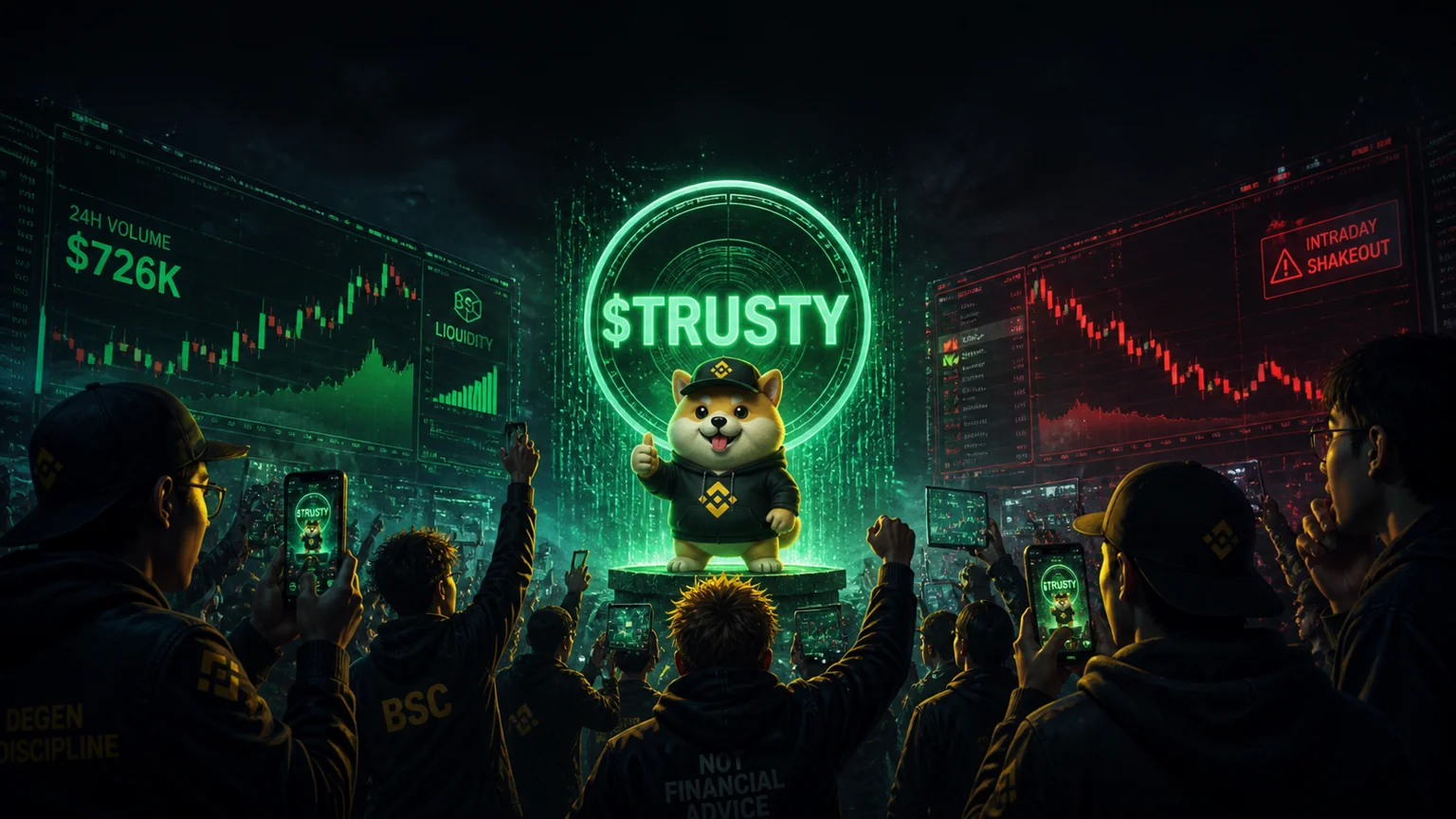
$TRUSTY is not subtle. It is a wallet-brand mascot riff trading on BSC, and that alone explains why it made it through the noise. Meme traders do not need a long setup when the reference is already familiar: wallet iconography, mascot energy, and a ticker that reads like a promise even when the market knows it is only a joke. The first-day numbers are loud enough to matter. The problem is that the latest candles are loud in both directions.
At the latest snapshot, $TRUSTY was up 325% over 24h with roughly $726K in volume. That is a serious amount of turnover for a token sitting around $194K market cap. But the same feed also showed a -39.6% one-hour move and a -19.1% five-minute slide. That is not a clean victory chart. It is a turnover test, where the market has clearly found the meme but has not yet proven that buyers can absorb the first real wave of profit-taking.
- → $TRUSTY has a recognizable BSC meme hook: a Trust Wallet Mascot riff with active socials and a live website.
- → The volume is larger than the market cap, with about $726K traded against a $194K valuation and $43.1K liquidity.
- → The warning is immediate exhaustion: $TRUSTY is still up big on the day, but the latest one-hour and five-minute moves are sharply red.
A Brand-Adjacent Meme With Instant Recognition
$TRUSTY's strongest asset is recognition. Brand-adjacent meme coins work because they borrow mental real estate without needing to own the brand. The wallet reference gives traders a clean visual lane, and the mascot framing makes it less sterile than another ticker-only parody. That matters on BSC, where speed and recognizability often beat elaborate worldbuilding. If a token can be understood in one glance, it has a chance to get passed around before the market loses patience.
The danger is that brand-adjacent trades can be brutally short-lived. They often sprint when the reference is fresh, then stall when the market realizes there is no deeper catalyst behind the joke. $TRUSTY has a website and a social channel, which gives it more surface area than a bare chart. Still, the real question is whether those channels can create new attention or only recycle the launch move. Meme traders will forgive a thin roadmap if the meme keeps mutating. They are less forgiving when a mascot trade becomes a static logo attached to a falling candle.
The Turnover Is The Story
The standout number is not the 325% gain. It is the volume-to-market-cap relationship. $TRUSTY traded about $726K over 24h while sitting near $194K market cap and $194K FDV. That is nearly four times the valuation in daily turnover. Sometimes that means the market is actively repricing a token that was discovered too low. Other times it means the float is spinning through fast hands, with every new buyer providing liquidity for the last one.
The buy-sell split shows why this is not an automatic red read. Across the 24h window, the feed showed 4,524 buys against 4,197 sells, or a small buy-side edge across 8,721 transactions. That is real participation. The issue is timing. When the latest one-hour candle is down nearly 40%, the market is telling you that participation is not the same thing as control. There may be enough buyers to keep $TRUSTY alive, but the sellers are already testing how deep those bids really are.
What the On-Chain Data Shows
$TRUSTY is a BSC token, so the Solana-specific authority read does not apply in the same way. There is no Solana freeze authority or mint authority profile to lean on from the current data, and no Rugcheck Solana score is relevant to this contract. The available market data instead points to pool depth, transaction flow, and whether the token's visible liquidity can support the size of the rotation. On that front, $43.1K of liquidity against $726K in 24h volume is active but fragile.
Holder concentration is not available in the current signal, which keeps $TRUSTY in speculative territory. That missing holder map matters more because the chart has already pulled back hard. Without a clear read on top wallets, insider exposure, unlocked supply behavior, or deployer balances, the market has to judge the token by visible turnover and liquidity. Those numbers say there is demand, but they also say the exit door is not especially wide if the mascot bid loses pace.
$TRUSTY has enough volume to be real, but not enough visible depth to ignore the intraday drop. A token can trade four times its market cap in a day and still be mostly churn if bids do not hold.
Why The Pullback Matters
A strong meme can pull back and still be healthy. In fact, the first violent reset often decides whether the move becomes a broader rotation or just a screenshot for early buyers. $TRUSTY is now at that point. The 24h performance brought attention. The one-hour drawdown tests whether that attention includes patient buyers or mostly momentum tourists. When a token is still young, that distinction matters more than the headline percentage gain.
If $TRUSTY stabilizes near this range, the pullback could become constructive. A mascot meme with real turnover, three visible pairs, and an active external site has enough structure to get a second look. If it keeps bleeding, the market will reinterpret the 24h volume as exit liquidity. That is the harsh part about BSC launch radar names: they get repriced fast, but they also get demoted fast when the bid does not refresh.
What Would Flip The Read
The bull case needs three things. First, the market cap has to stop acting like every bounce is an exit. Second, liquidity needs to deepen or at least avoid draining while volume stays high. Third, the brand-adjacent mascot angle has to produce social repetition beyond the launch wave. A website is useful. A Twitter account is useful. But the trade really improves when the audience starts turning the mascot into a shared joke rather than simply pointing at the price.
The bear case is simpler. If $TRUSTY cannot reclaim bid after a 40% hourly drawdown, the 325% daily move becomes a trap for late buyers. The volume number then stops looking like discovery and starts looking like distribution. Without holder data, the market has less protection against that interpretation. That is why this read stays yellow, even though the initial scanner score was strong. The brand hook is useful, but the chart is already asking for proof.
$TRUSTY is worth watching because the meme is instantly readable and the turnover is too large to ignore for a $194K BSC token. The rating stays speculative because the latest price action is already showing post-pump exhaustion, holder concentration is not visible in the current signal, and $43.1K liquidity can turn a crowded mascot bid into a fast unwind. Recognition got $TRUSTY noticed. Bid support has to do the rest.
What is $TRUSTY?
$TRUSTY is a BSC meme token branded as Trust Wallet Mascot, using a wallet-brand parody and mascot hook for recognition.
Why is $TRUSTY on radar?
$TRUSTY traded roughly $726K in 24h volume while sitting near $194K market cap, which is unusually high turnover for its size.
Why is the rating speculative?
The latest candles showed a sharp pullback, liquidity is only about $43.1K, and the current signal does not include a full holder concentration read.