$Terra Just Printed a GPT-Themed Solana Sprint, but the Easy Reprice May Already Be Gone
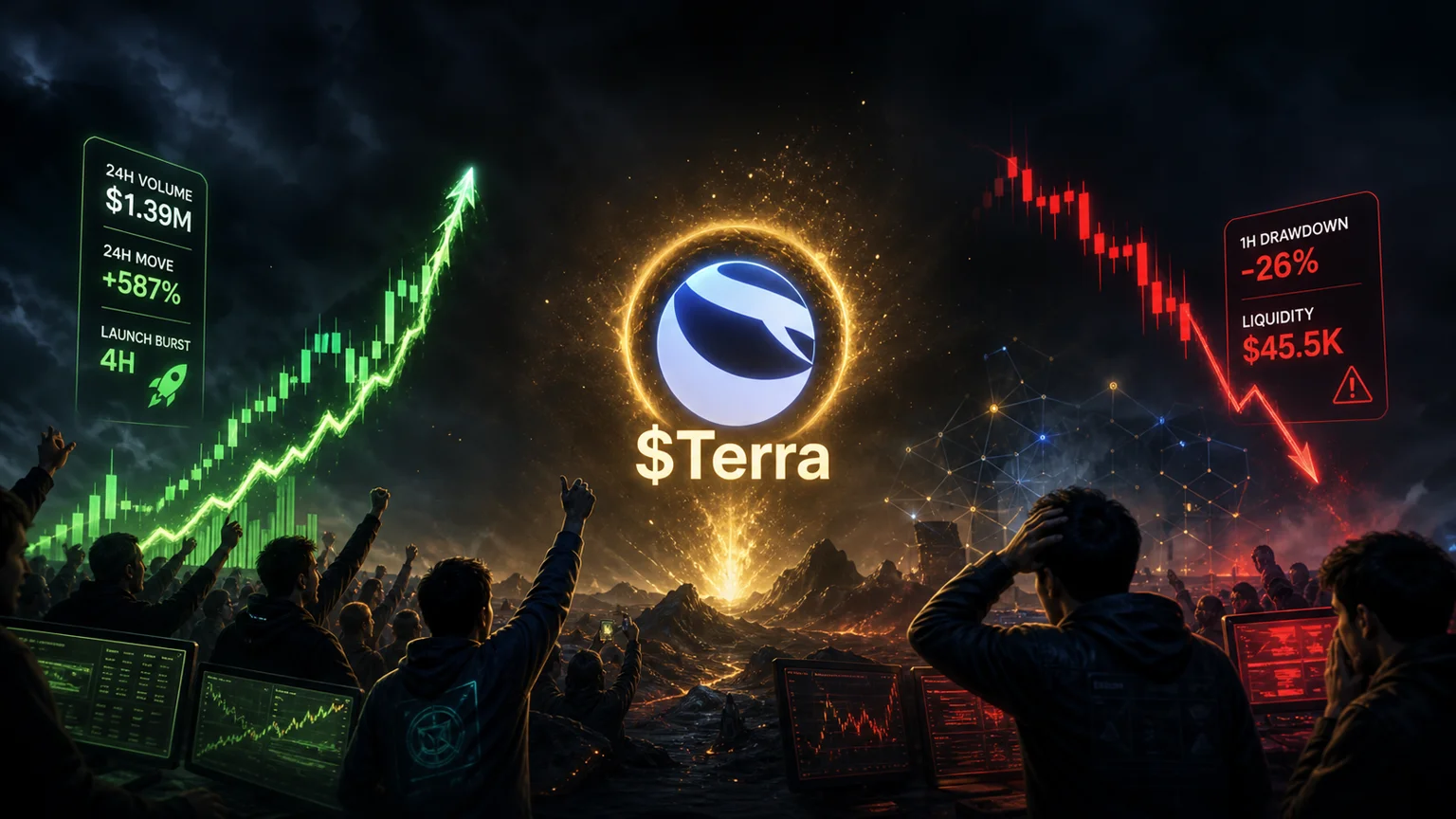
At the 2026-06-26 22:15 UTC reference point, $Terra was still showing roughly $1.39M in 24-hour volume and a 587% daily move after a four-hour launch burst, but the one-hour drawdown near 26% and only about $45.5K in liquidity say this is already a post-pump judgment call rather than a clean first-look chase.
The saved Rugcheck profile is contract-clean on first pass: freeze authority is disabled, mint authority is disabled, and the rug score sits at 1. The harder part is market structure, not permissions. Liquidity was only about $45.5K at the reference point, and the holder snapshot did not yet surface a meaningful top-holder table, so degens are trading a fast tape without much visibility into whether supply is already spreading into stronger hands.
By the 2026-06-26 22:15 UTC reference point, $Terra had already done the part of the trade that gets everybody's attention fast. The token pushed roughly $1.39M in 24-hour volume, sprinted 587% on the day, and reached a roughly $349K market cap in a little over four hours. That is enough velocity to drag almost any Solana degen into the chart at least once. The problem is that first-sprint numbers are not the same thing as a durable board. On $Terra, the real story is not that the launch was loud. It is that the first loud phase may already be over, and now the market has to decide whether the AI-themed wrapper can keep buyers engaged after the easiest upside has already printed.
That is why the best angle here is post-pump exhaustion, not clean discovery. DexScreener still showed a positive five-minute read near 4.97%, which means the chart had not fully died. But the one-hour change was down about 26.37% at the same checkpoint. That combination usually tells you the board has moved from simple excitement into a much less forgiving phase where every bounce is being tested for whether it is fresh demand or just trapped holders trying to believe the first move can happen twice. In other words, $Terra is no longer asking whether it can launch. It is asking whether it can survive being obvious.
- → $Terra hit roughly $1.39M in 24-hour turnover against a market cap near $349K while the lead pool was only about 4.2 hours old, so the market absolutely noticed this launch.
- → The tape is no longer one-way. A 587% daily surge still looked dramatic, but the one-hour drawdown near 26.4% says the board has already entered a profit-taking phase rather than a pure first-discovery phase.
- → The contract read is cleaner than the liquidity read. Freeze authority is off, mint authority is off, and the saved rug score is 1, but only about $45.5K in liquidity means shallow depth can still turn normal selling into an ugly air pocket.
Why This Meme Found a Bid
$Terra did not pull volume out of nowhere. The project website is packaged like a parody product page for a made-up AI model lineup, complete with pricing tables, a celestial naming gimmick, and a polished landing-page wrapper built around the idea of a balanced mid-range system called GPT-5.6 Terra. That matters because meme traders do not only buy jokes. They buy shortcuts. The joke here is instantly legible: take the language of frontier-model hype, compress it into a ticker, and hand CT something current enough to post without needing to explain the premise for six tweets first. In a market that rewards recognisable themes more than deep lore, that kind of compression is worth real attention.
The Numbers So Far
The raw size of the move is what made $Terra impossible to ignore. Roughly $1.39M in turnover against a market cap under $350K means the board traded almost four times its own notional size in a matter of hours. That is not passive interest. It is active price discovery mixed with a lot of very fast emotional decision-making. DexScreener also logged 22,708 buys against 18,333 sells across more than 41,000 swaps, which is enough participation to prove the token did not live off one caller or one whale shoving a dead pair uphill. There was real traffic.
The catch is liquidity. About $45.5K in the pool is not tiny for a launch this fresh, but it is absolutely small enough that the chart can overreact in both directions. When a board prints this much turnover on that little depth, the early upside can look stronger than it really is because buyers are all trying to fit through a narrow door at once. Later, the same structure makes the downside uglier because sellers discover the exit was always just as narrow. That is why the one-hour drawdown matters so much more than the headline 24-hour candle. The first rip tells you the meme got attention. The first flush tells you whether the attention came with any patience.
What the On-Chain Data Shows
Contract-level risk is not the main reason to fear $Terra here. The saved on-chain profile shows freeze authority disabled, mint authority disabled, and a rug score of 1. Those are the kind of baseline checks traders want to see before they even begin arguing about whether a chart has another leg. There is no obvious permissions trap in the first-pass profile, and the saved creator history did not point to a serial-deployer narrative worth turning into fake detective content. For a live Solana launch, that is a cleaner contract posture than plenty of boards ever manage.
What is missing from the snapshot is just as important as what is present. The holder table was not meaningfully populated in the saved profile, and top-three concentration came through as 0.0 rather than a readable live distribution. That does not mean the holder map is magically perfect. It means the market is moving faster than the saved visibility into how supply is settling. Traders therefore have clean freeze and mint settings, but incomplete holder clarity. That is a real distinction. When liquidity is only around $45.5K, one concentrated wallet can still bully a chart even if the contract itself looks fine. The on-chain read says there is no obvious admin-button disaster. It does not say the supply has already rotated into safe hands.
Why the First Flush Matters More Than the First Rip
Plenty of fresh Solana memes can print a huge first candle if the meme is current and the entry crowd is fast enough. Much fewer can digest that candle without immediately turning into somebody else's exit map. That is the line $Terra is standing on now. The AI wrapper already did its job. It got eyes, clicks, and enough trading to make the board feel culturally current for a few hours. The next phase is different. Now the token has to prove that the first buyers were not the only buyers who cared. If the board can stabilize after a 26% one-hour hit and still hold meaningful turnover, then the move starts looking like a real handoff instead of a one-cycle joke.
If it cannot, the failure mode is straightforward. Traders look at the 587% daily move, realise the easiest asymmetry is gone, and start treating every rebound as a better place to sell than to add. Thin liquidity accelerates that mood shift because the chart does not need much inventory pressure to look suddenly broken. That is the danger with stylish launches built around current tech branding. They can feel smarter than the average meme for just long enough that people forget the same old market-structure rules still apply. $Terra can absolutely bounce from here. The question is whether that bounce is a second wave of belief or just a prettier version of exhaustion.
What Has to Happen Next
For the constructive case to survive, $Terra needs to do three things in public. First, it needs to keep processing real turnover instead of collapsing into quiet candles now that the initial novelty is spent. Second, liquidity needs to improve from the current roughly $45.5K zone, because a board trying to extend after a first flush cannot keep relying on a tiny pool forever. Third, the holder picture needs to become easier to trust, whether that means a broader distribution shows up in later snapshots or simply that the tape stops behaving like a few wallets can push it around at will. Without those upgrades, the token remains tradable but fragile.
🟡 Speculative, with a very specific reason. $Terra earned attention the hard way by printing real volume fast and wrapping itself in a meme that traders could understand instantly. The contract read is cleaner than average because freeze authority is off, mint authority is off, and the saved rug score is low. But this is no longer a clean launch-radar discovery where degens can pretend they are first. The board already looks like a post-pump test. With only about $45.5K in liquidity and incomplete holder visibility, the next move has to prove that fresh buyers still want the joke after the first crowd already got paid.
FAQ
What is $Terra on Solana?
$Terra is the ticker for GPT-5.6 Terra, a fresh Solana meme coin trading under contract address 2j6CApLFvzSaRZ21bAStanY5qKAJwkuit6yn7eQbpump. The meme is packaged as a parody AI product page.
Why is $Terra on launch radar?
Because it printed roughly $1.39M in 24-hour volume and a 587% daily move while the main pair was only about 4.2 hours old.
Does the $Terra contract look clean?
On first pass, yes by meme-coin standards. The saved profile shows freeze authority disabled, mint authority disabled, and a rug score of 1.
What is the biggest risk on $Terra right now?
Shallow structure. Liquidity was only about $45.5K at the reference point, and the saved holder snapshot did not yet show a clear top-holder distribution.
What would improve the $Terra read from here?
The board needs to hold real turnover after the first flush, deepen liquidity, and show a more trustworthy holder map over time.