$SUPERMAN Found Solana's Loudest Culture Bid of the Day, but Half the Supply Still Sits Behind One Door
By the 2026-06-30 10:04 UTC selection read, $SUPERMAN had ripped toward a $3.49M market cap on roughly $6.23M in 24-hour volume with about $183.7K in liquidity only hours after launch. The meme is universal, the turnover is real, and the harder question is whether a board with one wallet near 50% of supply can stay a culture trade instead of turning into a concentration trap.
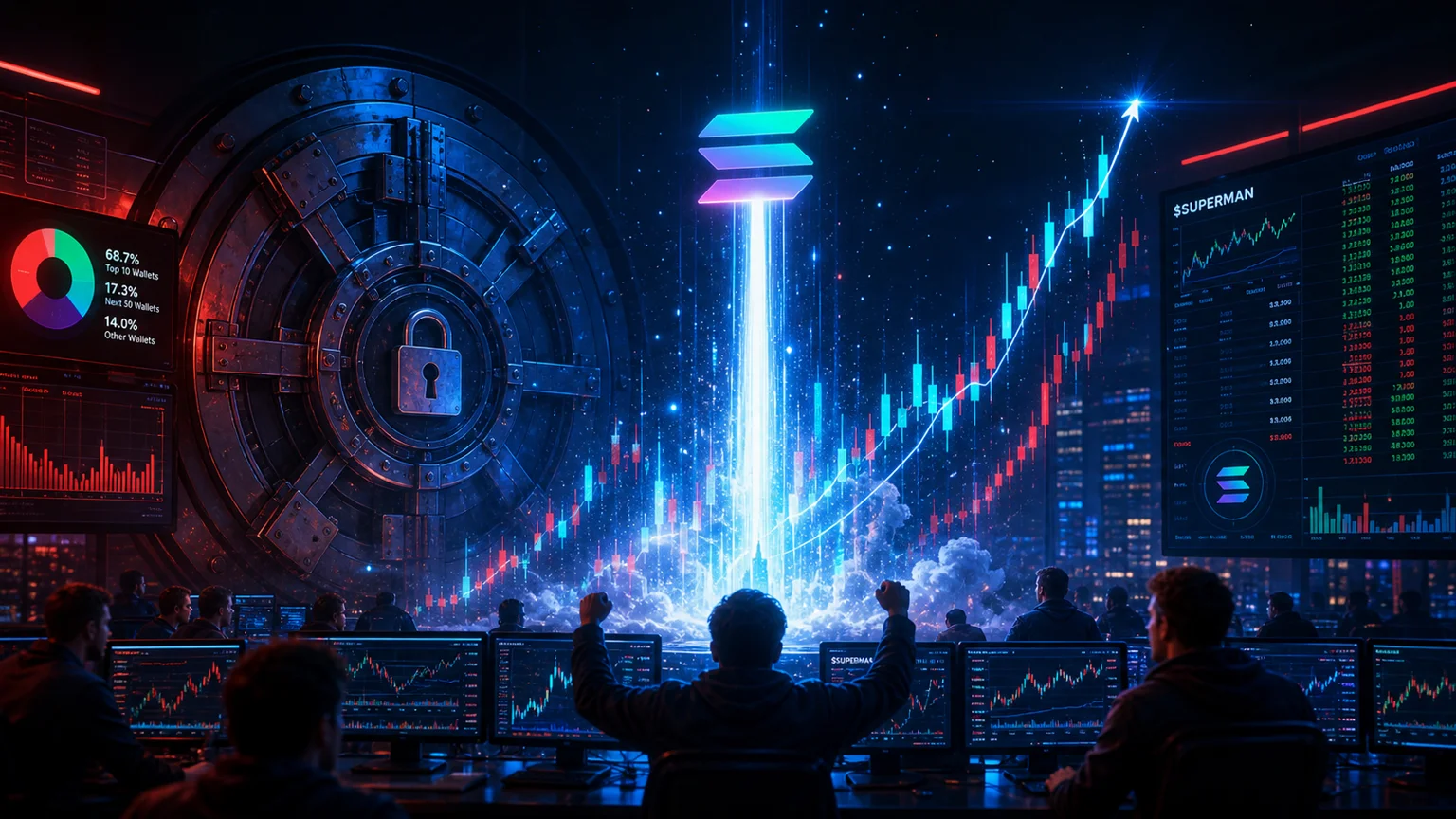
Freeze authority is off, mint authority is off, and Rugcheck scored $SUPERMAN at 1, but one visible holder still controls 49.75% of supply while the top three wallets sit above 53%. The creator wallet is also linked to 48 prior token launches, so the chart still asks traders to respect concentration and operator history.
$SUPERMAN is exactly the sort of ticker that can drag a room into a trade before anyone has finished pretending to be disciplined. The meme is instantly legible, the symbol carries its own marketing budget, and the market does not need a long lore thread to understand why Solana traders would pile into a token called $SUPERMAN on the same day it appears. By the 2026-06-30 10:04 UTC selection read, that instinct had already turned into a serious move: roughly $6.23M in tracked 24-hour turnover, about $183.7K in liquidity, and a market cap near $3.49M less than six hours after the pair showed up. That is enough to move the board out of novelty status and into a real launch-radar debate.
The cleanest way to frame the setup is not as a blind victory lap for another hot symbol. It is a holder-concentration story wearing a culture-meme costume. The attention is real. The size is real. The symbol clearly accelerated discovery. But one visible wallet still controls 49.75% of supply, and the top three visible holders sit above 53% combined. That means degens are not trading a widely shared board yet. They are trading a chart with genuine demand and a supply map that can still turn the entire mood with one aggressive decision.
- → $SUPERMAN pushed to roughly a $3.49M market cap by the 2026-06-30 10:04 UTC selection read with about $6.23M in tracked 24-hour volume and close to $183.7K in liquidity only hours after launch.
- → Freeze authority is off, mint authority is off, and Rugcheck scored the contract at 1, but one visible wallet still controls 49.75% of supply while the top three holders sit above 53%.
- → The bull case is a universal meme with real turnover and a high-organic feel. The bear case is that traders are still renting momentum from a cap table they do not fully control.
Why the Culture Bid Worked So Fast
Most fresh launches have to teach the market what they are. $SUPERMAN skipped that part. The ticker already lives in mainstream memory, which matters on Solana because speed of comprehension is a real edge. When traders are cycling through dozens of pairs, the board that explains itself in a single glance gets the first shot at volume. $SUPERMAN did not need a white paper or a mascot backstory. It needed one look and one fast candle.
That kind of instant recognition changes who arrives first. Instead of waiting for a niche circle to manufacture consensus, the token can attract a mixed crowd right away: momentum traders, meme tourists, and the usual Solana launch hunters who only need proof that the next room is louder than the last one. The volume profile suggests that is exactly what happened here. Roughly 75,728 total transactions in the saved selection snapshot is not the footprint of a dead pair being cosmetically recycled. It is the footprint of a board that found broad participation quickly.
The trap is assuming that instant cultural recognition automatically produces a durable market. It does not. Culture gets a board on stage. Distribution decides whether it can survive the encore. That is why $SUPERMAN is worth writing about now. The board already proved it can command attention. It has not proved the ownership structure can absorb that attention without eventually turning it into exit liquidity for a concentrated group.
What the On-Chain Data Shows
Start with the good news because it is real and it deserves to be acknowledged before the caution shows up. Freeze authority is disabled. Mint authority is disabled. Rugcheck scored the contract at 1. Those are meaningful positives for a same-day Solana runner because they eliminate two of the fastest contract-level ways a launch can disqualify itself. Traders do not have to worry about a live mint switch expanding supply out of nowhere, and they do not have to wonder whether transfers can be frozen the moment the board gets crowded. On a chain where too many charts fail the first mechanical smell test, that matters.
The second layer is where the article actually begins. One visible holder controls 49.75% of supply, while the top three visible wallets sit at about 53.2% combined. Those numbers force a very different reading of the same chart. Strong volume and a clean contract say the token earned a real audience. Holder concentration says that audience is still trading on a board whose balance of power remains heavily skewed. You can have organic-looking flow and still have a structurally fragile cap table. $SUPERMAN is a clean example of that contradiction.
Liquidity is also large enough to take seriously but not large enough to neutralize the concentration issue. About $183.7K under the pair is a better cushion than the average throwaway launch gets, especially with more than $6M in turnover pushing through it. But liquidity is not a magic shield. If the biggest wallet decides to lean into a bid, the pool is still thin enough for the chart to feel the impact quickly. That is why traders should read the liquidity and the holder map together instead of letting either metric tell the whole story alone.
The broader participation data adds one more useful nuance. The saved selection snapshot counted about 4,465 holders, a buy ratio near 55.5%, and an organic score just under 89. Those are constructive signs because they suggest the room is not being held together by a handful of obvious wash wallets. Even so, none of that changes the mint and freeze discussion or the holder discussion. The contract settings are clean. The holder map is still tight. Any serious read of $SUPERMAN has to keep both ideas together.
Why the Deployer History Still Matters
The other detail that keeps $SUPERMAN from graduating into a clean rating is the creator history. The saved dev profile links the creator wallet to 48 prior token launches. That number does not prove malicious behavior, and it does not cancel out the low Rugcheck score. It does, however, change the default assumption traders should bring into the room. This is not a naive one-shot launch from a wallet learning on the fly. It is a board connected to an operator who has been through the meme-token loop many times before.
That matters because experience cuts both ways. A serial deployer can know how to package a token well enough to maximize first-day attention. The same experience can also mean the operator understands exactly how to manage distribution, emotion, and exits while the crowd is still arguing about whether it is early. In other words, a long creator history is not automatically bearish, but it absolutely raises the bar for trust. The market should want stronger evidence of holder dispersion and more proof of sustained interest before treating the board like a clean new franchise.
The contract-side read is cleaner than average because freeze authority is off, mint authority is off, and the Rugcheck score came in at 1.
The behavior-side risk is harder: one wallet near half the supply, top-three ownership above 53%, and a creator tied to 48 prior launches.
That combination can still produce a painful chart even when the code itself looks better than most same-day launches.
What Has to Happen Next
For the bull case to stay alive, $SUPERMAN needs to do more than print another violent candle. It needs to keep broadening the audience. The obvious upgrade would be deeper liquidity and visible evidence that the top holder's dominance is easing rather than hardening. Another constructive sign would be a second session where the board keeps meaningful turnover without the supply map getting uglier. If the market can force distribution wider while the meme stays culturally sticky, the token has a path from first-day spectacle into a more durable Solana board.
The bear case is simpler because concentration simplifies the ways a chart can break. Maybe the symbol did most of the heavy lifting already and the best part of the move was the opening surprise. Maybe the crowd keeps showing up but never really owns enough of the board to matter. If any of those versions take over, the clean contract will not save late entrants from the reality that ownership still leans on one side of the table.
That leaves the right editorial read exactly where the data says it should be: speculative, tradable, and worth watching because the demand is too real to dismiss. $SUPERMAN is not another empty launch pretending to be a phenomenon. The market genuinely cared. The problem is that care alone does not fix distribution. Until the holder map looks less top-heavy, the board remains a culture-meme bid with a concentration trap still sitting in plain sight.
🟡 Loud Tape, Tight Supply — $SUPERMAN earned a real launch-radar spot because the board pushed roughly $6.23M in 24-hour turnover, carried close to $183.7K in liquidity, and paired a universal meme with a cleaner-than-average contract read. It stays speculative because freeze authority and mint authority being off do not erase the fact that one visible wallet still controls 49.75% of supply and the creator wallet is linked to 48 prior launches.
What is $SUPERMAN on Solana?
$SUPERMAN, also called THE SAVIOUR, is a Solana meme token trading at contract address CzigqJ9h9mnfXq3G3jKBVcApKu8Kh8JtZGxarzY2pump. By the 2026-06-30 10:04 UTC selection read, it was trading near a $3.49M market cap.
Why did $SUPERMAN move so fast?
The symbol is instantly recognizable, which helped it catch a same-day culture bid, and the early tape was strong enough to keep traders involved. The saved selection snapshot showed roughly $6.23M in 24-hour volume only hours after launch.
What does the on-chain profile say about $SUPERMAN?
The on-chain read shows freeze authority disabled, mint authority disabled, and a Rugcheck score of 1, which keeps the contract-side risk relatively low. The bigger issue is holder concentration, with one visible wallet at 49.75% and the top three holders above 53% combined.
Why is $SUPERMAN rated speculative instead of clean?
A clean label would require a much healthier ownership spread. $SUPERMAN has real demand and a cleaner contract than most same-day launches, but the concentration profile and the creator wallet's 48-launch history keep the board in speculative territory.