
$STITCHY Rips 471% in Under an Hour, Then Runs Into the Liquidity Question
$STITCHY hit Jupiter cooking screens with nearly $800K in early volume, a $197K market cap, clean authority data, and a pool that still has to grow before the move can mature.
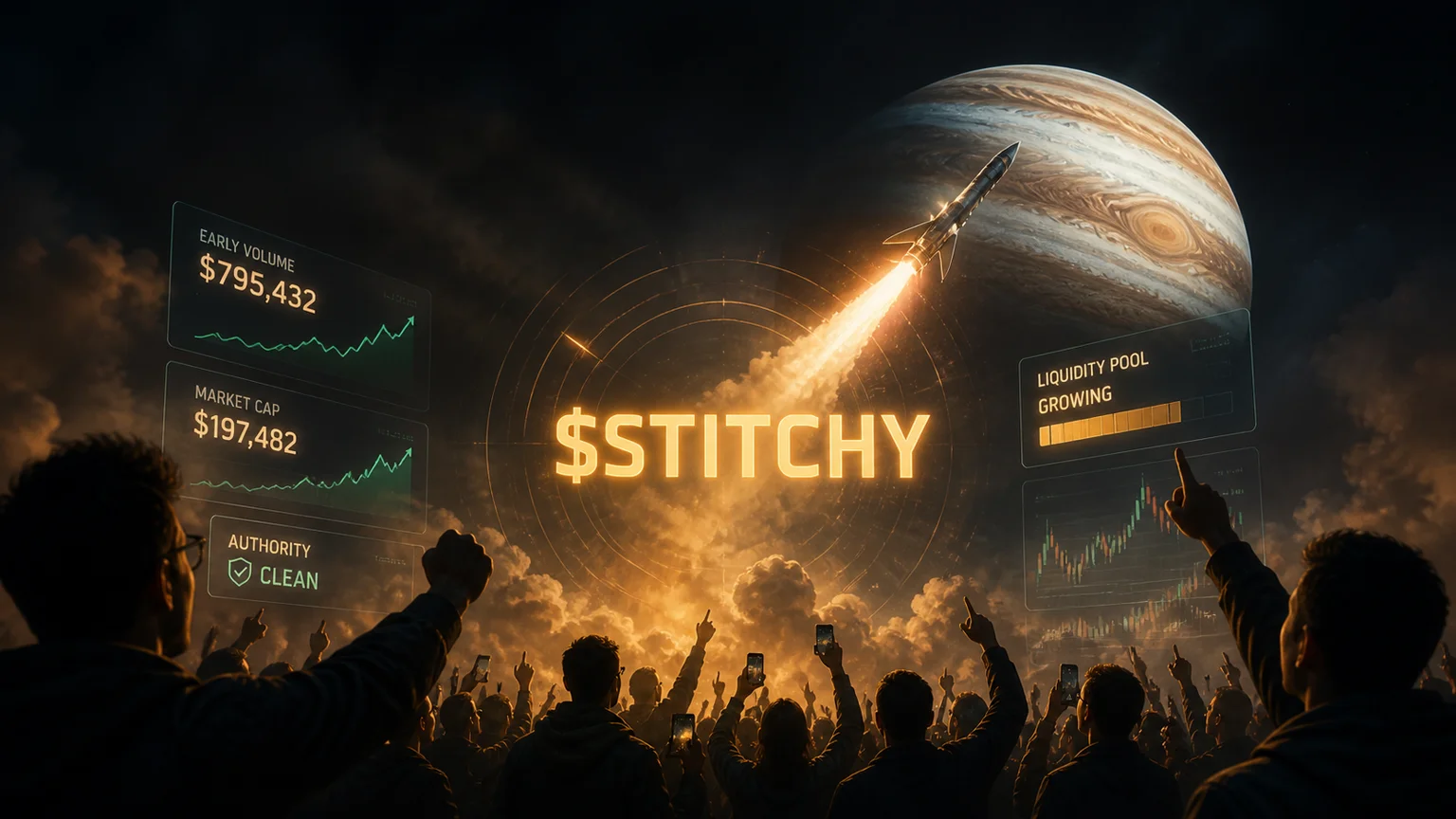
Top three holders control about 14.5%; freeze and mint authority are disabled, with no listed Rugcheck risks.
$STITCHY is the kind of chart that forces a fast editorial decision because the move is young, violent, and still small enough to matter. At signal time, the pump.fun launch was only 44 minutes old and already showing a 471% move across the 1-hour, 6-hour, and 24-hour windows. That is not mature price discovery. It is the market trying to decide, in public, whether a brand-new meme can handle the first wave of attention without turning into a trap for late buyers.
The angle is organic volume anomaly. $STITCHY printed roughly $798.8K in volume against a market cap near $197K, which means the token had already traded several times its own valuation before most watchlists could settle. That kind of turnover is more meaningful than a lonely green candle, but it is also more dangerous. When volume arrives before the pool has time to deepen, a token can look liquid on the feed while still being thin at the actual exit.
- → $STITCHY reached about $197K market cap less than an hour after launch, with roughly $798.8K in early 24-hour volume.
- → Liquidity was only about $16.1K at the snapshot, so the chart is still exposed to sharp impact from ordinary selling.
- → Rugcheck data is cleaner than expected: freeze authority disabled, mint authority disabled, rug score of 1, and top-three concentration near 14.5%.
A New Meme With Real Turnover
Most new Solana memes do not fail because nobody buys them. They fail because the first burst is all they ever get. $STITCHY's first burst is big enough to demand a closer look. Nearly $800K of volume in the first hour means the token found active two-sided trading quickly, not just a handful of wallets nudging a micro pool upward for screenshots. The market cap also stayed below $200K, which keeps the trade in that uncomfortable zone where degens can still imagine upside while the downside remains brutally close.
That is the tension. $STITCHY is not priced like a fully discovered winner, but it has already moved like one. A 471% impulse creates a chart full of early winners, and early winners eventually become sellers. For the signal to stay constructive, the next phase has to show rotation rather than collapse: higher liquidity, cleaner pullbacks, and volume that does not vanish the moment the first vertical candle cools.
The Liquidity Gap
The pool is the part of the $STITCHY read that cannot be ignored. About $16.1K in liquidity is better than the truly broken micro pools, but it is still small next to the amount of turnover already moving through the token. A thin pool can make buyers feel like the trade has unstoppable momentum because every fresh bid moves the chart. The same mechanics work in reverse when holders start taking profit.
That means the cleanest bullish read is not simply that $STITCHY went up fast. The cleaner read would be $STITCHY holding a real range after the first spike while liquidity improves. If market cap keeps expanding and liquidity lags, the token becomes more reflexive with every green candle. Reflexive memes can keep ripping, but they punish anyone who confuses screen volume with actual depth.
What the On-Chain Data Shows
$STITCHY's on-chain profile is the reason this does not get dismissed as just another first-hour burner. Rugcheck shows freeze authority disabled and mint authority disabled. Those two settings matter because they remove the direct ability to freeze transfers or create new supply through an active mint authority. The normalized rug score is 1, and the listed risk set is empty in the available report.
Holder concentration is workable but not invisible. The largest listed holder controls 10.44%, while the next two sit at 2.11% and 1.97%. That puts the top three near 14.5%. For a token this young, that is not a death sentence. It is also not something to wave away. If the largest holder sells into a liquidity base under $17K, the chart will feel it immediately. The difference from more dangerous launches is that the concentration is not wildly clustered across the first few wallets, and none of the top three are marked as insiders in the supplied data.
The creator profile is quiet as well. The available data does not show a list of previous creator tokens, and the creator balance is not presenting as a visible dump overhang. That keeps the editorial focus on market behavior, not deployer history. For $STITCHY, the question is whether the market can build depth around a clean enough setup before the first winners start treating the pool as their exit.
$STITCHY has cleaner contract rails than many first-hour launches. The problem is not an obvious authority trap; the problem is whether a $16.1K pool can support attention this hot.
Why This Can Still Fail Fast
The bearish case is not complicated and should be taken seriously. A 471% move in under an hour can front-load too much excitement. Buyers who enter after the first screen-wide candle are not early; they are paying for confirmation. In a meme this new, confirmation can disappear quickly if the next few rotations are mostly profit-taking. There is no deep history, no established community floor, and no long trading range to lean on.
The volume number also cuts both ways. Nearly $800K in volume sounds strong, and it is strong for visibility. But it can also mean the token has already been heavily churned before the broader market understands what it is. If the same capital keeps cycling rather than fresh wallets arriving, the chart can print one more dramatic squeeze and then lose its bid. The first hour proves attention. It does not prove staying power.
The Better Signal From Here
For $STITCHY to graduate from a first-hour anomaly into a cleaner launch-radar name, three things need to happen. Liquidity has to move higher. The market cap has to hold a meaningful portion of the spike without requiring constant vertical candles. And the holder map needs to stay calm, especially around the largest wallet. If those conditions improve together, the early volume starts to look like discovery instead of churn.
The strongest version of the $STITCHY story is that degens found a clean-rails meme before the pool caught up. The weakest version is that the chart already consumed most of its first audience while liquidity stayed too small. Both can be true for a while, which is why this belongs on radar rather than in the victory-lap category.
$STITCHY earns a clean watchlist rating because the available authority, Rugcheck, and holder data are better than the usual first-hour pump.fun mess. The rating is narrow: clean rails, not a clean trade. The liquidity base is still too small for comfort, and the 471% impulse means late entries are dealing with a chart already full of winners.
Why is $STITCHY being covered so early?
$STITCHY reached about $197K market cap with nearly $800K in volume less than an hour after launch, which is enough turnover to deserve a fast read.
What makes $STITCHY cleaner than the average new launch?
The available Rugcheck data shows disabled freeze authority, disabled mint authority, a rug score of 1, and no listed risks.
What is the main risk for $STITCHY?
Liquidity. A pool near $16.1K can move violently in both directions, especially after a 471% first-hour run.