$STEAK Has the Watched-Wallet Nudge and Real Turnover, but $26K of Liquidity Still Sets the Terms
$STEAK landed on Solana launch radar after a watched wallet tied to Yennii56 bought early into the move, just as the token was pushing roughly $838.5K in 24-hour volume against about a $127.9K fully diluted value. The reason this board matters is not a giant whale print. It is the combination of a clean permission profile, real turnover, and an early smart-money breadcrumb before broader crowd confirmation. The reason it stays speculative is simpler: liquidity is still only about $26.4K and the top wallet still owns more than one-fifth of supply.
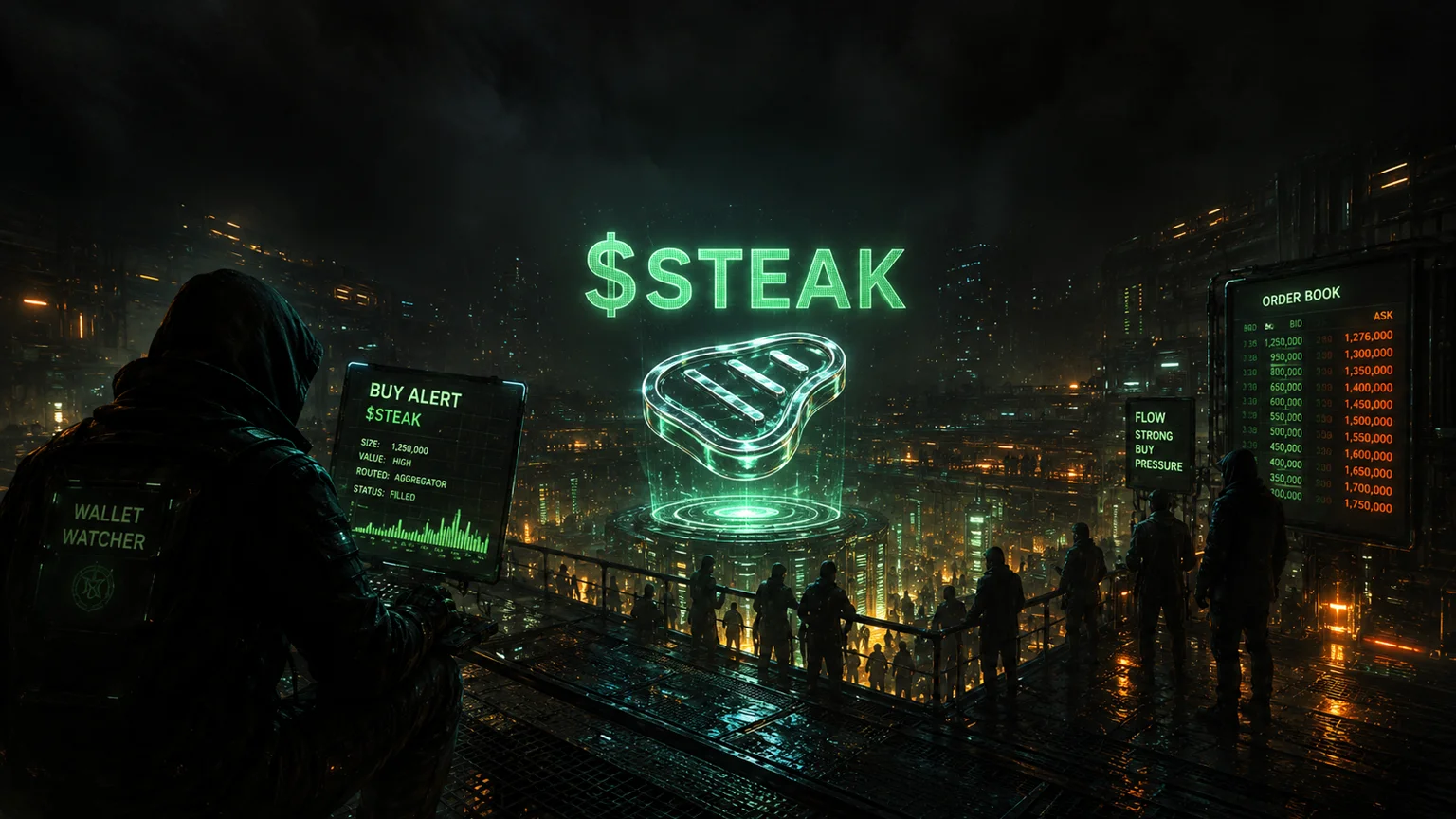
Rugcheck scores $STEAK at 1, freeze and mint authority are both off, and there are no flagged risk labels in the selection snapshot. The pressure point is not permissions. It is whether a token with only about $26.4K of liquidity can absorb concentrated holders if the first watched-wallet breadcrumb fails to recruit a wider crowd.
$STEAK is the kind of board that forces a trader to separate signal quality from signal size. The watched-wallet entry here was not some giant six-figure aping event that instantly rewrote the chart. According to the selection snapshot, a wallet tied to Yennii56 bought roughly $13.36 worth of $STEAK at 3:32 PM UTC on June 14, picking up a little more than 88,000 tokens while the tape was still forming. On its own, that amount is tiny. But in fast Solana launch flow, the first watched-wallet breadcrumb often matters less for its dollar value than for its timing. A tracked wallet stepping in early can tell the market that somebody who lives inside these rotations saw enough to touch the trade before the crowd had fully arrived.
That timing becomes more interesting when the rest of the board is already moving. By the 4:03 PM UTC selection snapshot, $STEAK was trading around a $127.9K fully diluted value with roughly $838.5K in 24-hour volume and about $26.4K of liquidity. That is an aggressive amount of turnover for a token still sitting below a $130K valuation. It tells you the pair is not surviving on one wallet's curiosity. It is getting real traffic. The watched-wallet print matters because it arrived into an actual market, not an empty chart. That combination makes the token more than a random dashboard curiosity, even if the setup is still too early and too thin to confuse with a safe breakout.
- → $STEAK was trading near a $127.9K fully diluted value with about $838.5K in 24-hour volume and roughly $26.4K of liquidity at the latest UTC snapshot, giving it one of the louder turnover-to-size ratios on the board.
- → A watched wallet linked to Yennii56 bought at 3:32 PM UTC, which is small in dollar terms but important in sequencing because the entry happened before broader crowd confirmation was complete.
- → The contract profile looks clean at first read. Rugcheck scores $STEAK at 1, freeze authority is off, mint authority is off, and there are no flagged risk labels in the selection snapshot, but the top three wallets still control roughly 36.0% of supply.
Why the Early Wallet Print Matters
The easiest mistake with $STEAK is to overstate the wallet signal because the wallet is watched. The better read is narrower. The Yennii56-linked buy does not prove consensus or inevitability. What it does prove is that the pair was interesting enough for a tracked participant to click before the move fully matured. That kind of breadcrumb matters most on launches where the market still needs a reason to take the next look. It can become a coordination spark. Traders scanning fresh pairs tend to care less about the size of the first smart-money touch than about whether anybody they respect got there before them. In that sense, $STEAK already passed one useful social test even without needing a loud public KOL call.
The more important part is that the chart did not need that one breadcrumb to exist. Roughly $838.5K of 24-hour volume against a $127.9K fully diluted value means the board was already generating enough turnover to justify attention. This matters because some watched-wallet stories are purely narrative props attached to untradeable pairs. $STEAK does not read that way. The market was already doing business. The wallet print simply adds a layer of confidence that at least one tracked participant judged the setup worth tagging before the next wave of scanners piled in.
The Turnover Is Real, Even if the Pool Is Still Thin
The strongest part of the $STEAK setup is the mismatch between turnover and size. A token sitting around a $127.9K fully diluted value normally does not command anything close to $838.5K of daily volume unless traders think there is still another leg available. That does not guarantee a second repricing wave, but it does tell you the pair is not starving for attention. The buy ratio near 57.7% supports that read. Buyers are winning, but not in a cartoon way. There is enough selling to make the market honest, and enough buying to keep the board alive.
The catch is liquidity. About $26.4K is decent for an early microcap meme, yet it is still small enough that one or two determined exits can shift the whole mood. This is the line that matters most for traders trying to judge whether the board is a clean runner or just a fast local top. If fresh participants keep rotating in, thin liquidity becomes part of the upside because it lets the chart move quickly. If flow stalls, the same thin liquidity becomes the reason everybody scrambles at once. The structure is tradable, but it is not forgiving.
What the On-Chain Data Shows
On-chain, $STEAK looks better than a lot of fresh Solana launches that hit scanners on pure momentum. Rugcheck scores the token at 1. Freeze authority is off. Mint authority is off. The selection snapshot also surfaced no explicit risk flags, which is a meaningful positive in a landscape where too many first-day boards still carry some obvious contract catch. Those checks do not make the token safe, but they do remove the laziest rug vectors from the discussion. That is one reason the board can plausibly be framed as a cleaner runner rather than a pure permission gamble.
The more important on-chain question is distribution. The top holder controls 20.69% of supply, while the top three wallets together control roughly 36.0%. That is not catastrophic for a five-hour-old pair, but it is enough concentration to matter every single time the chart pauses. The dev wallet identified in the selection snapshot holds about 5.7%, which is not outrageous on its own, yet it is still meaningful in a token with only about $26.4K of liquidity. In other words, the contract shell is cleaner than average, but the holder map still demands respect. A token can have no freeze key, no mint key, and still deliver a nasty unwind if concentrated holders decide the easy part of the move is done.
That balance is what keeps $STEAK from getting upgraded to a clean rating. The board is structurally easier to trust than the average brand-new meme, but the supply is not loose enough and the pool is not deep enough to ignore concentration risk. Good permissions reduce one danger. They do not remove market structure risk.
Where the Trade Can Still Break
The bull case is clear. A watched wallet got there early, the turnover is already large relative to valuation, and the permission profile is strong enough that traders do not have to waste time debating obvious contract traps. That is the kind of setup that can recruit a second audience once people notice the ratio between volume and market cap. If the next set of buyers sees the same thing, $STEAK can keep repricing because there is enough activity to create urgency and enough structural cleanliness to keep the chart from looking instantly unserious.
The bear case is just as easy to understand. The initial wallet breadcrumb may end up being more interesting than predictive, the liquidity may remain too thin to support meaningful exits, and the holder map may stay tight enough that one large seller can break confidence. In that scenario, the huge turnover number stops reading like proof of strength and starts reading like the market already burned through most of the easy curiosity. $STEAK does not need hidden permissions to fail. It only needs the next rotation of buyers to decide the first move was good enough without them.
🟡 $STEAK is one of the more respectable micro-launches on the board right now because the ingredients are actually there: a watched-wallet breadcrumb ahead of wider confirmation, nearly $838.5K in turnover against only about a $127.9K fully diluted value, and a cleaner-than-average contract shell with no freeze authority, no mint authority, and a Rugcheck score of 1. The reason it remains speculative is that the market structure still has teeth. Liquidity is only about $26.4K, the top wallet controls 20.69% of supply, and the top three wallets control roughly 36.0%. If more buyers keep arriving, the board can keep working. If the second wave never shows up, the same thin rails that make the upside possible will make the exit feel a lot smaller than the volume number suggests.
What is $STEAK on Solana?
$STEAK is a Solana meme token trading under the contract address EQHgekT3TAyNqXmENfgbexxzBj6rQzXV6n5nEM89pump.
Why did $STEAK make launch radar?
Because the token combined a watched-wallet entry at 3:32 PM UTC with roughly $838.5K in 24-hour volume at only about a $127.9K fully diluted value, which is a strong turnover profile for a pair only around five hours old.
Does $STEAK look clean on-chain?
Cleaner than many fresh launches, but not fully clean. Rugcheck scores the token at 1, freeze authority is off, mint authority is off, and there are no flagged risk labels in the selection snapshot. The issue is holder concentration and thin liquidity, not obvious contract permissions.
What is the main risk on $STEAK right now?
The top wallet controls 20.69% of supply, the top three wallets control roughly 36.0%, and liquidity is only about $26.4K. That means one or two meaningful exits can change the feel of the chart quickly if new buyers stop rotating in.
What would improve the $STEAK setup from here?
More depth and looser distribution. If liquidity builds from current levels and the holder map spreads out while turnover stays strong, the board has a better chance of upgrading from a watched-wallet curiosity into a sturdier runner.