A Watched Wallet Put $SPDR on the Solana Tape, but the Holder Map Still Decides Whether This Sprint Has a Second Leg
$SPDR reached the 2026-06-19 01:15 UTC writer read at roughly a $160.6K market cap on about $921.9K in 24-hour volume after a monitored wallet stepped in near the open. If that early print pulled a real crowd behind it, the robotics meme can keep repricing fast. If not, 42.9% top-three concentration and only about $30.2K of liquidity can turn the same velocity into a thin-board trap.
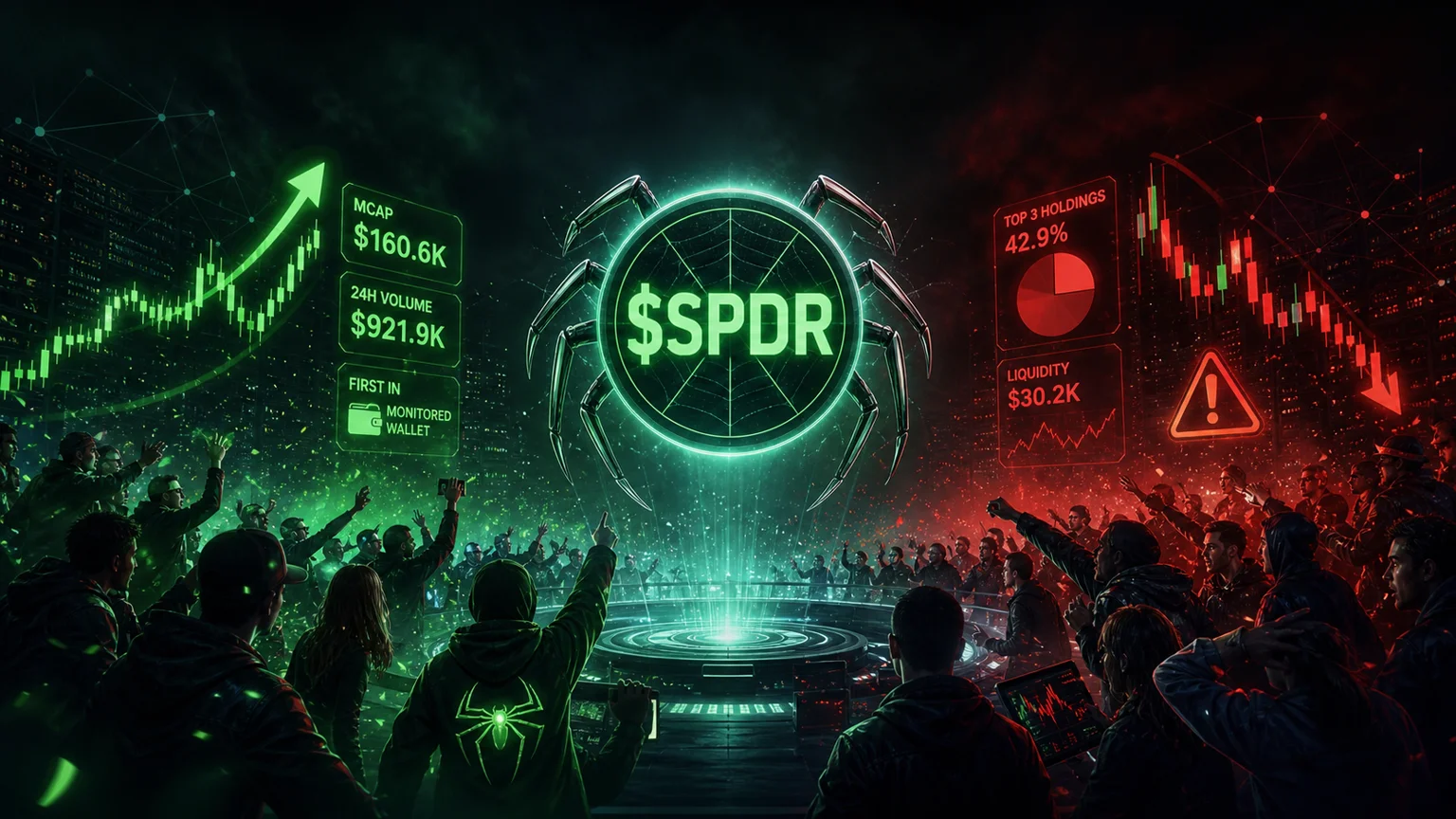
$SPDR carries a Rugcheck score of 1 with freeze authority disabled and mint authority disabled, but the live structure is still tight: the top visible wallet controls 20.97% of supply and the top three rows account for roughly 42.9%, which matters more than the clean contract when liquidity is still around only $30.2K.
$SPDR is exactly the kind of Solana board that can fool people twice in the same night. The first trap is obvious: a small-cap chart prints a violent percentage move, traders see a robotics meme with an easy ticker, and everyone assumes the story is just speed plus screenshots. The second trap is subtler. A monitored wallet touched this name early enough to make the move look informed, which tempts the market to skip the harder work and treat one smart-looking entry as proof that the whole board deserves a premium. At the 2026-06-19 01:15 UTC writer read, Spider Robotics was trading near a $160.6K market cap on about $921.9K in 24-hour volume with liquidity around $30.2K while the pair was only about 4.0 hours old. That is enough tape to matter. It is not enough structure to stop the cap table from having the last word.
- → $SPDR reached roughly a $160.6K market cap on about $921.9K in 24-hour volume after a monitored wallet stepped in near the open, which makes the setup more credible than a pure random screenshot pump.
- → The contract shell itself looks cleaner than the average first-night board because Rugcheck scored it 1, freeze authority is disabled, and mint authority is disabled, so the immediate risk is market structure rather than an obvious admin-key gimmick.
- → That structure is still tight enough to punish late buyers because liquidity is only about $30.2K, the top visible wallet holds 20.97% of supply, and the top three visible rows control roughly 42.9% combined.
Why the First Watched-Wallet Print Matters
In the microcap lane, the first meaningful buyer often changes the kind of audience a board attracts. A chart that rises only because random traders pile into a catchy ticker usually feels disposable even while it is green. A chart that gets discovered by a known wallet before it becomes obvious to the crowd reads differently. It feels chosen. That distinction matters because traders are not just buying candles on Solana. They are buying implied hierarchy. If somebody they track put money to work before the wider room organized itself, they become more willing to treat the move as a thesis instead of a coincidence.
That is the main value of the early $SPDR wallet print. It gave the token a narrative spine before the market cap was big enough to defend itself. The buy itself was tiny in dollar terms, which keeps the story honest. This was not some giant conviction swing that forced the whole market to pay attention. It was a small but timely touch that happened while the board still had room to become a social object. On Solana, timing often matters more than clip size.
The Board Is Fast, but the Depth Is Still Thin
The volume-to-size relationship is the strongest bullish feature on the page. Roughly $921.9K in daily turnover against a market cap near $160.6K tells you the board is being processed aggressively, not admired passively. That kind of ratio matters because it means the chart has already become inventory for fast money. Traders are not waiting for a cleaner setup to emerge. They are actively negotiating the move in real time. On a board this small, that is often the only reason a second leg even gets a chance to exist.
The problem is that turnover does not automatically create safety. About $30.2K of liquidity is enough to make a small runner feel alive, but it is still nowhere near the sort of depth that neutralizes concentration risk. When traders see close to seven figures of volume, they often assume exits will stay forgiving. That assumption is where microcap pain starts. Volume can make a board look democratic right up until one meaningful seller arrives. Then the chart reminds everyone that liquidity, not attention, sets the terms of the unwind.
This is why $SPDR still belongs in the speculative bucket even though the early tape looks better than average. The market cap is small enough that another push is easy to imagine. The day move is large enough to create social gravity. The liquidity is just deep enough to make people overestimate how much punishment the board can absorb. That combination is precisely what produces the sharpest upside and the ugliest reversals on Solana. It is not a reason to ignore the chart. It is a reason to read it with more precision than the headline percentage demands.
What the On-Chain Data Shows
The contract read is the easy part. Rugcheck scored $SPDR at 1. Freeze authority is disabled. Mint authority is disabled. There were no saved risk flags in the profile, and the creator history does not scream serial factory behavior. That matters because it removes the dumbest reasons to dismiss the board immediately. Traders are not staring at a live admin-button problem here. They are staring at a market-structure problem, which is harder because clean permissions can seduce people into forgetting that cap-table risk is still risk.
Holder concentration is where the tone changes. The top visible wallet controls 20.97% of supply. The next two visible rows take top-three concentration to roughly 42.9%. None of those addresses were marked as insiders in the saved profile, which helps, but it does not magically turn the board loose. A holder map can stay well-behaved while momentum is rising and then become the whole story the moment the pace slows. On microcaps, concentration does not need to be malicious to be destabilizing. It only needs to exist while liquidity is too shallow to absorb conviction turning into pragmatism.
That is also why the clean Rugcheck score cannot be treated as a green light. A score of 1 is useful context, not absolution. It tells traders the token is not obviously compromised by permissions or a glaring contract flaw. It does not tell them the board is broadly owned, or that the next seller will get a gentle exit, or that a large holder will behave like a steward instead of a trader. The on-chain file is clean enough that the real danger has shifted from contract mechanics to ownership mechanics. In practical terms, that means the market itself now has to earn the next upgrade.
Why the Robotics Meme Can Recruit Buyers Fast
The meme wrapper matters more than people like to admit. Spider Robotics is easy to parse, easy to repeat, and close enough to familiar AI-and-machine aesthetics that traders do not need a lore document to understand what they are looking at. That matters in the first few hours of a launch because symbols that can be explained in one breath travel much faster than symbols that need context. $SPDR has that advantage. It is visually legible and emotionally simple, which gives the chart a better chance of pulling in opportunistic buyers who are trading recognition as much as data.
But the same simplicity that helps the board recruit can also make it disposable. Easy memes are easy to leave. If traders decide the next robotics-flavored or AI-adjacent ticker gives them a cleaner cap table, deeper liquidity, or just a newer screenshot, attention can rotate instantly. That is why the cultural hook here should be read as accelerant, not foundation. It can help $SPDR attract the next wave. It cannot protect the chart if the structure underneath that attention proves too narrow.
Where the Holder Map Starts to Matter More Than the Wallet Call
$SPDR deserves a stronger second-day case only if liquidity expands materially from the current $30.2K zone while top-wallet concentration stops feeling like an immediate overhang and the board keeps printing real turnover without needing another heroic early-wallet narrative.
That is the point the market is approaching now. The watched-wallet angle got the token into the conversation. The next stretch belongs to the board itself. If $SPDR can keep turning volume without the market cap outrunning liquidity by too much, the early entry will look like a credible first read. If liquidity stays thin while the chart keeps recruiting late buyers, concentration will dominate the entire discussion.
The bull case is still live. Small boards with seven-figure turnover can keep repricing hard if the narrative remains easy to spread and no major holder interrupts the flow. The bear case is just as live. A top wallet near 21%, top-three concentration near 43%, and only about $30.2K in liquidity mean the board can go from orderly excitement to disorderly repricing very quickly. That is the real split. $SPDR has already done enough to earn attention. It has not yet done enough to earn trust.
Verdict
🟡 Speculative. $SPDR has the ingredients of a real microcap continuation setup: roughly $921.9K in 24-hour volume, a timely watched-wallet entry, a clean Rugcheck score, freeze authority disabled, and mint authority disabled. But the board is still thin where it matters. Liquidity sits near $30.2K, the top wallet holds 20.97%, and top-three concentration is roughly 42.9%. Respect the speed. Do not confuse a clean contract with a forgiving cap table.
FAQ
What is $SPDR on Solana?
$SPDR is the Solana meme token Spider Robotics under contract address wF4Cdd3h7TYtyKdHN2KD5xmxPasmuMEcLAyqHWVpump. At the 2026-06-19 01:15 UTC writer read it was trading near a $160.6K market cap.
Why did $SPDR make MemeDesk radar?
Because the board paired a timely monitored-wallet entry with unusually strong turnover for its size: about $921.9K in 24-hour volume against a market cap near $160.6K while the pair was only around four hours old.
Does $SPDR look clean on-chain?
Cleaner than the average first-night Solana board by contract standards. Rugcheck scored it 1, freeze authority is disabled, and mint authority is disabled. The bigger issue is ownership concentration.
What is the biggest risk on $SPDR right now?
The holder map relative to liquidity. The top visible wallet holds 20.97% of supply, the top three visible rows account for roughly 42.9%, and liquidity is only about $30.2K.
What would improve the $SPDR thesis from here?
A stronger follow-up read would show liquidity rising alongside the market cap while turnover stays elevated. If that happens without the holder map getting tighter, the early watched-wallet call matters much more.