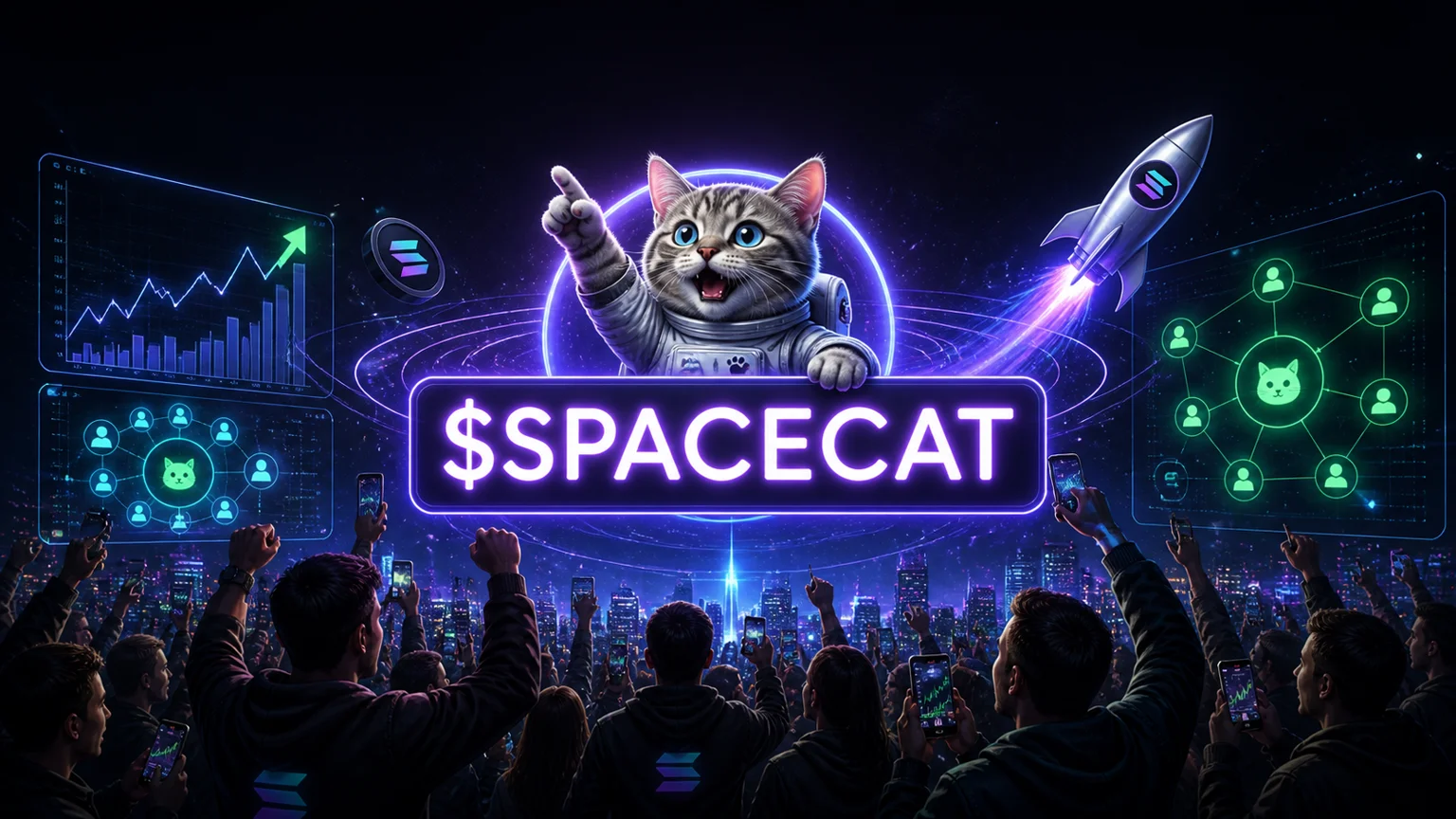
$SPACECAT Turns A Simple Mascot Into A Million-Dollar Solana Bid
$SPACECAT held enough speed after launch to reach a $1.25M market cap, $3.2M in turnover, and a cleaner holder map than most fresh animal rotations.
Top three holders sit near 11.1%, with mint and freeze authority disabled and no listed Rugcheck risks.
$SPACECAT is not winning because the market discovered a new thesis. It is winning because Solana still knows exactly what to do with a clean, immediately readable mascot when the first few hours of trading look alive. The token launched through pump.fun at 9:35 PM UTC on August 25, then pushed to roughly a $1.25M market cap by the 1:05 AM UTC signal timestamp. In a market full of disposable animal tickers, that size forces a better question: is this just another cat sprint, or did $SPACECAT catch enough real flow to stay on the board?
The current read leans toward culture-meme bid. $SPACECAT has the obvious mascot hook, a live website and X profile in the market data, and a trading profile that kept accelerating after the first launch burst. The price was up about 105.6% in the latest one-hour window and 183.6% across the available 24h window. That is not a quiet hold. It is a token still being repriced several hours after graduation, with enough transactions to make the move feel broader than one early wallet cluster.
- → $SPACECAT reached about a $1.25M market cap with roughly $3.21M in available 24h volume, an unusually active first-session profile.
- → The one-hour tape showed 2,931 buys against 2,599 sells, while the broader launch window logged more than 29,500 trades.
- → Rugcheck shows disabled mint and freeze authority, a score of 1, and top-three holder concentration near 11.1%.
A Mascot With Actual Market Footprint
The reason $SPACECAT stands out is not originality. Space cats are not a new invention, and Solana has turned simpler mascots into tradable objects many times before. The reason this one matters is execution in the first session. A $1.25M market cap with $50.1K in liquidity and $3.21M in turnover gives the coin enough market footprint to separate it from the usual five-minute launch noise. It has not earned durability yet, but it has earned attention.
The holder count helps the case. $SPACECAT was showing 1,825 holders, with holder growth above 865% across the available launch window. That does not make the coin safe, but it does mean the token spread wider than a tiny insider circle during the first few hours. The market also reported 17,107 buys and 12,405 sells across the available 24h window, which is enough churn to show real debate rather than a silent mark-up.
The Volume Is Loud, But The Pool Is Still Young
$SPACECAT's cleanest market signal is the volume-to-age profile. The token had about $3.21M in available 24h volume while being only a few hours old. That is the kind of number that tells traders the mascot has already moved through multiple waves of attention. It also means the chart has been stress-tested more than the average new pump.fun name. The buy side remained slightly ahead in the latest one-hour window, but the sell side was not absent. That two-sided churn matters because straight-line pumps often fail the moment the first exit pressure appears.
Liquidity is the part that still needs respect. Around $50.1K in liquidity is much better than many sub-hour launches, yet it remains small relative to a $1.25M valuation and multi-million-dollar turnover. The pool can support active degen trading, but it cannot make everyone whole if the crowd tries to leave at once. The difference between $SPACECAT and weaker launches is that its holder spread and authority data give it a cleaner base. The difference between a watchlist signal and a comfortable trade is still depth.
What the On-Chain Data Shows
$SPACECAT's on-chain profile is why the rating can stretch to clean, with the usual meme-coin caution attached. Rugcheck lists mint authority disabled and freeze authority disabled. The normalized Rugcheck score is 1, and the profile shows no listed risks. The largest holder sits around 4.98%, the second around 4.22%, and the third around 1.87%, putting top-three concentration near 11.1%. The broader market-data audit shows top holders around 15.4%, still a relatively manageable top-end spread for a token barely past its first few hours.
The dev profile is not completely blank, which is worth saying clearly. Rugcheck shows the creator wallet still holding a small balance, while the market-data audit lists dev balance near 0.33%. It also shows three prior creator tokens, including one with a much larger reported market cap and two smaller launches. That is not enough to call a serial-deployer warning by itself, but it does mean the creator history is not pristine emptiness. The important part is that the present $SPACECAT contract does not show mint or freeze authority risk, and the current top-holder map is not dominated by one wallet.
Why This Cat Is Different Enough To Watch
Mascot coins live or die on repeatability. A trader only needs to understand $SPACECAT once. The name gives the art direction, the ticker gives the social hook, and the early volume proves the market was willing to pass it around. That is the cultural edge. It does not require a complicated backstory, which can be an advantage when Solana attention spans are measured in candles. The coin has to keep turning that simplicity into new holders instead of relying on the first violent move.
The organic score sits at 65.9, labeled medium. That fits the tape: better than an obvious bot-only squeeze, not strong enough to treat the whole move as naturally sticky. The clean case improves if $SPACECAT can hold above the earliest discovery zone while liquidity keeps rising. A messy but constructive version would include sideways trading, a higher pool, and holder growth that continues even when price stops doubling. That would show the mascot is becoming a shared object rather than a one-session instrument.
$SPACECAT has the rare early mix traders look for: a simple meme, multi-million-dollar turnover, disabled authorities, and top-three holder concentration near 11.1%.
The Failure Path Still Exists
The bear case is not that $SPACECAT has an obvious contract problem. The bear case is that the market has already paid up for a simple mascot. At a $1.25M market cap, the coin is no longer an undiscovered micro launch. Early buyers have room to take profit, and the liquidity pool is still thin relative to the amount of volume that has already moved through it. If turnover fades while valuation stays stretched, the chart can reprice quickly without any dramatic on-chain event.
There is also the replacement risk every animal coin faces. A clean cat can be displaced by the next cleaner cat if the market loses emotional attachment. $SPACECAT needs visible community behavior, not just a better first session. The website and X link help it look less disposable, but markets do not reward links for long. The next useful signal is whether traders keep treating the mascot as a live rotation after the launch novelty wears off.
$SPACECAT gets a clean launch-radar read because the available data shows strong early participation, a medium organic score, disabled mint and freeze authority, low Rugcheck risk, and a relatively balanced top-holder map. It is still a meme coin with thin liquidity and brutal rotation risk, but the first-session profile is cleaner than most animal launches trying to clear the same lane.
What is $SPACECAT?
$SPACECAT is a Solana meme token launched through pump.fun around a simple space-cat mascot.
Why does $SPACECAT rate clean?
The available data shows disabled mint and freeze authority, a Rugcheck score of 1, top-three holders near 11.1%, and broad early trading activity.
What should traders watch next?
Liquidity growth, holder retention, and whether volume remains active after the first launch-window repricing cools.