$SOLVENGERS Pulled the Right Wallets Early, but the Solana Board Already Needs a Real Second Wave
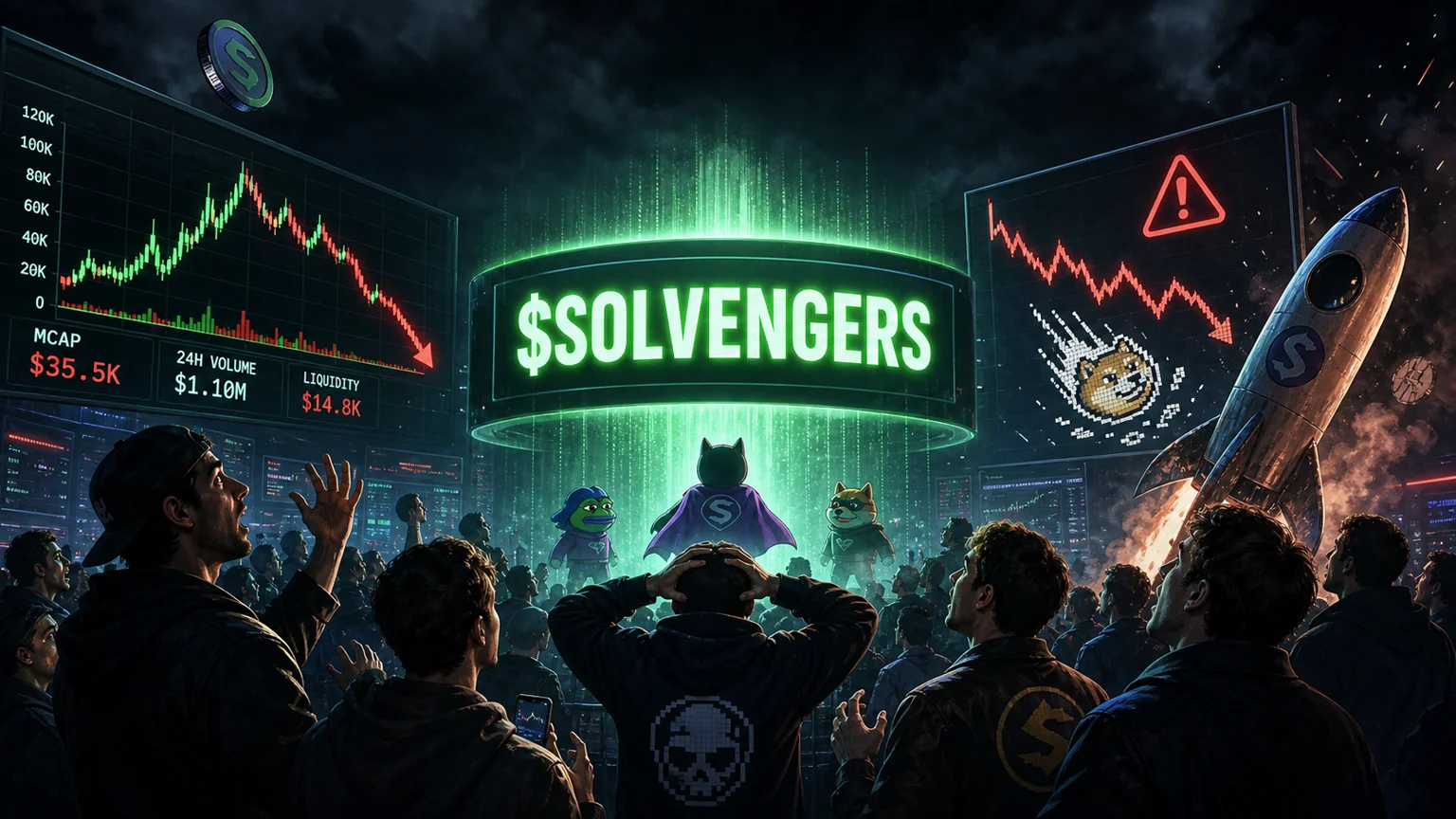
At 2026-06-21 04:15 UTC, $SOLVENGERS was trading near a $35.5K market cap with roughly $1.10M in 24-hour volume and about $14.8K in liquidity after an opening burst that had been closer to a six-figure headline. The watched-wallet entries were real, but the sharper truth now is how quickly the first reprice gave altitude back.
The contract read is much cleaner than the chart. Freeze authority is off, mint authority is off, the creator balance is zero, Rugcheck scored the token at 1, and the biggest visible wallets are pool addresses rather than one obvious outside whale. The risk on $SOLVENGERS is not hidden contract poison; it is the possibility that the market already spent its first burst of demand.
$SOLVENGERS is the sort of launch that can fool traders in two opposite directions. The first read looks strong because watched wallets really did show up before the board became ordinary public noise. One wallet tagged as ozark spent roughly $120.75 at 2026-06-21 02:36 UTC, and a second watched wallet tagged as Cupsey kept adding between 2026-06-21 02:45 UTC and 2026-06-21 02:51 UTC. That is credible early interest, not a made-up story. The trap is assuming early credibility automatically means lasting strength. By 2026-06-21 04:15 UTC, the board was already back near a $35.5K market cap with only about $14.8K in liquidity, which means the token had already spent a lot of its opening excitement.
That is why the right editorial frame is post-pump exhaustion rather than clean-runner optimism. $SOLVENGERS did enough to matter. It did not do enough to protect late traders from the usual first-wave fade. Roughly $1.10M in 24-hour volume still gives the token a real footprint, but a footprint is not the same thing as a healthy board. The more useful question now is whether the market is about to build a second, sturdier leg from a damaged first cycle, or whether the early wallet buys simply marked the most interesting part of the move and left everybody else to trade the leftovers.
- → $SOLVENGERS drew genuine watched-wallet entries early, including buys from ozark and repeated adds from Cupsey in the 2026-06-21 02:36 UTC to 02:51 UTC window.
- → By the saved 2026-06-21 04:15 UTC read, the board had already cooled to roughly a $35.5K market cap with about $14.8K in liquidity, even though 24-hour turnover still sat near $1.10M.
- → The contract profile looks unusually clean for a fast Solana meme launch: freeze authority off, mint authority off, creator balance zero, Rugcheck score 1, and no major risk flags, which means the current weakness is more about demand decay than contract fear.
Why the Early Wallet Buys Mattered
Watched-wallet entries matter because they change the burden of proof. A random board can flash on a scanner for any number of silly reasons. A board that gets touched by traders with a reputation for arriving early on fast Solana names deserves a more serious look. That does not make the token right. It makes the signal real enough to examine. In the case of $SOLVENGERS, the wallet activity built a plausible opening narrative: somebody saw enough there to step in before the pair had become obvious to the rest of the market, and that is often how first-hour winners begin.
The issue is that wallet interest only buys a token time. It does not buy permanence. If anything, watched-wallet traffic can make the second phase harder because it encourages everyone else to show up with a shortcut thesis. Once traders start repeating that the smart money is already in, the board stops being judged on its own tape and starts being judged on whether the crowd can front-run the wallets that front-ran them. That is a fragile setup. It creates urgency, but it also creates a market full of participants who are mostly there because they think someone else knows something.
The Reprice Was Fast, but the Retest Was Faster
The chart tells the uncomfortable part of the story. The saved selection read had $SOLVENGERS much closer to a six-figure market cap. By the later 2026-06-21 04:15 UTC snapshot, the live pair had already fallen back to roughly $35.5K and was down about 52.7% over the preceding hour. That does not automatically kill the token. Solana boards can reset violently and still rebuild. It does, however, change the burden from celebration to repair. A token that gives back that much altitude this quickly no longer gets to live on the prestige of who bought first. It has to prove the crowd still cares after the first adrenaline cycle is over.
Volume complicates the picture in a useful way. Roughly $1.10M in 24-hour turnover is still too much activity to dismiss the token as fully dead-on-arrival noise. There was a real market here. Buyers and sellers both spent time in it. Yet the liquidity line is what keeps the article cautious. About $14.8K is enough for a board to remain tradable, but it is not enough to make a fast retrace feel harmless. When price damage shows up before liquidity has deepened, the market starts asking whether the next bounce will be owned by genuine new demand or simply by traders trying to recycle the same fragile story one more time.
What the On-Chain Data Shows
The interesting twist with $SOLVENGERS is that the on-chain read is cleaner than the chart deserves. Freeze authority was off. Mint authority was off. The creator balance was zero in the saved Rugcheck report. Rugcheck scored the token at 1 and did not attach the kind of obvious contract warnings that usually explain a first-hour collapse. That matters because it changes the interpretation of the fade. The token is not currently screaming hidden supply inflation, transfer-freeze danger, or a dev wallet waiting overhead with an easy dump button. The board is weak because the market stopped paying the same price for the story, not because the contract suddenly exposed a glaring technical defect.
Holder concentration needs nuance rather than panic. The saved top-three concentration was high at face value, but the two largest visible wallets were pool addresses tied to the launch and AMM structure, not one outside whale trying to own the entire outcome. Once that context is applied, the cleaner takeaway emerges: the most meaningful outside wallet in the visible top slots was closer to 4.19% of supply. That is not nothing, but it is far from the sort of single-wallet overhang that automatically invalidates a microcap. In other words, the holder map is not the reason the board lost air. Demand simply faded faster than bulls expected.
Liquidity depth is still the practical constraint. Even a clean contract and a manageable holder map cannot rescue a pair that never gets enough fresh size behind it. The main pool was only around $14.8K in the saved live read. That is why the next step matters so much. If buyers return and the pool grows with them, the board can graduate from first-cycle disappointment into a legitimate second attempt. If price tries to bounce without liquidity materially improving, then every recovery candle will be vulnerable to the same problem that hurt the first one: too many traders leaning on a board that still cannot carry much weight.
What Would Need to Change for a Real Recovery
The bullish case from here is not impossible. It is just specific. $SOLVENGERS needs a second wave that is broader than the first and less dependent on the prestige of the early wallets. The market needs to see liquidity firm up, not merely price tick upward. It needs to see that the board can attract fresh participants after the original watched-wallet story is already public. If that happens, the token can be re-read as a launch that flushed weak hands early and rebuilt on cleaner terms. Solana has produced that pattern before.
The bearish case is more immediate because it requires less imagination. Traders may have already extracted the best part of the story. A watched-wallet headline is often strongest before everyone knows it, and weakest right after it becomes the main reason people are entering. If the board keeps sitting at this liquidity level while the crowd looks for a miracle second act, $SOLVENGERS risks becoming one of those launches that was directionally right for the earliest readers and structurally wrong for almost everyone who arrived after the screenshot started circulating.
$SOLVENGERS did get the kind of early wallet attention traders care about.
The chart damage now matters more than the prestige of those entries.
Because the contract read is clean, any recovery will have to come from renewed demand and deeper liquidity, not from a sudden change in on-chain risk.
$SOLVENGERS stays speculative because the token had a real early-wallet signal and a contract profile that is cleaner than most same-hour Solana meme boards, but the market already forced the trade into repair mode. The live pair fell back to roughly a $35.5K market cap with only about $14.8K in liquidity and a one-hour slide near 52.7%, which means the next move has to be earned by a broader second wave rather than assumed from who bought first.
What is $SOLVENGERS on Solana?
$SOLVENGERS is The Solvengers meme token trading on Solana. In the saved 2026-06-21 04:15 UTC read, it was priced near $0.00003552 with a market cap around $35.5K, roughly $1.10M in 24-hour volume, and about $14.8K in liquidity.
Why did traders care about $SOLVENGERS so early?
The token attracted watched-wallet entries before the board became ordinary public chatter, including an ozark buy around 2026-06-21 02:36 UTC and repeated Cupsey adds between 2026-06-21 02:45 UTC and 02:51 UTC. That gave the launch a credible early-signal narrative even before the broader market reacted.
Is the problem with $SOLVENGERS the contract or the demand?
The saved on-chain read points more toward a demand problem than a contract problem. Freeze authority was off, mint authority was off, creator balance was zero, and Rugcheck scored the token at 1, so the weakness looks more like first-hour exhaustion than a hidden contract shock.