
$SNILL Has the Smart-Wallet Style Bid Traders Chase, but the Float Still Looks Tighter Than the Candle
At the 2026-06-25 19:15 UTC read, $SNILL was trading near a $83.4K market cap after roughly $439.5K in 24-hour volume with about $31.0K in visible liquidity less than nine hours after its main pool opened. The attraction is easy to understand: watched-wallet interest showed up early, the contract shell has both authority switches off, and first-day turnover is real. The caution is that one wallet still holds about 24.0% of supply while another 18.6% sits in pool inventory, which keeps the handoff tighter than the headline move suggests.
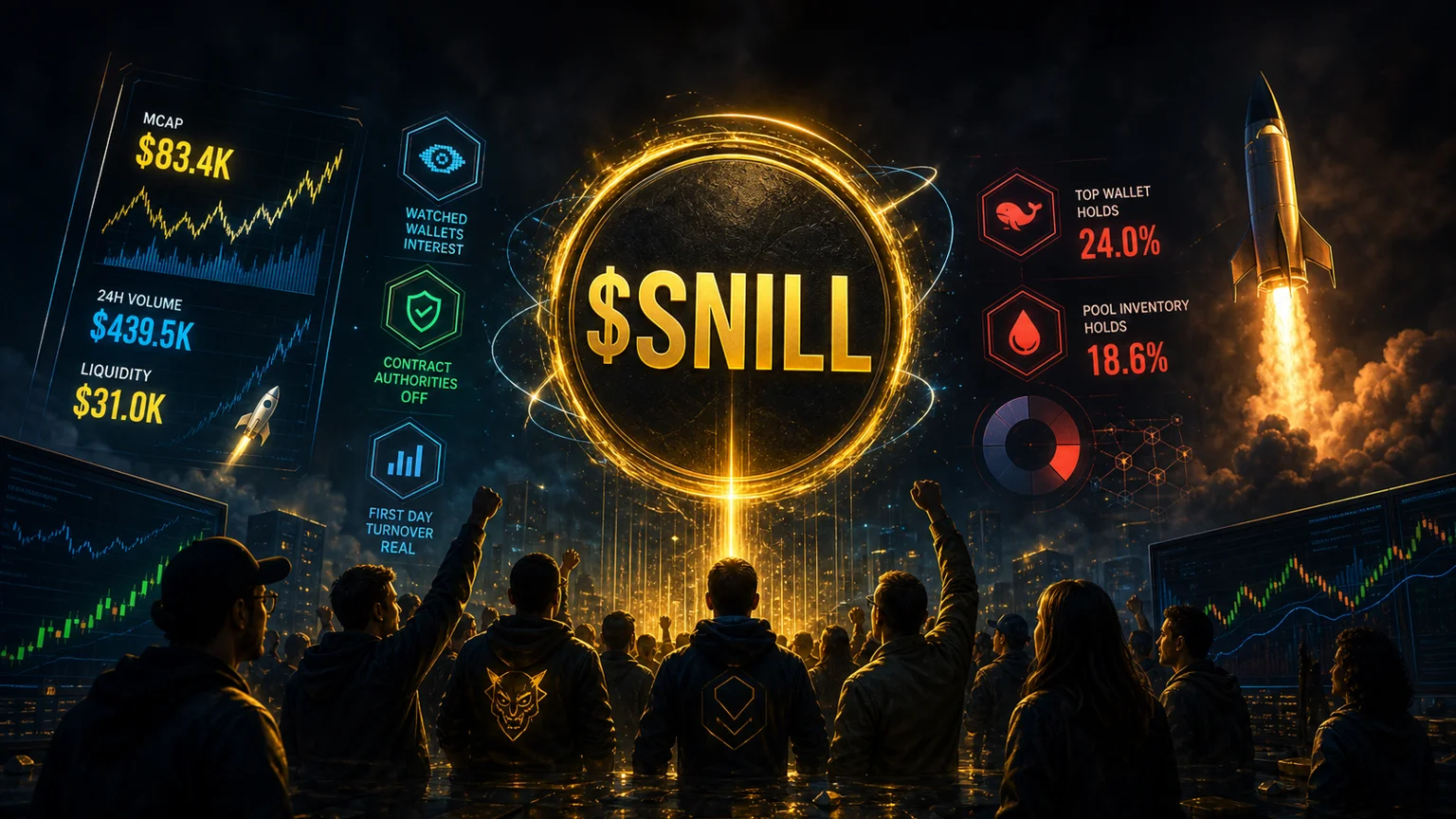
$SNILL keeps the obvious contract risk switched off with freeze authority disabled, mint authority disabled, and a Rugcheck score of 1. The real issue is distribution rather than permissions: one visible wallet still controls about 24.0% of supply, while another 18.6% sits in the main pool inventory, leaving the board cleaner than a rug shell but tighter than a truly loose first-day float.
$SNILL does not read like the usual tiny Solana chart that prints one exciting candle and then asks everyone to pretend the structure does not matter. At the 2026-06-25 19:15 UTC read, the board was sitting near a $83.4K market cap after roughly $439.5K in 24-hour volume with about $31.0K in visible liquidity. That is enough turnover to make the chart real, not imaginary. It is also enough to create the kind of first impression that gets traders reaching for the phrase smart money before the handoff has actually been tested.
That is why tight float test is the right editorial angle. The shell is cleaner than a lot of same-day Solana launches. Freeze authority is off. Mint authority is off. Rugcheck scored the token at 1, and the creator wallet was not sitting on an obvious leftover bag. Those are the easy questions, and $SNILL answers them well enough. The harder question is who really owns the float that matters. One visible wallet still controls about 24.0% of supply, and another 18.6% sits inside the main pool inventory. That means the board can keep moving, but it is still moving through a narrower door than the headline turnover suggests.
- → $SNILL hit the radar with watched-wallet style interest and then backed it up with roughly $439.5K in first-day volume on a board still under a $100K market cap.
- → The contract profile is cleaner than average for a fresh Solana launch: freeze authority disabled, mint authority disabled, creator balance at zero, and a Rugcheck score of 1.
- → The problem is distribution, not permissions, because one wallet still holds about 24.0% of supply while liquidity stays thin near $31.0K.
Why $SNILL Got Attention Before the Chart Looked Mature
The first thing worth respecting is that the move was noticed before it looked comfortable. That matters in memecoins because the easiest charts to talk about are usually the least useful ones. By the time everyone agrees a board is obvious, the easy entry has already happened and the market has shifted from discovery to distribution. $SNILL got picked up while it still looked like a developing first-day tape. That matches the basic shape of the numbers now. Thousands of trades rolled through the pair over the day, buys stayed ahead of sells, and price still held a meaningful daily gain even after the first rush cooled off.
Still, the watched-wallet angle should be treated as a prompt to inspect the structure, not as proof that the trade has already won. In this market, early wallet activity matters because it tells you where attention formed first. It does not remove the need to ask whether the rest of the market is broad enough to absorb profit-taking once the first wave starts paying itself. That is the exact line $SNILL is walking now.
What the On-Chain Data Shows
Start with the clean part. $SNILL is not broadcasting the easy rug mechanics. Freeze authority is disabled. Mint authority is disabled. The creator wallet balance was zero in the saved Rugcheck report. The Rugcheck score itself sat at 1. Those facts matter because they clear away the most obvious reasons to dismiss a fresh Solana board outright. If this chart fails, it probably fails because the market structure was too tight or the crowd lost interest, not because the token was built with an obvious self-destruct button.
The holder map is where the conversation gets interesting. One visible wallet still controlled about 24.0% of supply in the saved read. That is too large to ignore. The next big line, about 18.6%, appears tied to the main pool inventory rather than a discretionary whale bag, which is an important distinction. Pool inventory is not the same thing as a trader waiting to dump on a green candle. But it still tells you something important about the board: a lot of the token sits inside the mechanism keeping the market alive, and that means the freely rotating float is not especially wide yet.
This is the nuance traders usually miss when they read concentration numbers too quickly. A top-three share near 45.6% sounds terrifying on its own, but the raw figure overstates the discretionary holder risk because part of that stack is market inventory. The better way to read it is that $SNILL has one genuinely oversized wallet plus one large pool component, not three random insiders quietly controlling half the board. That is better than the worst-case interpretation, but it is still not the same as a loose, comfortingly distributed tape. A single 24.0% line can still dominate mood if it ever starts moving.
Liquidity is the second number that should keep bulls honest. Roughly $31.0K is workable for a board in the mid-five-figure market-cap zone, but it is not deep enough to make a trader feel relaxed once the first serious selling wave shows up. The chart pushed roughly $439.5K in 24-hour volume, which means turnover has been many times larger than the visible liquidity cushion holding the pair together. That ratio is excellent when momentum is pulling traders in. It becomes much less charming the moment the market needs the pool to absorb exits instead of entries.
The final on-chain read is that the board is active, not settled. Around 400 holders and a main pair created at 2026-06-25 10:18 UTC tell you this thing is still in the earliest part of its life cycle. For $SNILL, the main flaw is not a live mint switch or a toxic creator profile. It is the possibility that the market is still narrower than the volume line makes it look.
Why the Structure Still Feels Tighter Than the Candle Suggests
The bullish case is straightforward. A clean contract shell plus watched-wallet attention plus real first-day turnover is enough to keep a microcap Solana name in rotation longer than most people expect. If the board can add new holders while keeping that 24.0% wallet quiet, the current chart can still be remembered as the awkward early phase before a cleaner second leg.
The reason the read stays speculative is that traders do not get paid for the path that exists. They get paid for the path that actually survives the handoff. When one wallet owns almost a quarter of supply, the market has to keep asking whether that stake is dead inventory, real conviction, or future exit pressure.
That is also why the clean contract profile should not be confused with a green-light verdict. A lot of bad trades start from technically acceptable contracts. $SNILL has enough legitimate traction to stay on radar. It has not yet proven that the next crowd is big enough to make the first crowd irrelevant.
$SNILL is structurally cleaner than plenty of same-day Solana launches, but clean permissions do not solve float pressure.
One visible wallet still controls about 24.0% of supply, liquidity is only around $31.0K, and first-day turnover has already run far ahead of the pool depth.
If that large wallet starts distributing before fresh buyers meaningfully widen the holder base, the chart can unwind much faster than the daily volume line makes it look.
The practical read is simple. $SNILL deserves attention because the signal was not fake, the shell is not obviously toxic, and the board already proved it can transact at a level bigger than its market cap would normally imply. It also deserves restraint because distribution still looks tight enough that one actor can matter too much.
$SNILL earns a speculative rating because the setup is good enough to matter but not broad enough to relax into. The positive side is real: watched-wallet style attention arrived early, roughly $439.5K in volume came through a board still near a $83.4K market cap, freeze and mint authorities are both disabled, the creator wallet balance is zero, and Rugcheck scored the token at 1. The caution is just as real: one visible wallet still holds about 24.0% of supply, liquidity remains near only $31.0K, and the float still looks tighter than a healthy second-stage handoff would ideally require. This is a board to track for widening ownership, not one to mistake for a solved clean runner.
What is $SNILL on Solana?
$SNILL is the Solana meme token Snill.ai under contract address 4quUyZSeuNkBDwR3xqV83cqEB9EnAT348B9ExbhGwory. At the 2026-06-25 19:15 UTC read, it was trading near a $83.4K market cap.
Why is MemeDesk calling $SNILL speculative instead of clean?
Because the contract shell looks healthy, but the ownership structure still has one oversized line. In the saved read, one visible wallet controlled about 24.0% of supply while liquidity was only around $31.0K, which keeps the handoff tighter than a fully comfortable board.
Does $SNILL have freeze or mint authority risk?
Not in the saved on-chain report. Freeze authority and mint authority were both disabled at the time of the read, and Rugcheck scored the token at 1. That removes some easy contract-level concerns, but it does not remove market-structure risk.
What should traders watch next on $SNILL?
The big tells are whether the holder base widens beyond roughly 400 wallets, whether liquidity grows from the low-$30K area, and whether the 24.0% wallet stays inactive while the market keeps rotating. If those improve together, the chart read upgrades. If they do not, the current strength can fade quickly.