
$SLAWTH Turns a Sloth Joke Into Real Flow, But the Holder Map Is the Trade
$SLAWTH is not moving like a dead launch. The cleaner authority read helps, the $759K volume matters, and the top-three wallet concentration is still the part every late buyer has to respect.
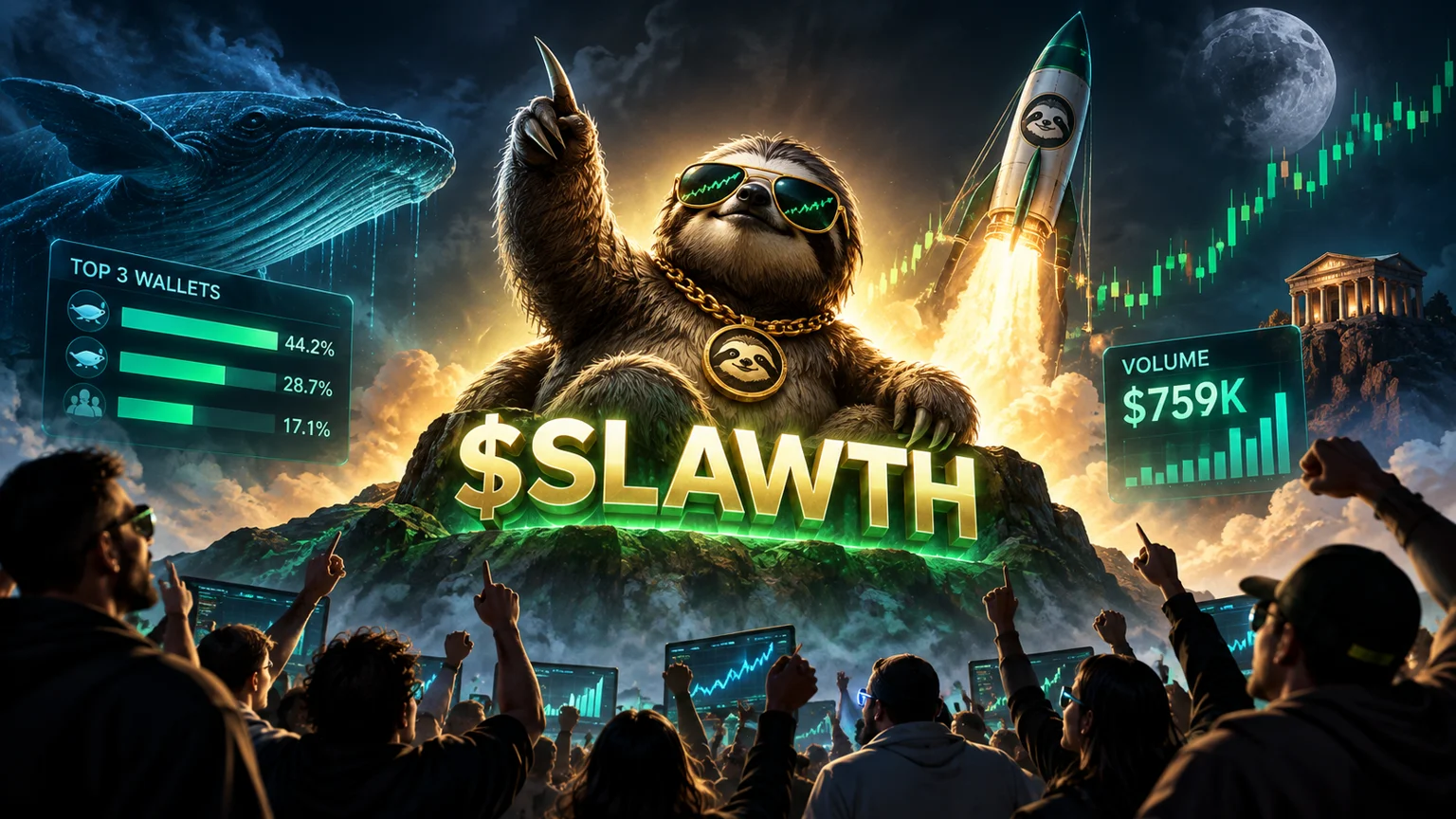
Clean authority read, but the top three wallets still control 42.2% of visible supply.
$SLAWTH is the kind of Solana launch that looks unserious at first glance, then forces a second look because the tape refuses to act like a one-candle joke. The name is Vawlt Slawth, the setup is pure culture-meme bait, and the market has already pushed it into a roughly $2 million market cap zone with $759,000 in 24-hour volume. That is enough activity to separate it from the usual disposable launchpad clutter, but not enough to make the structure comfortable.
The editorial angle here is not that a sloth meme pumped. That happens. The angle is that $SLAWTH has survived long enough to invite a more serious rotation while still carrying a holder map that can punish lazy entries. Clean mint and freeze authority remove two of the ugliest contract-level risks. Liquidity near $73,000 gives the chart more room than the ultra-thin pairs. But the top three visible holders sit around 42.2% combined, and that means every continuation candle has to fight the same question: is this an organic meme bid, or a patient distribution window?
- → $SLAWTH is up 187% over 24 hours with about $759K in volume and 4,285 transactions.
- → The contract read is cleaner than many fresh Solana launches: mint authority and freeze authority are both disabled.
- → The risk is supply shape, not branding. The top three visible holders control roughly 42.2%, led by one wallet at 21.59%.
Why This Sloth Is Getting a Bid
Meme markets reward speed, but they also reward simplicity. $SLAWTH has both. It is easy to say, easy to meme, and weird enough to travel without needing a whitepaper cosplay routine. The stonk-adjacent animal rotation has been one of the more durable micro-themes in Solana culture because it gives traders a familiar frame: a dumb character, a clean ticker, and enough room for communities to remix it into their own joke.
That matters because fresh token flow is rarely about fundamentals in the traditional sense. It is about whether a market can understand the joke before the liquidity window closes. $SLAWTH has already cleared the first test by pulling real transaction count. A token can fake attention with a few large swaps. It is harder to fake thousands of trades, especially when the buy ratio is not wildly lopsided. A 49% buy ratio says this was not a one-way chase at the snapshot. Sellers were present, buyers were present, and price still printed a large 24-hour move.
That balance can be healthier than a cartoonish 90% buy reading. When a launch is all buys and no friction, the first real sell wall often becomes the entire story. $SLAWTH already had churn in the tape. The question now is whether churn turns into base-building or whether the early wallets use every bounce to unload into late meme demand.
The Numbers Behind the Move
The $2 million market cap zone is awkward in the best way. It is no longer invisible, but it is not yet so large that the market automatically treats it as fully discovered. For meme traders, that middle zone is where psychology gets loud. Early entrants are sitting on meaningful gains. Fresh buyers see a chart that has already proven it can move. Liquidity is deep enough to invite size compared with micro-pairs, but still thin enough that a single holder can bend the candle if the market gets careless.
That is why the $73,000 liquidity figure matters. It is respectable for a young Solana meme, but it is not a fortress. A $2 million market cap with $73,000 in liquidity can move quickly in both directions. If volume stays near the current pace, liquidity becomes a launchpad. If volume fades, it becomes a narrow exit lane. The market does not need a malicious event to retrace; it only needs attention to rotate elsewhere for a few hours.
What the On-Chain Data Shows
The cleaner part of the $SLAWTH profile is the authority setup. Freeze authority is off, which means the deployer cannot freeze holder transfers through that mechanism. Mint authority is also off, which removes the unlimited-supply overhang that can wreck a meme coin before holders even understand what happened. Those two checks do not make a token safe, but they do take away two common instant-disqualification risks.
The Rugcheck score sits at 36. That is not a screaming red score, but it is also not a free pass. The bigger issue is concentration. The largest visible holder controls 21.59%, the second 12.61%, and the third 7.97%. Together, the top three account for roughly 42.2%. None of those top-three wallets are flagged as insiders in the available read, and the creator-token count is listed at zero, so the data does not point to a serial deployer pattern. Still, concentration this high means the chart is exposed to wallet behavior.
For $SLAWTH, the on-chain read creates a split verdict. The contract permissions are cleaner than average. The deployer history does not look notable from the available data. But the supply stack remains chunky enough that a single large wallet decision can change the mood quickly. That is the difference between a clean contract read and a clean trade. The former is a technical check. The latter has to survive market structure.
The meme is doing its job. The risk sits in the holder map: 42.2% across the top three visible wallets means continuation depends on large holders not turning every bid into exit liquidity.
Culture-Meme Bid or Exit Window?
The strongest bull case for $SLAWTH is that it is not trying too hard. Some launches die because they need a complicated pitch before anyone can care. $SLAWTH only needs the market to keep finding the sloth funny. That sounds ridiculous, but in meme coins, ridiculous is often the product. A character with remix potential can generate its own order flow if traders believe other traders will understand it fast.
The bear case is just as simple. If the move was mostly early-wallet positioning plus late attention, the chart may have already spent its easiest upside. A 187% 24-hour move creates profit-taking pressure even when the community is still excited. Near-even buy pressure shows the market had two sides, but it also means sellers were active during the run. If those sellers become more aggressive while volume cools, the same liquidity that helped $SLAWTH climb can make the downside look abrupt.
What would improve the read from here is not another isolated green candle. It would be a higher-volume consolidation where the top holder share does not become the story, liquidity holds or deepens, and the token keeps attracting fresh transactions without needing a straight vertical chart. That is how a joke becomes a tradable market instead of a screenshot.
The Trade to Watch
For now, $SLAWTH belongs in the speculative watch bucket. It has enough volume, transaction activity, and meme clarity to deserve attention. It also has enough concentration to make blind chasing feel lazy. The clean authority profile is the best part of the setup. The holder map is the part that keeps the badge yellow.
The next real signal is whether $SLAWTH can hold attention after the first easy rotation. If it keeps printing volume while the market cap stabilizes above the early breakout zone, the sloth bid starts looking more durable. If volume slips and the large wallets begin leaning on liquidity, the launch becomes another reminder that clean permissions are only one piece of the meme-coin risk stack.
$SLAWTH has the ingredients of a culture-meme runner: clear joke, real volume, clean mint and freeze authority, and enough market cap to matter. The top-three holder concentration keeps it speculative. Watch the wallets as closely as the meme.
Why is $SLAWTH on MemeDesk radar?
$SLAWTH combined a 187% 24-hour move with about $759K in volume, 4,285 transactions, and a meme format simple enough to travel quickly across Solana trading circles.
What is the biggest $SLAWTH risk?
The main risk is holder concentration. The top three visible wallets control roughly 42.2%, including one wallet above 21%, so large-holder selling could pressure liquidity quickly.
Is the $SLAWTH contract clean?
The available Solana read shows mint authority and freeze authority disabled. That removes two common contract-level risks, but it does not eliminate market, liquidity, or holder-distribution risk.