$QBX Is Trying to Turn a Sunnyikes Wallet Bid Into a Real Solana Launch Breakout
At the 2026-06-30 22:15 UTC reference point, $QBX was trading near a $72.3K market cap with about $259K in 24-hour volume and roughly $20.7K on its main Solana pool less than two hours after launch. The permissions read is unusually clean for a board this fresh, but 117 holders and a 14.29% top wallet mean the breakout still lives or dies on whether new hands keep showing up.
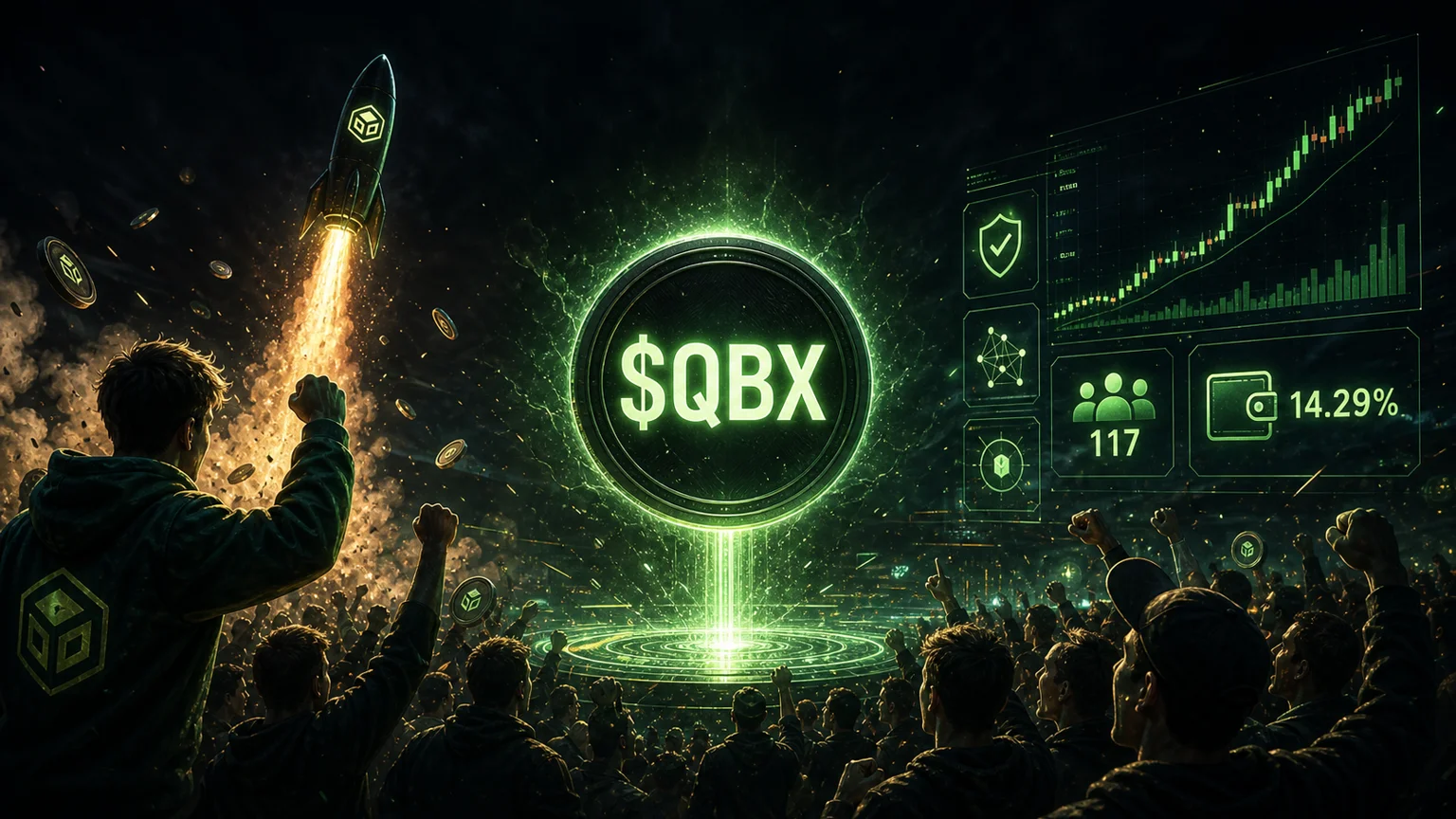
$QBX has mint authority disabled, freeze authority disabled, and a rug score of 1, but the token still only has 117 holders and the top three wallets control 29.72% of supply. That is clean contract plumbing paired with a very young ownership map, not a solved launch.
Most first-hour Solana launches are only interesting for one candle. They appear, print an absurd percentage, and collapse back into the anonymous pile before anyone can decide whether a real market formed. $QBX is more interesting because the early demand did not look random. The tape came out of the gate with the kind of repeat buying that usually follows a wallet-led push, not a single screenshot trade. At the 2026-06-30 22:15 UTC reference point, $QBX was trading around a $72.3K market cap with roughly $259K in 24-hour volume and about $20.7K of liquidity on its main pair. For a token that was still less than two hours old, that was enough to make the board feel like an active instrument rather than a forgotten launchpad leftover.
The specific reason it deserves a closer read is the shape of the move. Scanner chatter around repeated Sunnyikes-linked buying gave the token an obvious ignition source, but the board did not instantly die once the headline number hit. Plenty of fresh launches can borrow attention for five minutes. Much fewer can keep trading with purpose after the first burst of curiosity has already had its chance to leave. $QBX looked like a board still trying to recruit its second audience, and that is the stage where a launch either becomes a rotation or reveals it was only temporary theatre.
- → $QBX hit about a $72.3K market cap with roughly $259K in 24-hour volume less than two hours after launch, which is enough turnover to prove traders were revisiting the board instead of only tapping it once.
- → The setup reads like a wallet-led breakout: early attention came from repeated Sunnyikes-linked activity, but the pair kept holding above its first expansion zone instead of instantly giving back the whole move.
- → On-chain permissions look clean with freeze authority off, mint authority off, and a rug score of 1, yet the token still only has 117 holders and the top three wallets own 29.72% of supply.
Why the First Buyers Got Paid Fast
The simplest explanation is that $QBX offered exactly the kind of asymmetry early launch traders want to see. The market cap started tiny enough that even modest demand could move it violently, while the ticker package was polished enough to keep late arrivals from feeling like they were aping a totally broken product. The website and docs links were already live in the public footprint, the X account gave the launch a place to point traffic, and the pair printed buy-heavy traffic quickly enough to make the move feel self-reinforcing. That combination is usually how a microcap escapes the dead zone between a stealth launch and a real social chart.
It also helped that the board was not pretending to be broad and stable. $QBX looked like a sprint from the start, which is often healthier than a weak attempt to fake maturity. Traders knew they were looking at a young, narrow board, so they traded it for speed. When everyone understands that the first mission is expansion rather than comfort, the market often gives the chart one clean window to travel before it starts asking harder questions about depth and ownership. That window is what $QBX is still trying to exploit.
Where the Tape Still Looks Alive
The headline number is not the percentage move. It is the turnover relative to size. Roughly $259K of volume against a $72.3K market cap tells you the board was being used repeatedly, not merely discovered. In fresh-launch terms, that matters more than a vanity candle. High turnover on a small capitalization means the market kept revisiting the pair, and that behavior is usually the first sign that a token can stay on watchlists longer than one scroll cycle. The hourly activity cooled from the craziest part of the burst, but it did not disappear. That is exactly what a tradeable early board is supposed to do after the first adrenaline hit.
The price level also deserves context. DexScreener showed the active pair around $0.00007231, down from the wild upper wicks you would expect on a board that printed a 3,040% daily move, but still holding far above the earliest invisible stage of the chart. That makes the current read more useful than a straight-up launch candle. Readers are not being asked to imagine whether $QBX can print its first serious markup. It already did. The more relevant question is whether enough new participation exists to keep the token from turning into a pure exit ladder for the earliest wallets.
Liquidity is the part that keeps the yellow rating in place. About $20.7K on the main pair is not nothing for a board this young, but it is still thin enough that one impatient seller can rewrite the entire mood. Rugcheck sees a little more than $40K in total market liquidity across venues, which helps, yet the practical reality is the same: this remains a narrow board. Traders can make money precisely because the structure is small. They can also get trapped for the same reason. The tape looks alive because the market has not tested the exit door at scale yet.
What the On-Chain Data Shows
The contract read is cleaner than the average microcap that shows up this early. Mint authority is disabled. Freeze authority is disabled. Rugcheck scores the token at 1. There are no saved risk flags screaming that the deployer left a giant permissions backdoor open. In practical terms, that removes the dumbest reason to ignore the chart. Readers do not have to spend this setup wondering whether one admin switch can instantly turn the trade into a lesson. The plumbing is simple, which gives the market permission to focus on structure instead of contract fear.
The holder map is where the story gets more delicate. The biggest visible wallet controls 14.29% of supply, the second wallet holds 9.95%, and the third sits at 5.48%. That puts the top-three cluster at 29.72% combined. On a more mature board those numbers would be annoying but survivable. On a token with only 117 holders, they matter a lot more. This is not catastrophic concentration, but it is enough to ensure that price discovery is still happening in a room with very few meaningful voices. If those voices want higher, the chart can levitate. If they want out, the rest of the holder base is still too young to absorb much stress gracefully.
There is one more important nuance inside the liquidity structure. Rugcheck shows the main LP locked, which is constructive for the basic trust read, but it does not magically turn a tiny market into a comfortable one. Locked liquidity stops one kind of disaster. It does not solve the day-two problem of whether a token can widen its ownership fast enough to survive its first real profit-taking wave. That is why the on-chain picture reads clean but unfinished. The market got decent plumbing. It has not yet earned durable depth.
The Part That Decides Whether This Becomes More Than a Spike
For $QBX to graduate from launch curiosity into an actual rotation candidate, it needs a broader audience than the one that created the first breakout. The easiest way to spot that would be continued volume while the market cap stops feeling microscopic. If turnover stays lively as the chart tries to build a base, then the early wallet push will start to look like ignition instead of the whole story. If turnover fades as soon as the first buyers have a real profit cushion, then the market will have answered the question in the most common Solana way possible: a fast board was still only a fast board.
That is why this token is worth watching but not romanticizing. The bullish case is coherent. A clean contract read, a recognizable AI-quant wrapper, live launch infrastructure, and a board that already proved it can command repeat volume are all legitimate ingredients. The bearish case is just as coherent. Holder count remains tiny, liquidity remains narrow, and concentrated inventory still has too much influence over the next few candles. In other words, $QBX has the profile of a launch that can keep paying momentum traders, but only if new money shows up before the original money gets bored.
🟡 $QBX earns the speculative tag because the trade is real but the structure is still extremely young. The contract permissions are clean, the first breakout attracted enough turnover to matter, and the board has not instantly collapsed after the earliest wallet-led push. The problem is scale: 117 holders, about $20.7K on the main pool, and nearly 30% of supply in the top three wallets means the next phase still depends on fresh demand arriving quickly. Treat it like an active launch, not a solved one.
FAQ
What is $QBX on Solana?
$QBX is the Solana meme token for Qubix, trading under contract address 8uaVkhc4hrZHZB3GaJmzKHA7vWRrebMv5QQ82C1WtoFu. At the 2026-06-30 22:15 UTC reference point, it was trading near a $72.3K market cap with about $259K in 24-hour volume.
Why did $QBX land on launch radar so fast?
Because the token paired an early wallet-led buying burst with repeat turnover. The board was still attracting meaningful volume after the initial breakout instead of dying after its first screenshot.
What does the on-chain profile look like for $QBX?
The permissions read is clean: freeze authority is off, mint authority is off, and Rugcheck scored the token at 1. The more important issue is ownership structure. The token still has only 117 holders and the top three wallets control 29.72% of supply.
What is the biggest risk on the $QBX board right now?
The biggest risk is that the launch stays too dependent on a small holder base. Thin liquidity and concentrated inventory can turn an exciting breakout into a brutal round-trip if broader buyers do not keep arriving.