$PENSION Turned a Green-Bear Joke Into a Real Solana Sprint, but Two Wallets Still Own the Board
At 2026-06-27 19:00 UTC, $PENSION was trading near a $287.9K market cap after roughly $1.06M in 24-hour volume, a 369% daily jump, and about $40.4K in liquidity. The tape is loud enough to matter. The bigger question is whether a board with 66.7% of supply sitting in the top three wallets can survive its own first burst.
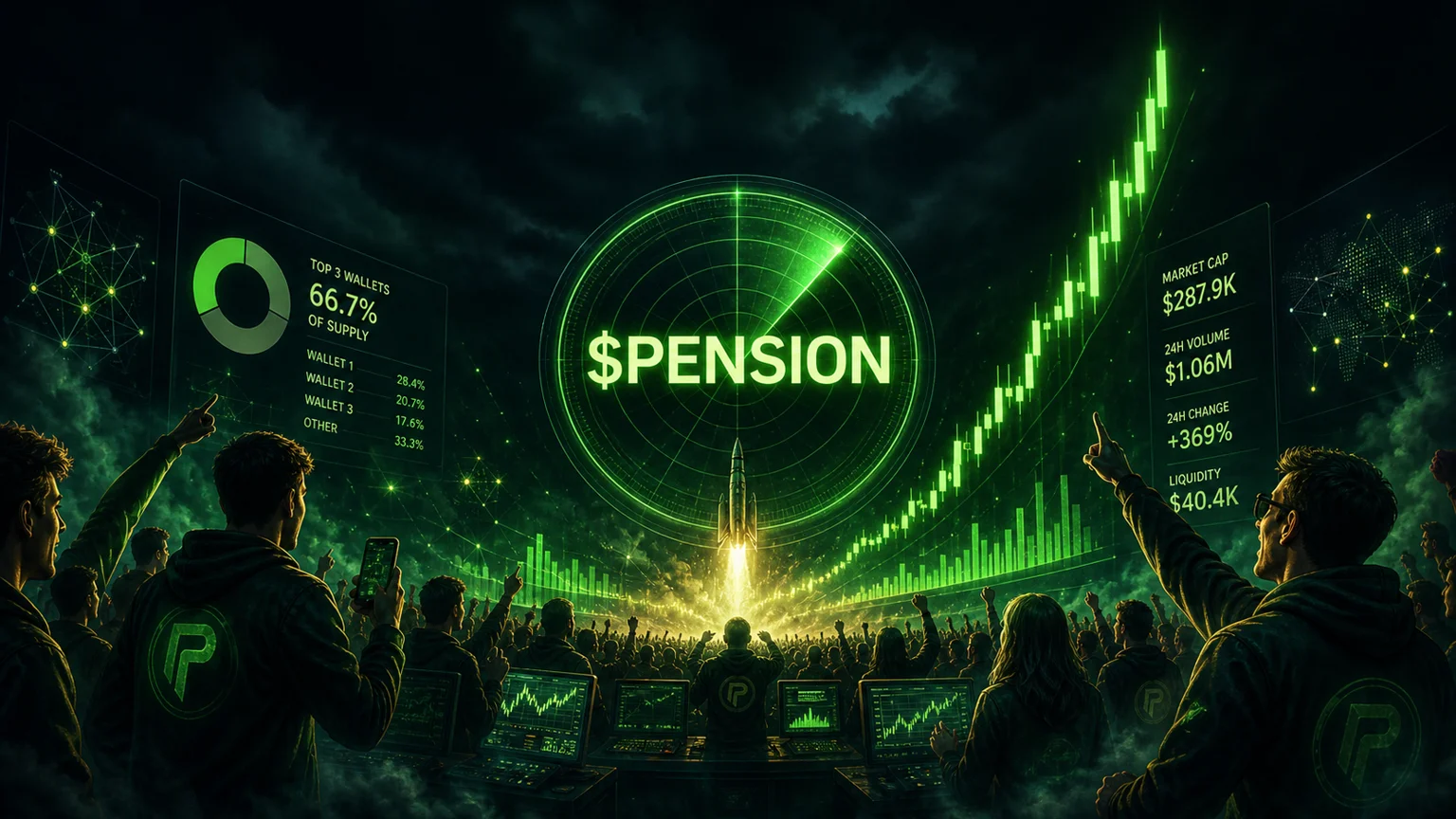
$PENSION does not show active freeze or mint authority, but the board is still structurally hostile because the top two visible wallets each hold roughly 30% of supply and the top-three cluster reaches 66.7% combined.
$PENSION is exactly the kind of fresh Solana board that forces a trader to separate meme quality from market quality. The meme itself is easy to understand. A token called The Green Bear does not need a manual, a launch thread, or a product diagram to travel across chats. It only needs one glance and a chart loud enough to make people care. By 2026-06-27 19:00 UTC, the chart had done that part. DexScreener showed roughly $1.06M in 24-hour volume, a market cap near $287.9K, about $40.4K in liquidity, and a 369% daily jump while the pair was still less than two hours old. That is not sleepy trench noise. That is a real first-burst market.
The problem is that first-burst markets can still be terrible boards. In meme trading, the same ingredients that create velocity can also create a trap. A fast ticker, a funny wrapper, and a volume number that looks much bigger than the market cap are usually enough to summon the second crowd. What matters is what the second crowd is actually walking into. With $PENSION, the answer is not a permissions nightmare. Freeze authority is off. Mint authority is off. The harder answer is the holder map. This board is being negotiated on top of one of the most concentrated cap tables you can still describe as tradable.
- → $PENSION reached roughly a $287.9K market cap with about $1.06M in 24-hour turnover and around $40.4K in liquidity by 2026-06-27 19:00 UTC, which is enough real tape to justify a serious launch-radar read.
- → The contract permissions are cleaner than the average same-day meme board, with no active freeze authority, no active mint authority, and a saved Rugcheck score of 34 rather than an obvious danger read.
- → The central risk is concentration: the top two visible wallets each control about 30% of supply and the top-three cluster reaches 66.7%, which means the board is still effectively a negotiation between a tiny set of holders and a much larger audience chasing the narrative.
Why the Green-Bear Wrapper Worked
The easiest mistake with a token like $PENSION is assuming the joke does not matter because the structure is messy. The joke matters a lot. Meme traders do not buy complexity early. They buy legibility. The Green Bear lands because it compresses a whole emotional frame into two words. Green means money, upside, and chart euphoria. Bear means the opposite. Smash them together and you get a phrase that feels contradictory enough to be meme-native without becoming too obscure to repeat. It is the kind of name that can survive the first scroll test, and that alone gives a fresh board a better shot at recruiting volume.
The saved tape suggests traders understood that instantly. More than 6,500 tracked transactions hit the pair across the 24-hour snapshot, with 2,664 buys against 3,870 sells. That split matters because it tells a more honest story than a simple green candle. $PENSION was not coasting on one neat vertical move. It was churning hard, which is exactly what happens when a meme concept lands fast enough to keep pulling in fresh participants even while early hands are already testing exits. The board feels active because it is active. The harder question is whether that activity is building ownership or just accelerating turnover.
That is also why the category fits launch radar rather than something more celebratory. The board is not interesting because the market discovered a hidden masterpiece. It is interesting because a simple culture-meme wrapper found traction quickly enough to produce seven-figure turnover on a sub-$300K board. In meme markets, that imbalance is the first sign of opportunity and the first sign of danger. When volume outruns valuation this aggressively, the chart can keep repricing if the next crowd decides the narrative still feels early. It can also snap back violently if the same crowd realizes too late that ownership never really broadened.
What the On-Chain Data Shows
The surface-level contract read is not the thing killing $PENSION. The saved security profile shows no active freeze authority and no active mint authority, which removes two of the cleanest scam vectors from the discussion. Rugcheck scored the token at 34. That is not a pristine reading, but it is also not the sort of catastrophic result that makes a board unpublishable on sight. The article does not need to invent hidden admin drama because the real market stress is already visible without it.
The real story is the holder map, and it is not subtle. The top visible wallet controls 30.0% of supply. The second wallet controls another 29.94%. The third adds 6.77%. Put together, the top three visible lines account for 66.7% of the token. That is an extreme concentration profile even by fresh Solana standards. Traders sometimes tolerate ugly distributions on very early boards if the concept is strong and the liquidity is building, but they should not confuse tolerance with safety. A cap table like this means the market is still dramatically dependent on a couple of actors choosing not to cash the joke all at once.
Liquidity provides only partial comfort. Around $40.4K in pool depth is enough to make the pair look real and enough to support a genuine first leg. It is nowhere near enough to make a two-wallet-heavy board forgiving. On a broader launch, forty thousand dollars of liquidity can sometimes absorb normal profit-taking without rewriting the chart. On a token where two addresses own almost 60% combined, the same depth looks much smaller. Liquidity is not just about whether buyers can get in. It is about whether larger holders can leave without turning the whole trade into a lesson.
Why the Board Still Has a Chance
A concentrated launch is not automatically dead. That is what makes $PENSION worth covering rather than dismissing. The concept is sticky, the volume is real, and the liquidity is big enough that the market has at least attempted to build an actual board around the joke. Fresh meme runners do not need perfect structure to survive day one. They need enough demand to outrun their own weaknesses. If the next crowd keeps deciding that a green-bear contradiction is funny enough to trade and early holders stay disciplined, the token can absolutely squeeze higher before the concentration issue forces the conversation.
There is another reason the setup can keep breathing: the current one-hour read was already negative 18.89% while the daily figure still looked explosive. That kind of pullback inside a larger green day can function as a test rather than a death sentence. Traders are clearly not arriving in a straight line anymore. Some are selling into the headline, others are trying to buy the first wobble, and the whole board is deciding whether the initial move was a single event or the start of a tradable range. On a healthier cap table that question would feel routine. On $PENSION, it becomes the whole game.
What would improve the case from here is simple and measurable. The holder base has to widen, liquidity has to deepen, and the next volume wave has to arrive without making the concentration picture even worse. That sounds obvious because it is. Launch-radar names either transition from first-burst theater into a broader market, or they stay trapped inside the power dynamics of the first table. $PENSION has enough traffic to attempt that transition. It does not yet have the ownership profile to claim it has completed it.
That is why the right editorial read is speculative rather than hostile. The board is not being dismissed because the underlying contract shell looks obviously malicious. It is being kept at arm's length because concentration this severe overwhelms almost every other bullish talking point. You can have a sticky meme, a million-dollar turnover print, and a lively pool. If two wallets still effectively control the atmosphere, later buyers are not stepping into an open market. They are stepping into someone else's room and hoping the hosts stay friendly.
🟡 $PENSION is a real launch-radar board with enough tape to justify attention, but it is still a concentration trade before it becomes anything cleaner. The bullish argument is straightforward: a memorable wrapper, about $1.06M in 24-hour volume, a sub-$300K market cap that can still move fast, and no active freeze or mint authority poisoning the shell. The reason the rating stays speculative is even more straightforward: the top two wallets each hold about 30% of supply, the top-three cluster reaches 66.7%, and roughly $40.4K in liquidity is not enough to make that ownership picture comfortable. If distribution improves, this can keep repricing. Until it does, the board belongs in the watchlist more than the victory lap.
What is $PENSION on Solana?
$PENSION is the ticker for The Green Bear on Solana, trading under contract address 562ve6KNpiCtzT2RcvJ9nuA8yBSZSV5GLkawEFGipump. At 2026-06-27 19:00 UTC, it was trading near a $287.9K market cap after about $1.06M in 24-hour turnover.
Why did $PENSION make launch radar?
Because the board printed real size quickly. The saved read showed roughly $1.06M in 24-hour volume, a 369% daily jump, about $40.4K in liquidity, and more than 6,500 tracked transactions while the pair was still under two hours old.
Does $PENSION look clean on-chain?
The contract permissions are cleaner than average, with no active freeze authority and no active mint authority. The main concern is distribution, not permissions, because the top three visible wallets control 66.7% of supply.
What is the biggest risk on $PENSION right now?
The biggest risk is that ownership is too concentrated for the current liquidity base. When two wallets each control roughly 30% of supply on a board with about $40.4K in liquidity, later buyers are heavily exposed to a very small set of holders.