$PATRON Goes 16x Fast, Then Runs Into a Holder-Map Test
$PATRON is a younger pump.fun burst with real early activity and clean authority flags, but the first wallet owns enough supply to make every breakout attempt a concentration check.
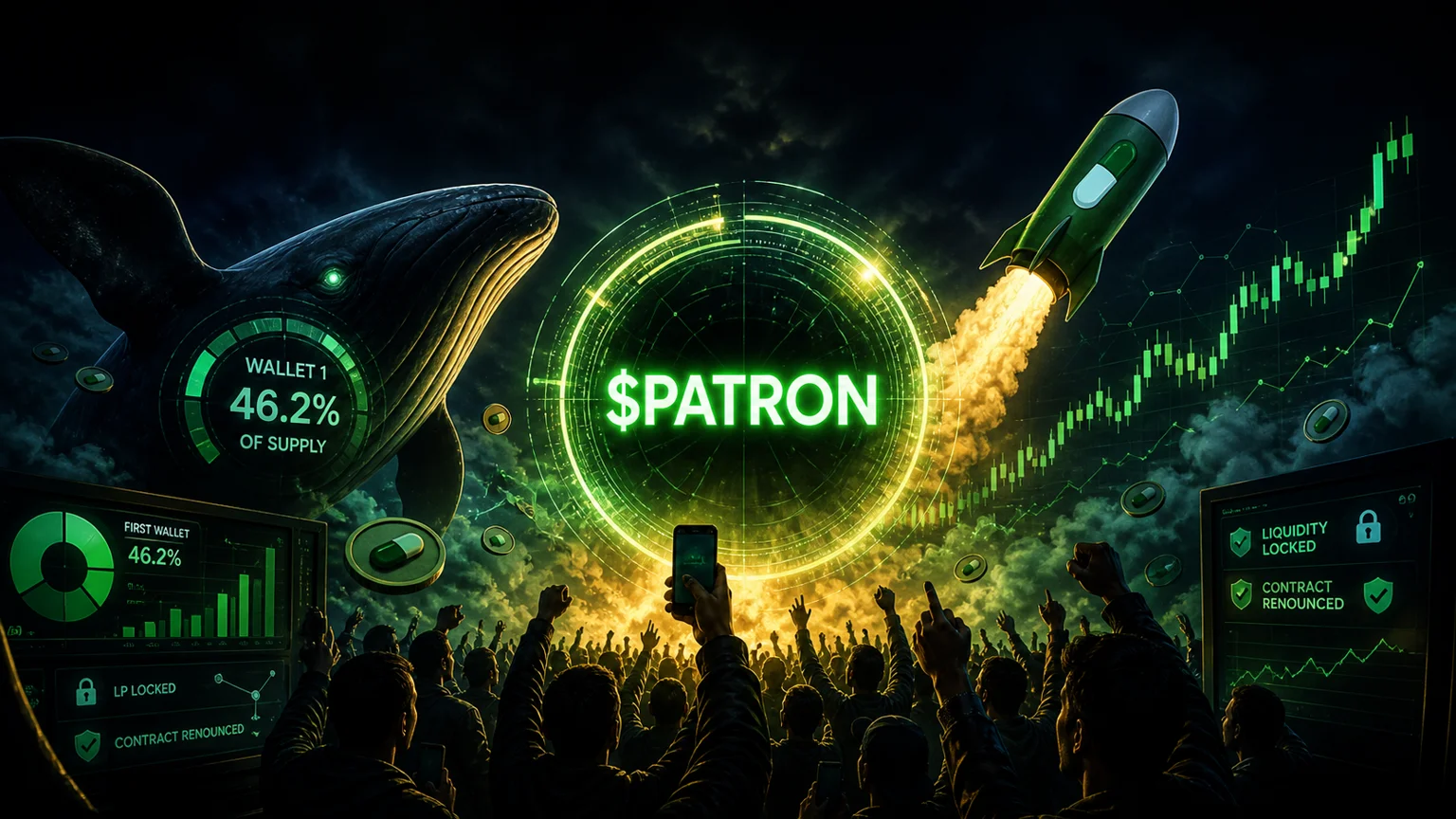
$PATRON is the kind of Solana launch that looks almost too fast to ignore. The early read shows a 1,626.3% one-hour expansion, roughly $79.2K in 24-hour volume, a market cap near $49.9K, and only about $7.5K in liquidity. That combination is exactly why the chart can feel electric and dangerous at the same time. A five-figure market cap can reprice brutally when buyers arrive, but the same tiny structure can punish anyone who mistakes speed for depth.
The more important $PATRON angle is not the 16x headline. It is the holder map. The token already has 151 holders, which is enough to show more than a single-wallet toy but not enough to prove broad distribution. The top wallet is listed at 18.2%, the next two at 5.34% and 2.86%, putting the top three around 26.4%. That is not an automatic death sentence in a brand-new pump.fun launch, but it is the whole caveat. When one wallet is close to a fifth of supply and liquidity is below $8K, market structure can change in one sell.
- → $PATRON printed a 1,626.3% one-hour move while the tracked market cap sat near $49.9K.
- → The pool is thin at about $7.5K in liquidity, which makes the 16x candle more fragile than it looks.
- → The top three holders combine for roughly 26.4%, with the largest holder around 18.2%, so concentration is the main on-chain test.
A 16x Candle With a Small Base
A move like $PATRON rarely comes from a mature market discovering a new consensus price. It comes from a tiny base getting hit by sudden demand. The tracked data shows 634 buys against 550 sells in the latest one-hour window, good for a buy ratio around 53.5%. That is a real fight rather than a dead chart. Buyers had the edge, but sellers were not absent. In early meme launches, that matters because it tells you the move already had opposition and still climbed.
The challenge is that $PATRON is still a small container for that energy. A $49.9K market cap and $7.5K of liquidity can make every incremental buyer look heroic. It can also make every exit look violent. If a token is going to survive beyond the first vertical candle, it needs to convert fast attention into either deeper liquidity, a larger holder base, or a meme strong enough that new buyers keep replacing early exits. $PATRON has the first part. The rest is still open.
What the On-Chain Data Shows
The basic authority checks are better than the usual worst-case launch. The available profile shows freeze authority disabled and mint authority disabled. That means there is no obvious freeze-transfer lever and no simple mint-more-supply lever in the data provided. The dev balance is listed at 0%, and Rugcheck gives the profile a score of 1. Those are constructive signals, especially for a pump.fun token that is still under an hour old at the signal timestamp.
But $PATRON is not a clean holder-map story. The first holder owns about 18.2%, the second about 5.34%, and the third about 2.86%. Together, the top three sit around 26.4%. The broader top-holder read is roughly 27.9%, so the concentration is not only one displayed wallet; it is the shape of the early float. A top wallet near 18% can be manageable if it is passive, but nobody should treat passivity as a fact before the market has seen a real drawdown. With only $7.5K in liquidity, that wallet does not need to sell much to change the mood.
Why the Holder Map Matters More Than the Meme
There is a temptation to treat a name like $PATRON as a pure culture bid because the ticker is easy, clean, and open-ended. It can mean sponsor, backer, supporter, benefactor, or just a word degens can bend into whatever joke the timeline wants next. That flexibility is useful, but it is not yet a moat. The data says the market has found a fast object to trade. It has not yet proved that the object has a durable identity.
That is why the holder concentration dominates the read. When a meme has not matured into a community story, the chart is still negotiating with supply. Early buyers are not only betting on attention. They are betting that the biggest holders will not turn the first real liquidity into an exit. A token can climb with a concentrated map, but the climb tends to require either obvious social heat or unusually sticky buyers. $PATRON has medium organic scoring in the enrichment data, which is better than a fully mechanical churn read, but medium is not enough to ignore the largest wallet.
The bull case is that $PATRON found a fast early bid before its holder base had time to broaden. The bear case is that the chart is already asking tiny liquidity to support a token where the largest holder controls about 18.2% of supply.
The Market Structure Test
The next healthy version of $PATRON would look boring before it looks spectacular. Holder count should rise without the top three expanding. Liquidity should move above the current five-figure danger zone. Volume should remain active after the first 1,600% number stops shocking people. If those three things happen together, the launch starts to look less like a candle chase and more like a small meme trying to find a market.
The unhealthy version is also easy to spot. If price keeps stretching while liquidity barely moves, the biggest holders gain more control over the exit. If volume fades but the chart stays elevated, the token becomes more vulnerable to a single sell. If holder count stalls near the current level, the market has not widened enough to absorb early profit-taking. None of those outcomes require a malicious deployer. They are basic mechanics when a small Solana coin has a large first wallet and a shallow pool.
Verdict
$PATRON is a speculative launch-radar watch built around holder concentration. The upside is obvious: a 1,626.3% first-hour move, real transaction activity, medium organic scoring, disabled freeze authority, disabled mint authority, no listed dev balance, and a low Rugcheck score. The problem is equally obvious: the largest holder is around 18.2%, the top three sit near 26.4%, and liquidity is only about $7.5K. That makes $PATRON a token where the next read should focus less on whether it can print another green candle and more on whether the holder map becomes less threatening while liquidity grows.
Why is $PATRON moving?
$PATRON showed a 1,626.3% one-hour move with more buys than sells in the tracked one-hour window and about $79.2K in 24-hour volume.
What is the biggest $PATRON caveat?
Holder concentration. The top wallet is listed near 18.2%, and the top three combine for about 26.4%.
Are $PATRON mint and freeze authorities disabled?
Yes. The available Solana profile shows mint authority and freeze authority disabled, which helps the contract-side read but does not remove market-structure risk.