
$NVIDUCK Is The Nvidia-Duck Parody With A Cleaner First-Hour Tape
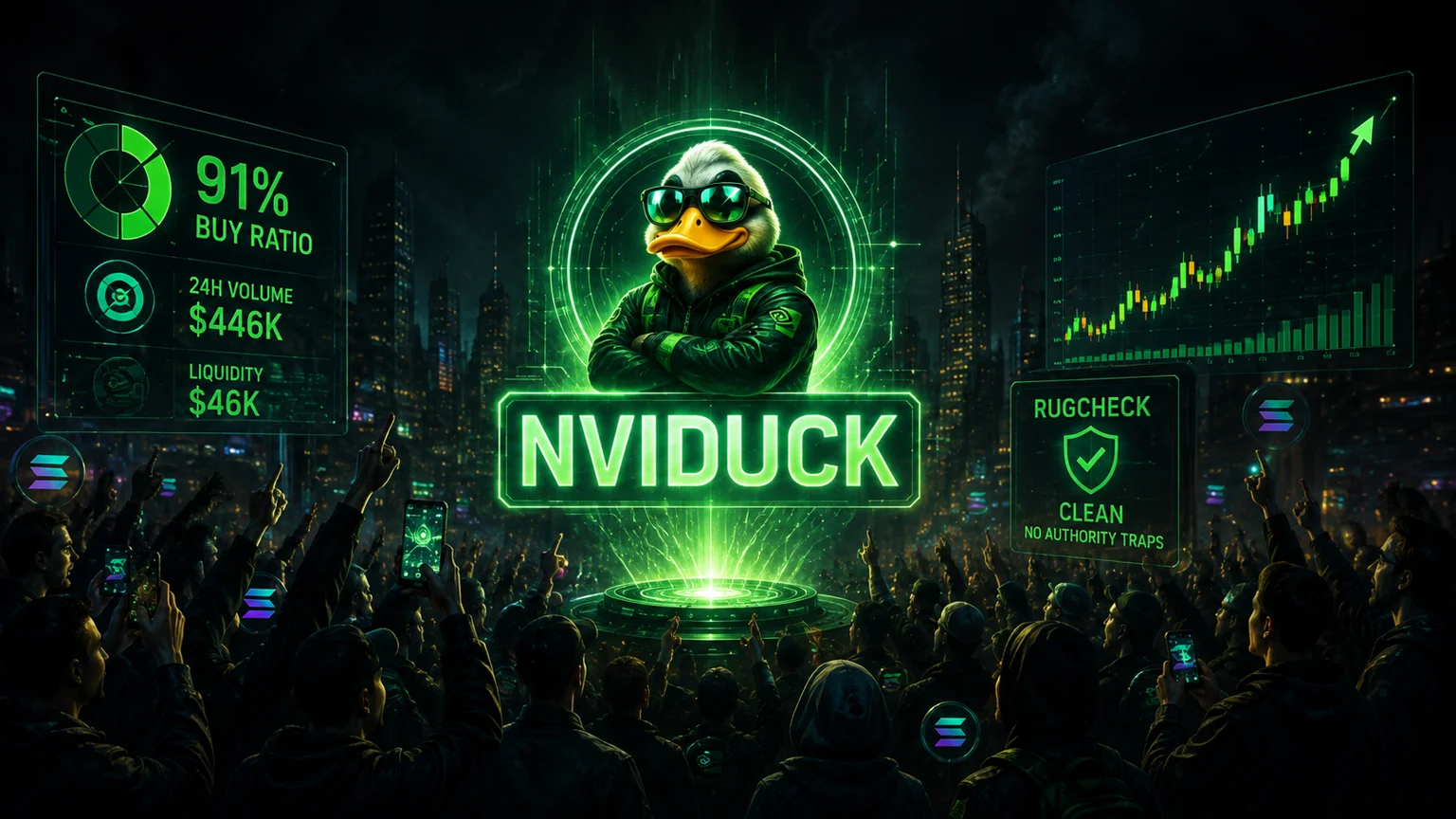
$NVIDUCK launched into heavy Solana demand with a 91% buy ratio, $446K in 24-hour volume, $46K liquidity, and a Rugcheck profile that does not show the usual authority traps.
Low Rugcheck score, disabled freeze and mint authority, and modest top-three holder concentration.
$NVIDUCK is exactly the kind of meme coin name that should sound too stupid to matter until the tape says otherwise. The pitch is not subtle: Nvidia attention, duck absurdity, Solana speed. In a market that keeps rewarding instantly legible parody, that can be enough to pull wallets into the same trade before a deeper story exists. The early data is why $NVIDUCK gets a cleaner-than-average launch-radar read: roughly $445.6K in 24-hour volume, a $294.9K market cap, $46.0K in liquidity, and a lopsided 91% buy ratio across 24-hour transactions.
That does not mean $NVIDUCK is safe. It means the first-hour profile is cleaner than most of the Solana nonsense that flies across the tape and disappears before lunch. The token is less than an hour old in the available pair-age read, has already printed 13,989 transactions, and is up roughly 288% over both the 24-hour and 1-hour windows. The latest 5-minute move is down about 9.83%, so the first shakeout is already showing. The question is whether that dip is normal launch digestion or the start of a full rotation out.
- → $NVIDUCK is trading near a $294.9K market cap after a fast Solana launch sprint.
- → The 24-hour transaction mix shows 12,738 buys against 1,251 sells, or about 91% buy pressure.
- → Rugcheck data shows disabled freeze and mint authority, a score of 1, and only 7.8% top-three holder concentration.
The Joke Is Obvious
The best early meme trades usually do not make people work. $NVIDUCK is not asking traders to decode lore. It attaches itself to Nvidia, one of the most recognizable market obsessions of this cycle, then undercuts the seriousness with a duck. That collision is dumb in the exact way meme traders understand. It gives the token a reason to be remembered, a ticker that can be repeated quickly, and a visual identity that does not need a dissertation.
That matters because new Solana launches compete against hundreds of other charts in the same feed. Most are just noise with a logo. $NVIDUCK at least has a clean mental hook: the AI-equity megatrade filtered through a cartoon bird. Cashtag collisions like this can catch bids because they let traders borrow attention from a larger narrative without pretending to be part of it. The market is not buying Nvidia exposure here. It is buying the meme version of Nvidia attention.
What the On-Chain Data Shows
The on-chain profile is the reason $NVIDUCK gets the clean label for now. Rugcheck data shows freeze authority disabled and mint authority disabled, which means two common launch traps are not visible in the current read. The normalized Rugcheck score is 1, and the provided risk list is empty. That is a notably clean first pass for a brand-new Solana meme, where plenty of charts fail before price action even gets a chance to matter.
The holder concentration is also not flashing the usual giant-wallet warning. The largest listed wallet controls 7.22% of supply, while the next two visible wallets sit at 0.31% each, putting the top-three concentration at roughly 7.8%. None of those listed top holders are marked as insiders in the provided profile. A 7.22% wallet can still move a small-cap token if it sells into weak liquidity, but this is not the same as a launch where half the supply is parked in a few suspicious hands.
Buy Pressure Is The Story
The standout number is not the 288% move. New tokens can print absurd percentages from tiny bases. The standout number is the transaction split: 12,738 buys against 1,251 sells. That is extreme demand pressure for a first read. It means wallets are not merely round-tripping the chart evenly; buyers have been dominating the flow. In launch trading, that kind of imbalance can create a reflexive loop where the green candles become the advertisement.
The liquidity profile gives that buy pressure more credibility than the average micro-pool sprint. About $46.0K in liquidity against a $294.9K market cap is still small, but it is healthier than the ultra-thin pools that can barely support a single medium-sized exit. This is why $NVIDUCK reads cleaner than a pure liquidity mirage. The pool is not deep enough to remove risk, but it is deep enough that the first move is not only a slippage illusion.
$NVIDUCK combines an easy narrative hook with strong buy pressure and a cleaner on-chain profile, which is why the early read is stronger than the average parody launch.
The Pullback Test
The negative 5-minute change matters because it is the first place hype meets patience. A 9.83% dip after a 288% sprint is not automatically bearish. It can be the normal churn that happens when early buyers take profit and new wallets decide whether the meme has more room. But it is also where weak launches start to reveal themselves. If the token cannot hold attention through the first profit-taking wave, the clean launch profile becomes trivia.
For $NVIDUCK, the key is whether buy pressure stays lopsided after the easy green candle is gone. The first wallets bought the joke and the chart. The next wallets need a reason to believe the joke can keep circulating. A parody token has to become social enough that traders want to quote it even when the chart is not vertical. That is the difference between a quick pump and a meme with a second act.
Bear Case
The bear case is that $NVIDUCK is still a very young Solana meme sitting below a $300K market cap. Clean authority flags do not create durable demand. A low Rugcheck score does not stop bored buyers from rotating into the next chart. The token has a website and social account listed, which helps the surface read, but the market still needs to prove that the Nvidia-duck joke has enough staying power after the first wave of buyers has already arrived.
The largest holder at 7.22% is not a dealbreaker, but it remains a wallet to watch because small-cap liquidity can change quickly. The 91% buy ratio is powerful while buyers are showing up, but it can also mean the first exit wave has not fully expressed itself yet. When a token runs hard this early, a clean profile should be treated as permission to keep watching, not as permission to ignore risk.
What Confirms The Move
The clean confirmation would be simple: $NVIDUCK holds a meaningful portion of the move, liquidity remains near or above current levels, and the buy/sell split normalizes without collapsing into panic. The market does not need the token to stay at a 91% buy ratio. In fact, a healthier next phase would probably look less extreme. What matters is whether sell pressure arrives without destroying the floor.
A higher holder count would help, but distribution quality matters more than raw count. If the top wallet does not expand, if freeze and mint authority remain disabled, and if liquidity keeps building while the meme circulates, $NVIDUCK can keep its cleaner launch-radar status. If liquidity drains or the first large wallet exits into the pool, the read flips quickly from clean runner to post-pump exhaustion.
$NVIDUCK earns a clean early read because the first available data lines up: strong buy pressure, decent launch liquidity, disabled freeze and mint authority, low holder concentration, and a very low Rugcheck score. The trade is still young and volatile, but the current signal is not a blind shill. It is a cleaner-than-average Solana parody launch that now has to survive its first pullback.
What is $NVIDUCK?
$NVIDUCK is a Solana meme token built around a Nvidia-duck parody, using the broader Nvidia attention cycle as a meme hook.
Why is $NVIDUCK rated clean?
$NVIDUCK has disabled freeze and mint authority, a Rugcheck score of 1, modest top-three holder concentration, and unusually strong early buy pressure.
What is the main risk for $NVIDUCK?
The main risk is age. $NVIDUCK is still a new small-cap meme, so the first pullback and liquidity behavior matter more than the initial percentage move.