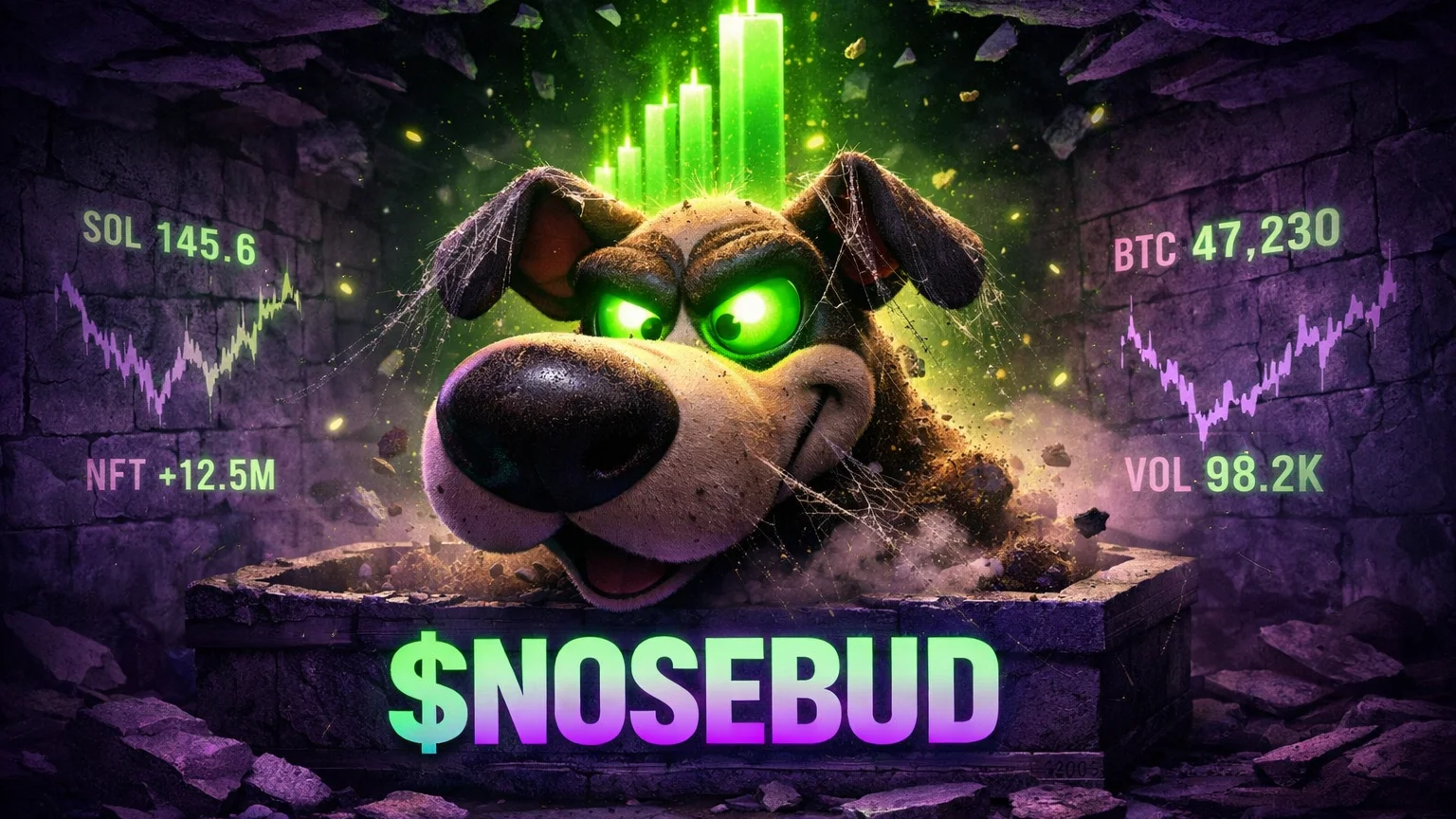
A 2-Year-Old Token Nobody Remembers Just Ripped 648% With $1.3M in Volume
$NOSEBUD launched in March 2024, flatlined for two years, then exploded past $256K market cap in a single session. The dog with the impossibly large nose is back — and 20,000 transactions in 24 hours say someone knows something.
Top holder at 34.5% is likely the Raydium LP pool. No freeze or mint authority. Clean rug score of 17.
At approximately 4:00 AM UTC on March 17, a token that most of Solana CT had long written off reappeared on DexScreener's trending page with numbers that don't make sense for a two-year-old micro-cap. $NOSEBUD — a meme coin built around a dog with a comically oversized nose — posted a 648% gain in 24 hours on $1.3M in volume, pushing its market cap past $256K from what was essentially flatline territory.
What Makes This One Different
Most meme coins that rip 600% are hours old. $NOSEBUD is two years old. That changes the math entirely. A token that survived two years of zero attention, zero volume, and zero narrative tailwinds suddenly doing $1.3M in daily volume means somebody — or a coordinated group of somebodies — decided this was worth reviving.
The premise is absurdly simple: a real dog with an impossibly large nose. The website describes it as a dog "with such ridiculous proportions and smelling capabilities, that all one must do is imagine the smell." The team has branded this as "Nose-Fi" — nose-powered decentralized finance — which is exactly the kind of deadpan absurdism that CT gravitates toward when the market is looking for fresh narratives.
The token launched stealth with no presale. LP was burnt and the contract renounced, which checks the basic safety boxes that degens look for before aping. Zero taxes on buys and sells. It's the vanilla meme coin formula executed cleanly — the question is why it's waking up now.
The Numbers So Far
Volume-to-market-cap ratio of 5:1 is aggressive for any token, let alone a two-year-old micro-cap. That ratio typically appears in fresh launches with manufactured hype — seeing it in a dormant revival is unusual and suggests either genuine organic rediscovery or a well-funded coordinated push.
The 6-hour numbers tell a more interesting story: $247K in volume with a 79% price increase in the most recent six hours. The 1-hour window shows things cooling — $24K volume, essentially flat price. That deceleration pattern is normal after a parabolic move, but it's the difference between "catching the trend" and "catching the top."
100 active DexScreener boosts are worth noting. Boosts cost money, and 100 of them means someone is spending real capital to keep $NOSEBUD visible on the trending page. That's either community-funded marketing or a single entity manufacturing visibility.
Who's Behind It
Rugcheck gives $NOSEBUD a score of 17 — well into "good" territory. No freeze authority, no mint authority. The original dev wallet holds zero tokens. LP was burnt at launch. On paper, this is about as clean as a meme coin gets.
The top wallet holds 34.5% of supply, but that address (5Q544f...) is the Raydium liquidity pool — not a single holder. After the LP, the next largest wallets hold 4.7% and 3.9%, which is healthy distribution for a micro-cap. No insider flags on any of the top holders.
Two warnings from Rugcheck: low number of LP providers and mutable metadata. The mutable metadata means the token's name, image, or description could theoretically be changed — an aesthetic risk more than a financial one at this stage, but worth flagging. The low LP provider count just reflects that this is a single-pair micro-cap on Raydium.
The project has a website (nosebudcoin.io), an active Twitter (@NoseBudCoin), and a Telegram group — more infrastructure than most sub-$300K tokens bother with. The creator has deployed zero other tokens, which rules out the serial deployer pattern.
The Zombie Revival Pattern
Dormant token revivals are their own micro-genre in meme coin trading. The playbook works like this: a token launches, builds some initial community, dies during a broader market downturn, then gets rediscovered when conditions align. The surviving community — however small — provides a nucleus that new buyers can rally around.
The advantage of a zombie play: the token has already been through its initial dump cycle. Anyone who was going to sell in frustration probably already did. What's left is a core of diamond-handed holders and a token with zero expectations — a low bar that makes any price action feel explosive.
The risk is equally clear: whatever killed momentum the first time might still be a problem. If the community couldn't sustain attention for two years, what's different now? A single pump doesn't prove durability — it just proves someone had enough capital and coordination to move a thin market.
The Bear Case
Liquidity at $176K is decent for this market cap, but the 1-hour data shows momentum fading. Volume dropped from $247K in the last 6 hours to just $24K in the last hour — a 94% deceleration. Buys and sells are nearly equal in the last 5 minutes (23 buys, 22 sells), which means the buying pressure that drove the 648% move has evaporated in the short term.
The 100 DexScreener boosts cut both ways. Organic revivals don't typically need paid visibility campaigns. Someone is spending to keep this on the radar — and when the boost budget runs out, so might the attention.
Mutable metadata remains a live risk. It's unlikely to matter at this price level, but it's the kind of detail that sophisticated traders notice and less experienced ones don't.
MemeDesk Verdict
Frequently Asked Questions
What is $NOSEBUD?
$NOSEBUD (Nose Bud) is a Solana meme coin launched in March 2024 featuring a real dog with a comically oversized nose. It launched stealth with no presale, burnt LP, and zero taxes.
Why is $NOSEBUD pumping after two years?
The token went from dormant to posting $1.3M in 24-hour volume with a 648% price increase. The catalyst appears to be community-driven rediscovery backed by 100 DexScreener boosts, though the exact trigger for the revival is unclear.
Is $NOSEBUD safe to buy?
Rugcheck gives it a score of 17 (good). No freeze or mint authority, LP was burnt, dev wallet holds zero tokens. The top wallet (34.5%) is the Raydium LP pool. However, mutable metadata is still active and the 1-hour momentum has slowed significantly.
Where can I buy $NOSEBUD?
$NOSEBUD trades on Raydium (Solana). The contract address is D8wLsSr9xFa8vS96tMK1rvckQRoEbH5XLRhqMRoXTbUr. Always verify the contract before swapping.