$MYLOO Ran 1,261% in Hours, but the Holder Map Already Looks Like a Crowded Chase
At the 2026-06-22 07:01 UTC selection snapshot, $MYLOO was trading near a $416.4K market cap on roughly $556.3K in 24-hour volume with about $48.1K in liquidity. The shell looks clean on first read, but only 156 holders and a 24.05% top wallet make this less about pure breakout momentum and more about whether a tiny board can survive its first real crowd.
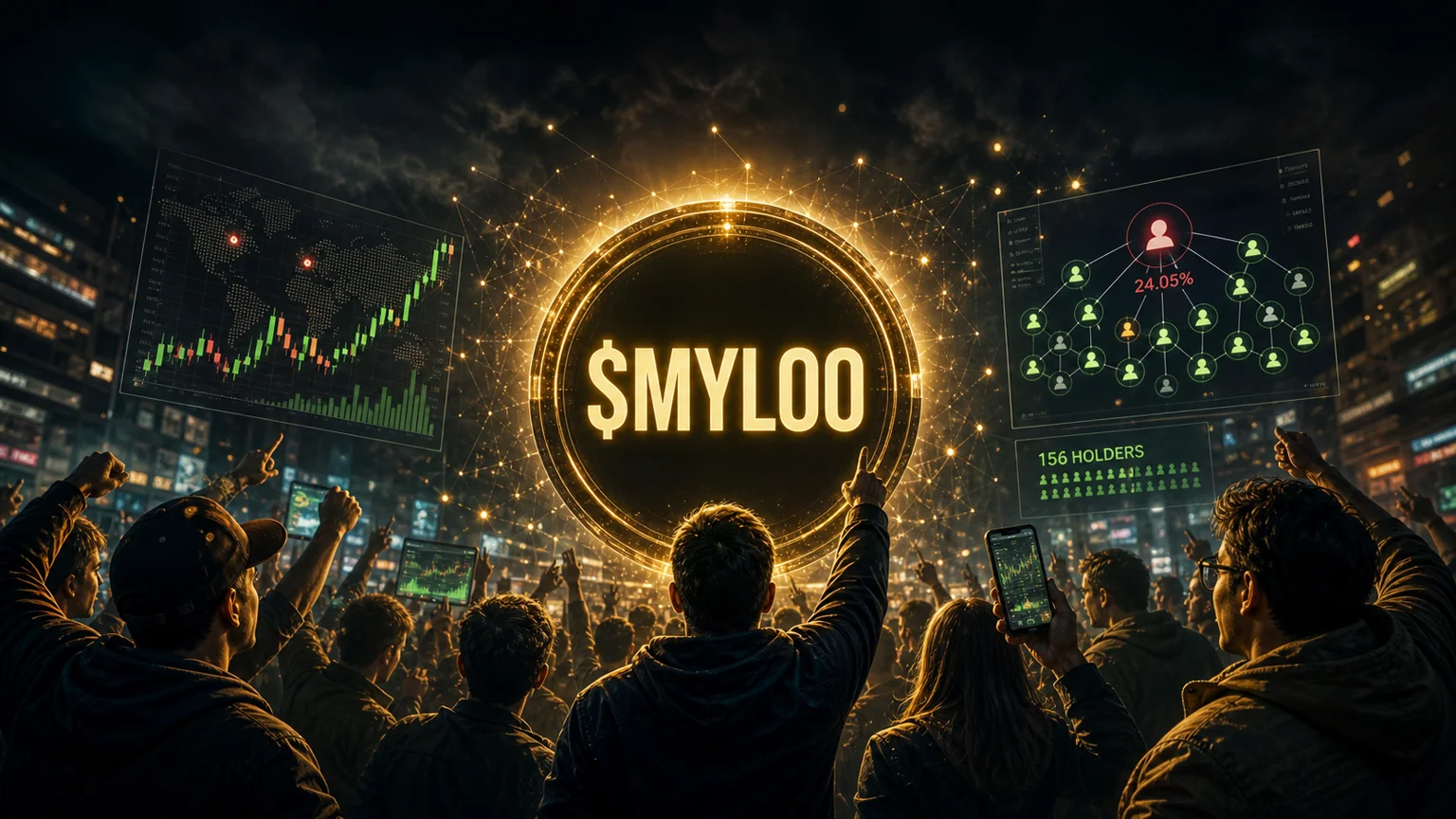
$MYLOO does not trip the obvious permissions alarms. Freeze authority is off, mint authority is off, Rugcheck scored the token at 1, and the pump.fun LP read shows 100% of the visible liquidity pool locked. The real tension sits in ownership and pace: only 156 holders were visible in the saved read, the largest wallet held 24.05% of supply, and the creator had launched five other tokens within the same morning window.
There is a very specific kind of Solana launch that traps traders precisely because it looks too alive to question. $MYLOO fits that pattern better than the raw 24-hour gain suggests. By the saved 2026-06-22 07:01 UTC selection snapshot, the token was already trading near a $416.4K market cap on roughly $556.3K in 24-hour volume with about $48.1K in liquidity. A 1,261% day like that will force almost anyone in meme land to at least open the chart. The problem is that the number that matters most is not the percentage gain. It is how little real distribution the board had built by the time the crowd started treating the move as confirmed.
That is why the clean editorial angle here is holder concentration rather than simple breakout momentum. Plenty of fresh boards can post a huge candle in the first two or three hours if the meme is sticky enough and the buy flow is aggressive enough. Much fewer can do it while also broadening ownership quickly enough to make the move sustainable. $MYLOO had the first part down. The board was loud, fast, and easy to understand. The second part is where the risk starts. At the same saved read, Rugcheck only showed 156 holders and a single visible wallet controlling 24.05% of supply. That is not fatal on its own, but it is tight enough that every new buyer needs to understand they are stepping onto a board where a few hands still matter a lot.
- → $MYLOO ripped 1,261% in 24 hours and processed roughly $556.3K in turnover while the pair was only about 2.4 hours old, which is exactly the kind of speed that makes a mascot launch feel inevitable.
- → The shell looks calmer than the chase. Freeze authority was off, mint authority was off, Rugcheck scored the token at 1, and the visible pump.fun LP read showed fully locked liquidity.
- → The real problem is board breadth: only 156 holders were visible in the saved profile, the largest wallet held 24.05% of supply, and the top three wallets controlled about 34.1%.
Why the Burst Looked Bigger Than the Board
On the surface, $MYLOO had all the first-hour ingredients traders love. The buy flow was one-sided enough to feel urgent, with 22,522 buys against 6,204 sells in the saved enrichment, and the last-hour gain was still another 36.65% even after the bigger 24-hour move had already printed. Those are the sort of numbers that can create instant social proof. Nobody wants to be the person overthinking a board that is already moving. But that emotional shortcut is exactly how crowded first prints happen. Volume can tell you a lot about attention. It tells you much less about how safely a board can absorb profit-taking once the first wave decides the easy part is over.
The more useful way to read the tape is to compare scale to depth. Roughly $556.3K of turnover against about $48.1K of liquidity is not automatically broken for a fresh pump.fun graduate, but it does tell you how little room the market has for sloppy exits. This was not a mature board with layers of patient bids underneath it. It was a very young board getting hit with more attention than its ownership structure had time to digest. That distinction matters because the faster a token outruns its holder base, the more every retrace becomes a test of whether there are actually enough independent buyers to keep the floor from turning into a vacuum.
What the On-Chain Data Shows
The first positive point is that the permissions file is not screaming at traders. Freeze authority was disabled in the saved profile. Mint authority was disabled too. Rugcheck scored the token at 1, and the pump.fun AMM read showed the visible LP stack fully locked. That removes the laziest bear case. Nobody needs to invent a scary contract story just to explain caution here. If $MYLOO loses altitude, it is more likely to happen because of the way the market is distributed than because a hidden admin lever suddenly changes the token economics.
The second point is the one that matters more. The largest visible wallet held 24.05% of supply in the saved read. The next two visible wallets held another 5.65% and 4.24%, bringing the top-three tally to about 34.1%. On a board with only 156 holders, that is meaningful concentration. Even if some of those wallets belong to market structure rather than a single directional actor, the practical lesson is the same: the token has not achieved broad handoff yet. In a healthier first-day board, attention starts spreading across hundreds or thousands of holders fast enough that no single visible wallet dominates the emotional read. $MYLOO was not there yet.
The Deployer Pattern Adds a Second Layer
There is another detail in the saved on-chain profile that keeps this from earning a cleaner rating. Rugcheck showed the creator had launched five other tokens in the same morning window before $MYLOO arrived. That does not automatically make the board toxic. Solana meme culture is full of serial deployers, and sometimes one of those rapid-fire launches catches the right joke at the right moment. It does, however, change how traders should think about conviction. A deployer who is spraying multiple mints in a tight cluster is usually running a discovery process, not building a single high-conviction long-term project. In other words, the board may be real enough for a trade without being real enough for a story traders should romanticize.
That tension shows up in the branding too. The public site leans hard into the cartoon identity and tries to sell a carefree mascot experience rather than an infrastructure-heavy roadmap. That is normal for this corner of the market. The issue is not that the brand is unserious. Meme coins are supposed to be unserious. The issue is that the market has already priced a lot of early excitement into a token whose ownership is still narrow and whose creator behavior reads more like iterative launch experimentation than singular focus. When that happens, the meme can remain funny even while the trade gets much less forgiving.
Where the Crowd Can Get Stuck
A 1,261% move can make traders feel late only for a few minutes, then very late all at once if concentrated holders start using the excitement as exit depth.
The permissions shell looks calm, but only 156 holders and a 24.05% top wallet mean the board still depends on a very small number of meaningful hands.
A creator who launched five other same-window tokens gives the move a faster, more opportunistic feel than a board growing from one obvious high-conviction launch.
This is why $MYLOO reads more like a crowded chase than a clean first-day handoff. The best version of the bull case is straightforward: the meme caught, the tape is active, and the clean contract shell gives traders permission to keep pressing as long as demand keeps refreshing. That case is not imaginary. The problem is that the market is already asking a lot from new buyers. It is asking them to keep sponsoring a board that has moved hard, is still very young, and has not yet dispersed ownership enough to make the next leg feel structurally comfortable. On Solana, that setup can keep working longer than skeptics expect. It can also reverse with almost no warning.
The upgrade path is simple even if it is not easy. $MYLOO would need a broader holder count, a less top-heavy visible map, and evidence that liquidity can expand with price instead of lagging behind it. If those things happen, the current concentration becomes less dangerous because the market starts proving it can absorb size without every green candle turning into a distribution opportunity. Until then, the board deserves respect as a live trade and caution as a structure. That is not a contradiction. It is the normal state of an early Solana meme that won the first round of attention before it finished building the conditions for a second one.
$MYLOO earns a speculative rating because the obvious contract red flags are not the story, but the ownership profile still is. Roughly $556.3K in 24-hour volume, a 1,261% day, freeze authority off, mint authority off, and a Rugcheck score of 1 make the board tradable. The reason it stays yellow is that only 156 holders were visible in the saved profile, the top wallet still held 24.05% of supply, and the creator had already launched five other tokens in the same window. That is enough to keep this as a signal to watch rather than a clean board to trust blindly.
What is $MYLOO on Solana?
$MYLOO is a Solana meme token under contract address 3HHTWR8mSdWGmNfH1gSpsFWvysWJ2DUwpmTsnTz1pump. At the saved 2026-06-22 07:01 UTC snapshot, it was trading near a $416.4K market cap.
Why is $MYLOO rated speculative instead of clean?
The contract shell looked calm, with freeze authority off, mint authority off, and a Rugcheck score of 1. The bigger issue was ownership. Only 156 holders were visible in the saved profile, the top wallet held 24.05% of supply, and the top three wallets controlled about 34.1%.
Does the creator history matter for $MYLOO?
Yes, because Rugcheck showed the creator had launched five other tokens in the same morning window. That does not prove the board is broken, but it does make the setup look more opportunistic and faster-moving than a single high-conviction launch.
What would improve the $MYLOO setup from here?
A broader holder count, lower visible concentration in the top wallets, and a deeper liquidity stack growing alongside price would all make the trade look healthier. Without that handoff, every new burst of demand can double as exit depth for earlier holders.