
$MSFT Turns a Microsoft Ticker Joke Into a Solana Volume Bid
$MSFT is not moving because the joke is subtle. It is moving because a cat parody just printed $1.6M in volume, $104K in liquidity, and a clean authority read inside its first few hours.
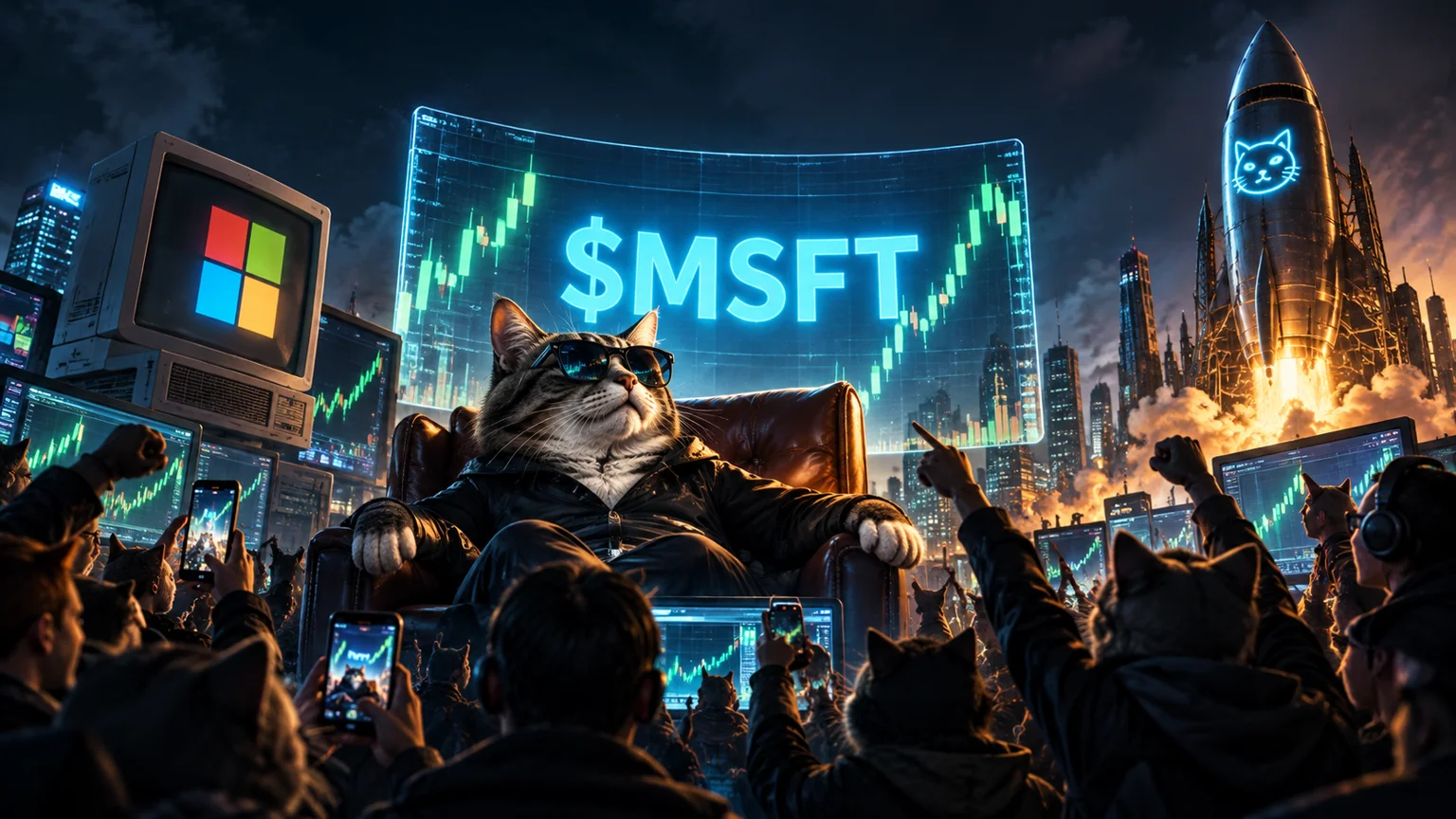
$MSFT is the kind of meme trade that does not ask the market to solve a puzzle. It borrows one of the most recognizable tickers in equities, straps it to a Solana cat character, and lets the cashtag collision do the first hour of marketing. That alone would normally be too thin to cover. The reason this one clears the bar is the tape: roughly $1.63M in 24-hour volume, a $1.39M market cap, $104.2K in liquidity, and a buy side that was still responsible for nearly three quarters of counted transactions at the snapshot.
The useful read is not that $MSFT is a serious Microsoft proxy. It is not. The read is that Solana traders are still paying for memes that can hijack attention instantly. A ticker people already recognize is a shortcut, and a cat wrapper gives it the degen-native shape. At 10:01 PM UTC on September 8, $MSFT was about 4.4 hours old and already doing the kind of turnover that separates a throwaway chart from something the market has to actively reject.
- → $MSFT printed $1.63M in 24-hour volume against a $1.39M market cap, enough churn to make the ticker joke tradeable instead of purely cosmetic.
- → Liquidity was listed at $104.2K, a healthier pool than many same-day Solana launches, though still thin enough for violent candles.
- → The first authority read is clean: no freeze authority, no mint authority, a Rugcheck score of 0, and no listed creator-token history.
Why the Ticker Matters
Meme coins do not need deep lore when the symbol itself creates the first click. $MSFT benefits from that immediately. The ticker is familiar before the token is explained, which is exactly why these parody launches can move before anyone has decided whether the joke is good. Traders see a legacy-market symbol, a cat, a live chart, and a Solana address ending in pump. The whole trade is compressed into one screen.
That compression cuts both ways. Cashtag collision can pull attention fast, but it can also burn out fast because the joke is obvious to everyone at the same time. There is no slow discovery curve if the entire pitch is visible in the ticker. $MSFT therefore has to turn the first laugh into repeat volume. If the trade remains only a Microsoft-adjacent sight gag, the chart eventually has to find a new buyer with less novelty left to sell.
The Numbers Behind the Move
The market data is what makes $MSFT more than a cute symbol. Price was listed near $0.001401, with market cap and FDV both around $1.39M. Volume stood near $1.63M over 24 hours, which means the token had already traded more than its market cap during a launch window of roughly four and a half hours. That is not a quiet launch gradually finding bids. That is a crowd rotating in and out quickly enough to build real chart pressure.
The transaction mix gives the bulls their best argument. The scanner counted 36,617 buys against 12,753 sells, a buy ratio around 74.2% across 49,370 total transactions. On a microcap meme, that does not guarantee conviction. It can include bots, tiny entries, and traders flipping fast. Still, a pool does not reach this level of participation by accident. The market had enough appetite to keep hitting the buy button even after the first vertical move was already visible.
The Pullback Is the Test
The chart was not all green. The same snapshot that showed $MSFT up 1,537% over 24 hours also showed a -15.03% move over five minutes. That is normal for a hot Solana launch, but normal does not mean harmless. The first real sell wave tells you whether the trade has a community forming underneath it or whether the market was just passing the bag around until the music paused.
For $MSFT, the healthier version of the story is simple: liquidity holds above six figures, volume remains active after the first flush, and the token builds a higher base instead of drifting back toward launch levels. The weaker version is just as simple: the ticker gets exhausted, buyers stop treating the dip as a second entry, and the same recognizable symbol that pulled traders in becomes a crowded exit sign.
What the On-Chain Data Shows
For a Solana token this young, the on-chain read is cleaner than the usual first-pass warning sheet. The available Rugcheck data shows freeze authority disabled and mint authority disabled. Those two points matter because they remove two of the easiest mechanical dealbreakers: a controller freezing transfers or expanding supply after traders have already entered.
The same profile shows a normalized Rugcheck score of 0, no listed risks, no creator-token history, and no creator token count in the provided enrichment. Holder concentration is less complete here than it is for some fresh launches because the top-holder array came back empty in the selected data. That means the clean read should be treated as an absence of obvious authority flags, not a full guarantee that every wallet is distributed well.
That distinction is important. $MSFT has the authority profile traders want to see, but liquidity depth and holder behavior still decide whether the chart can survive pressure. A $104.2K pool is strong for a same-day meme, yet it is not deep enough to make large holders irrelevant. The current on-chain setup earns a cleaner rating because the obvious contract controls are off, while the remaining risk sits in market structure rather than a visible mint or freeze lever.
$MSFT is a cashtag-collision trade with unusually loud early liquidity. The ticker gets attention, but the second wave of volume decides whether the meme becomes more than a one-session parody.
What Would Upgrade the Read
The cleanest upgrade would be boring: hold the million-dollar market-cap zone, keep liquidity near or above the current range, and continue printing volume without every green candle immediately getting sold. Meme traders often overcomplicate these launches, but the first durable signal is whether buyers keep accepting higher prices after the easy multiplier is gone.
The other upgrade is cultural. A ticker joke can open the door, but it needs recurring posts, remixes, and recognizable imagery to stay alive. $MSFT already has a website and an X account attached to the chart. If those become distribution rather than decoration, the token has a better chance of turning attention into identity. If they stay quiet while volume fades, the whole setup becomes a clever ticker wrapped around a cooling pool.
$MSFT gets a clean launch-radar read, not because meme coins are safe, but because the current data shows strong early participation, six-figure liquidity, disabled freeze and mint authorities, and no obvious Rugcheck risk in the selected profile. The trade is still young, crowded, and vulnerable to sharp pullbacks. The question now is whether the Microsoft-ticker cat joke can keep attracting real volume after the first attention spike.
What is $MSFT on Solana?
$MSFT is Meme Solana Feline Token, a Solana meme coin using a Microsoft-style ticker collision with cat-meme branding.
Why is $MSFT on MemeDesk radar?
$MSFT drew attention after posting about $1.63M in 24-hour volume, $104.2K in liquidity, and heavy buy-side transaction flow during its first few hours.
What is the main risk for $MSFT?
The main risk is market structure. The authority profile is clean in the available data, but a young meme coin with thin relative liquidity can still reverse violently if buyers stop defending dips.