$MARIO64 Is the Nostalgia Trade With a Cleaner Holder Map
$MARIO64 turned Nintendo-era memory into one of the faster Solana meme launches of the session, with stronger liquidity and a less crowded top-holder spread than most early pump.fun boards.
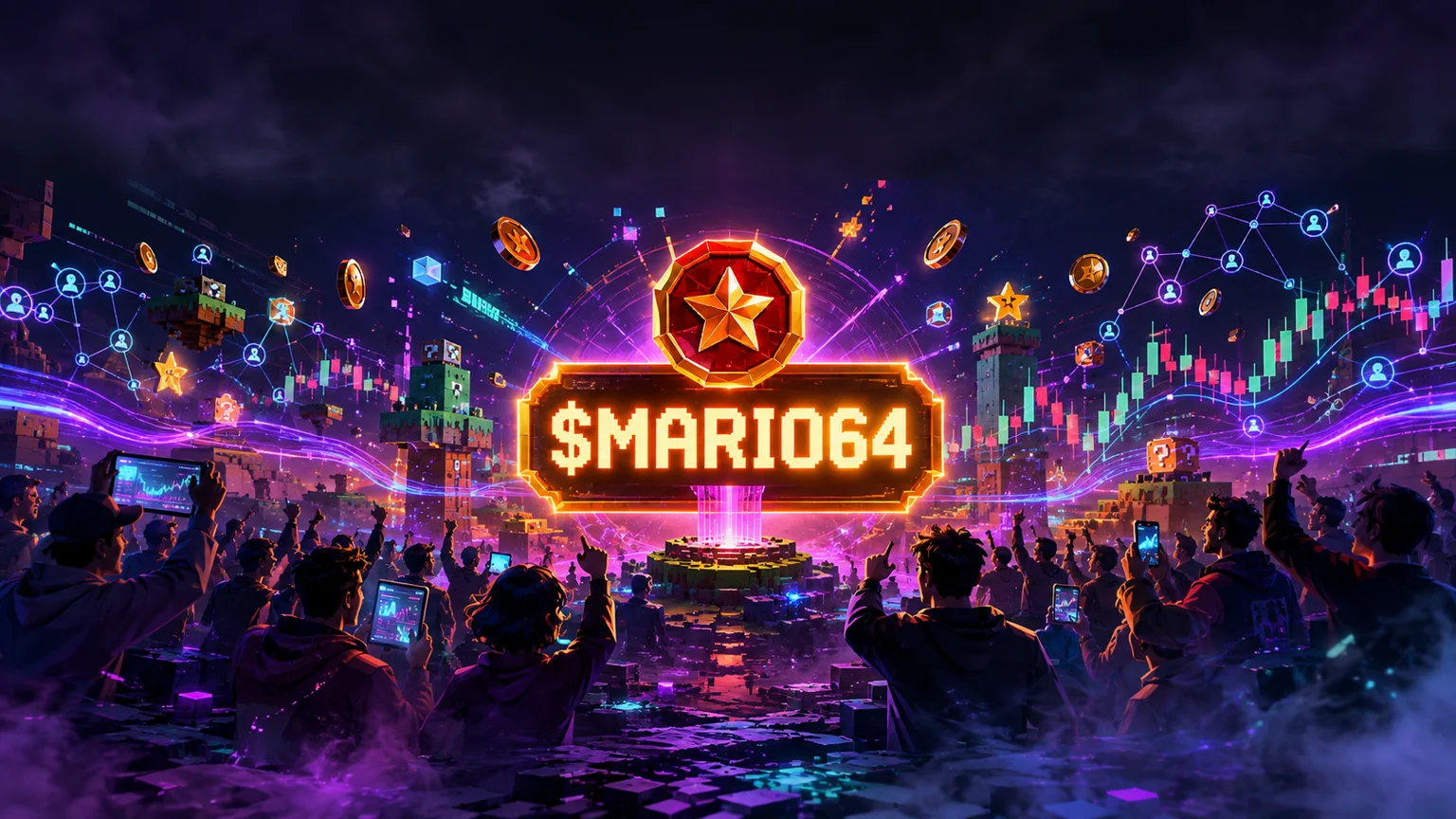
$MARIO64 has clean mint and freeze authority settings, low visible top-three concentration, and deeper launch liquidity than many same-session pump.fun runners.
$MARIO64 is the kind of meme launch that does not need a long explanation before the bid arrives. The market sees the ticker, remembers the cartridge-era reference, and immediately knows the lane: nostalgia, speed, and a familiar cultural object being remixed into Solana risk. By 9:29 AM UTC on August 11, $MARIO64 had already pushed to a $612K market cap with roughly $2.01 million in 24-hour volume and a 12,559% 24-hour move from the early board.
The reason this one deserves a cleaner read than the average nostalgia derivative is not the brand reference alone. Meme markets recycle childhood symbols every day. The stronger point is that $MARIO64 paired the recognizable hook with better launch mechanics: about $65.6K in liquidity, 1,985 holders, a top-three holder cluster near 9.1%, and disabled mint and freeze authorities. That does not make the token safe. It does mean the first on-chain pass is less hostile than most same-day Solana rockets.
- → $MARIO64 reached a $612K market cap roughly 6.5 hours after the tracked launch window.
- → The token posted about $2.01M in 24h volume with a 52.9% one-hour buy ratio.
- → Top-three holder concentration is about 9.1%, with mint authority and freeze authority both disabled.
The Nostalgia Reprice
Nostalgia is one of the easier meme bids to understand because it compresses a lot of emotional recognition into a single ticker. $MARIO64 is not asking traders to learn a new character or decode a new meta. It is tapping a shared reference that already lives rent-free in internet culture. The trade is less about a formal connection to a gaming giant and more about the way meme markets borrow symbols, strip them down, and turn recognition into liquidity.
That can be powerful in the first session. A token with an instantly readable meme has a lower friction path from chart to group chat to new buyer. $MARIO64's 744% six-hour move shows that the market did more than briefly click the chart. It repriced the idea through several waves of rotation. The one-hour gain of 63.4% at the snapshot also says the move was still active rather than purely historical. A lot of launch-radar names arrive already exhausted; $MARIO64 still had pressure on the bid.
Why the Structure Looks Better
The standout detail is liquidity. $MARIO64 had about $65.6K in liquidity at a $612K market cap. That is still early-stage and still volatile, but it is a healthier relationship than the micro-pools that often sit under explosive pump.fun charts. Liquidity is not a guarantee that holders can exit cleanly, especially when a meme is moving this fast. It does, however, give the chart more room to absorb normal rotation without instantly turning every sell into a cliff.
Volume also looks more believable when it is not absurdly disconnected from the pool. $MARIO64's $2.01M in 24-hour volume is large, but it is not sitting on a five-figure pool so tiny that the whole trade becomes a slippage warning. The market still has to prove that volume can hold after the first recognition burst, but the starting structure is more balanced than many same-session launches that rely on pure velocity and hope liquidity catches up later.
What the On-Chain Data Shows
$MARIO64's on-chain profile is the main reason the signal can lean clean rather than purely speculative. The token shows freeze authority disabled and mint authority disabled, removing two immediate control risks that matter on Solana launches. The supplied holder data shows 1,985 holders, with the top three listed wallets holding about 9.1% combined. The largest visible holder is 4.97%, followed by 2.08% and 2.02%, and those top entries are not flagged as insiders in the available profile.
The dev profile is also quiet in the right way. The normalized rug score is 1, no risk warnings are listed, and the creator-token count is 0 in the supplied data. That is not a promise about what the chart does next; meme tokens can dump for ordinary market reasons with no contract trick involved. But it does mean the most obvious authority and concentration traps are not the first story here. For $MARIO64, the cleaner read is that market attention is the variable to watch, not an immediate on-chain control flaw.
The Demand Test
The one-hour transaction mix showed 2,354 buys and 2,096 sells, giving $MARIO64 a buy ratio just under 53%. That is not euphoric dominance, but it is enough to keep an early meme moving when the cultural hook is doing work. More importantly, the token had already produced 32,045 transactions in 24 hours. That points to a live board, not a sleepy pool waiting for a single wallet to create the whole chart.
The next market question is whether the nostalgia trade becomes social behavior or stays as a one-session chart. A durable $MARIO64 run needs holders to build around the joke: edits, replies, quote posts, and a recognizable style that makes the ticker travel without needing the candle to do all the marketing. If the community can turn the reference into a repeatable meme format, the token has a better shot at surviving the first major cooldown.
$MARIO64's cleanest signal is the combination of recognizable meme fuel and a low top-holder cluster. The risk is that nostalgia gets priced quickly, then attention rotates before the community catches up.
Where the Trade Can Break
The bear case starts with speed. A 12,559% 24-hour move is not a calm accumulation chart. It is a launch that has already paid early buyers many times over, which means profit-taking pressure is real even when the contract read is clean. The more violent the first move, the less patience later buyers tend to have. If $MARIO64 loses the hourly bid, the same traders who celebrated the nostalgia angle can become mechanical sellers very quickly.
The second risk is legal and cultural ambiguity around borrowed icons. Meme markets constantly riff on famous characters and franchises, but the market does not always price the attention span correctly. A ticker can benefit from instant recognition while still having no official connection, no permission, and no durable narrative beyond the reference itself. That means $MARIO64 has to be treated as a culture-meme bid, not as a brand-backed asset.
$MARIO64 gets the cleaner launch-radar label because the current data shows a stronger structure than most early Solana nostalgia plays: deeper liquidity, low visible top-three concentration, disabled mint authority, disabled freeze authority, and no obvious risk warning in the supplied dev profile. The market risk is still high because the chart has already moved violently and the meme needs to become more than a familiar reference. For now, $MARIO64 is one of the better-structured culture-meme bids on the board, with continuation depending on whether attention turns into community instead of just another fast rotation.
What is $MARIO64?
$MARIO64 is a Solana pump.fun meme token using a Nintendo-era nostalgia reference as its core market hook.
Why is $MARIO64 rated clean here?
$MARIO64 has disabled mint and freeze authorities, about 9.1% top-three concentration, no visible top-holder insider flags, and more liquidity than many same-day launches.
What should traders watch next for $MARIO64?
The key watch is whether liquidity, holders, and social behavior keep expanding after the first nostalgia repricing, or whether the move becomes a fast one-session rotation.