$LR Printed $3.4M of Solana Volume in Barely Two Hours, but 59.6% of Supply Still Sits With Three Wallets
Ledger Realms reached roughly a $1.41M market cap on about $3.43M in 24-hour turnover by the 10:05 PM UTC selection snapshot, with a high organic score and more than 2,300 holders already on the board. If that demand is real, $LR has the velocity to force another repricing fast. If the market focuses on the fact that three wallets still control 59.6% of supply, the same breakout can unwind just as quickly.
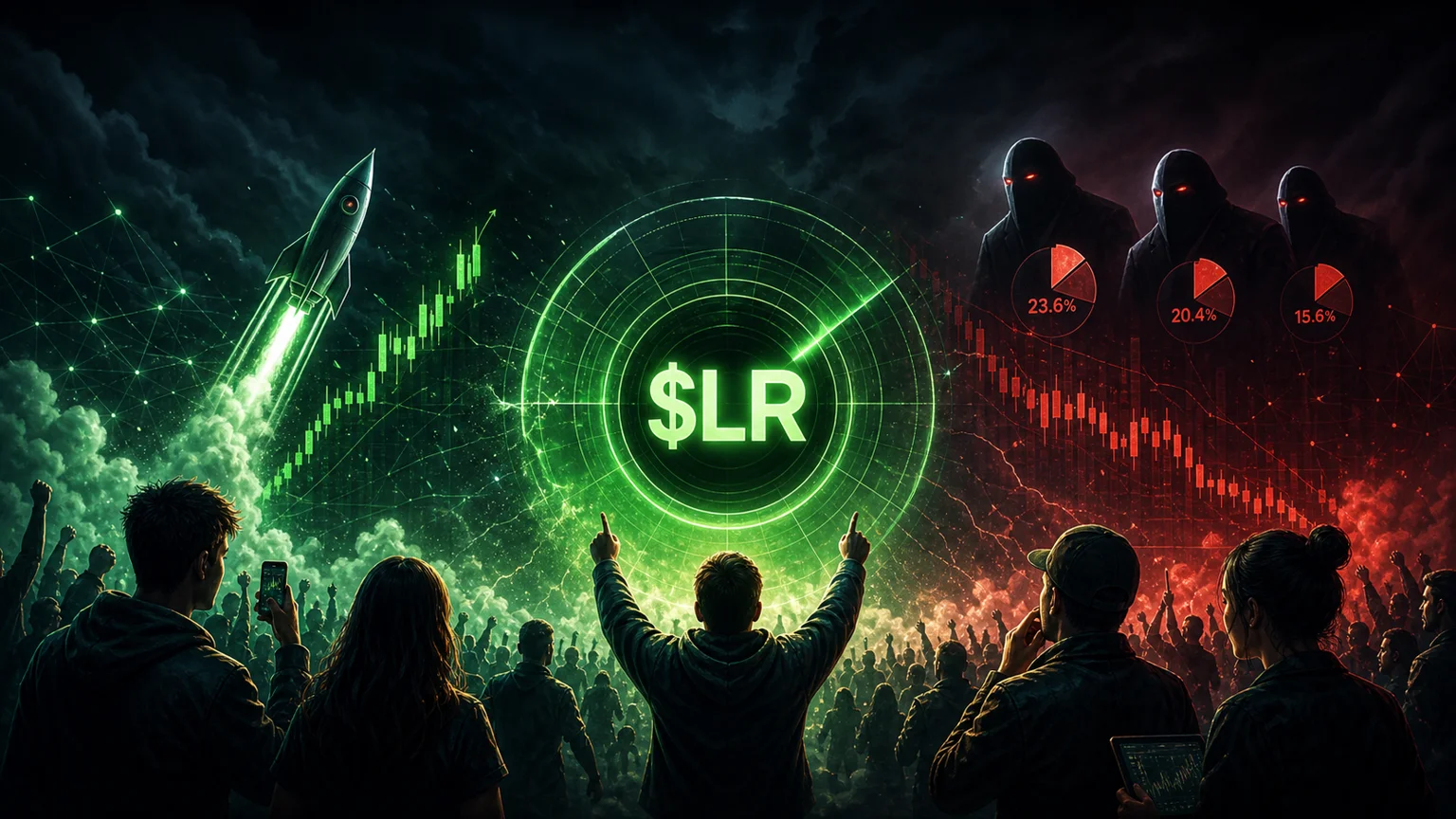
Rugcheck scored $LR 50 with freeze and mint authority disabled, so the contract shell is not the immediate problem. The real issue is concentration: the top three wallets still account for 59.6% of supply, including a dev wallet near 19.39%.
$LR made the board because the tape was too loud to ignore. The first handoff landed at 7:39 PM UTC, and less than three hours later Ledger Realms was already sitting near a $1.41M market cap after processing roughly $3.43M in 24-hour volume. When a launch does more than twice its own market cap in turnover before most traders have even learned the name, it stops being background noise and becomes a real test of whether momentum can outrun structure.
The obvious hook is velocity, but velocity is only half the story. The saved profile tagged the board with a high organic score of 83.2, which matters because plenty of first-session charts are just bot churn disguised as price discovery. $LR looks more complicated than that. There appears to be real curiosity and real flow here. The catch is that the holder map is tight enough to make every bullish read conditional.
- → $LR reached roughly a $1.41M market cap with about $3.43M in 24-hour turnover by 10:05 PM UTC, which is huge volume for a board only about 2.4 hours old.
- → The participation mix looked active rather than sleepy: about 40,493 total transactions, more than 2,300 holders, and a 67.46% one-hour move kept the breakout alive into the selection snapshot.
- → Freeze authority is off and mint authority is off, but the top three wallets still control 59.6% of supply and the dev wallet alone sits near 19.39%.
What Makes This One Different
Most two-hour Solana launches that print a flashy chart are easy to dismiss because the tape and the story never line up. Either the volume is too small to matter, the meme is too generic to travel, or the holder map is so ugly that nobody with real scars wants to touch it twice. $LR is worth writing up because it is hitting the screen with enough actual business to force a judgment call. The name is broad and legible enough to recruit curiosity without needing a lore document, and the board already has a market-structure problem that is interesting to parse instead of boringly fatal at first glance.
The Numbers So Far
The strongest bullish number is still the turnover-to-age ratio. $LR did about $3.43M of 24-hour volume while the pair was only around 2.4 hours old. That means the board did not need a full session to prove it could attract constant interaction. More than 40,000 transactions and a holder count above 2,300 tell you this was a broad scramble, not a sleepy insider circle pretending to be busy. In meme markets, that kind of participation is a real asset because fresh buyers trust a crowded board more than a perfectly engineered one.
The second useful number is the buy ratio, and here the read gets more nuanced. At roughly 51.3%, the split is positive but not euphoric. That suggests there was enough two-way trade to keep price discovery honest instead of turning the whole move into a single-file squeeze. Pair that with a one-hour gain of 67.46% and you get a chart that still had upward urgency without looking completely detached from actual order flow. The weakness is liquidity. About $90.6K is enough to make the tape exciting and nowhere near enough to make it durable by default.
What the On-Chain Data Shows
On the contract side, $LR is not waving the usual immediate danger flags. Freeze authority is disabled. Mint authority is disabled. The saved Rugcheck profile did not surface an ugly named-risk list, and the normalized score came in at 50, which is not pristine but also not the kind of reading that kills a launch on contact. If all you looked at were the authority keys, you could talk yourself into a cleaner-than-average first-session board. That is exactly why the holder data matters so much more here. The shell is not the problem. The distribution is.
The largest visible wallet held 20.93% of supply at the snapshot. The dev wallet was the second-largest visible holder at 19.39%. A third wallet held another 19.29%. Put those three together and you are looking at 59.6% of the token sitting in a tiny cluster. None of those wallets were explicitly flagged as insider accounts in the saved profile, but that does not neutralize the risk. Holder concentration is still holder concentration, whether it comes with a warning sticker or not. If one of those wallets decides the early breakout has paid enough, the chart does not need a scandal to roll over. It only needs one concentrated seller to discover how thin ninety thousand dollars of liquidity really is.
That concentration also changes how the holder count should be read. Seeing 2,332 holders in the first few hours sounds excellent, and it is directionally better than a board with no breadth at all. But breadth at the tail does not erase concentration at the top. In practice, $LR currently looks like a launch with real market curiosity layered underneath a power structure that still has too much influence over the next move. The clean interpretation is that early distribution has not fully finished yet and the big wallets will continue dispersing into strength. The darker interpretation is that the public is building the liquidity runway that those wallets eventually use.
Why Degens Are Still Looking Anyway
Because meme traders do not get paid for only buying perfect structures. They get paid for recognizing when demand is strong enough to temporarily overpower flaws that everybody can already see. $LR has one of those profiles. The board has a huge first-session footprint, the move stayed alive deep into the evening UTC window, and the organic score implies the action was not just a laboratory experiment run by bots. There were no confirmed KOL callers tied to the selection, which actually makes the move more interesting in one respect: the tape seems to be doing the recruiting by itself.
The practical line to watch from here is simple. If volume keeps outpacing market cap growth, liquidity deepens, and the top-wallet share starts loosening as the session matures, $LR can earn an upgrade from noisy breakout to real board. If volume fades while the same wallet cluster keeps most of the supply, the market will eventually realize it was paying for motion more than structure. That is the whole trade distilled down: not whether $LR can move, because it already proved that, but whether it can distribute fast enough to deserve the next move.
Verdict
🟡 $LR deserves launch-radar attention because the demand is real enough to matter, but it does not deserve a clean badge while three wallets still control 59.6% of supply. The bull case is obvious: multi-million-dollar turnover, a high organic score, more than two thousand holders, and a chart that was still accelerating late into the UTC window. The bear case is just as obvious: the holder map is tight, the dev wallet is still large, and $90.6K of liquidity is not much protection if one large holder decides the crowd has done enough work. Treat this as a live momentum signal with structural strings attached, not as a solved breakout.
FAQ
What is $LR on Solana?
$LR is the ticker for Ledger Realms on Solana, trading under contract address 32e2Rpw2ZLLhSaoVwMn4Vyx3vkHG6xCPRiyXrPJYpump. At the 10:05 PM UTC selection snapshot it was near a $1.41M market cap after roughly $3.43M in 24-hour turnover.
Why did $LR hit launch radar so quickly?
Because the board paired very fast turnover with sustained activity. The saved snapshot showed about 40,493 transactions, more than 2,300 holders, a 67.46% one-hour move, and a pair age of only around 2.4 hours.
Does $LR look clean on-chain?
Only partially. Freeze authority is off and mint authority is off, which removes two common contract risks, but the holder map is still tight. The top three visible wallets controlled 59.6% of supply in the saved profile, including a dev wallet holding roughly 19.39%.
What is the biggest risk for $LR right now?
Concentration more than contract design. The token has strong early demand, but with nearly 60% of supply sitting in three visible wallets and only about $90.6K of liquidity, one bad unwind could hit the chart hard.
What would improve the $LR setup from here?
Deeper liquidity, continued heavy turnover, and lower top-wallet concentration as more supply spreads into the market. If those pieces improve while the chart keeps holding bids, the breakout starts to look more durable.