
$LINGO Rips 493%, But the Exit Door Is Only $12.7K Wide
$LINGO has the kind of violent pump.fun ignition that gets every degen screen flashing, but the real story is whether nearly half a million dollars of volume can keep moving through a very small liquidity pool.
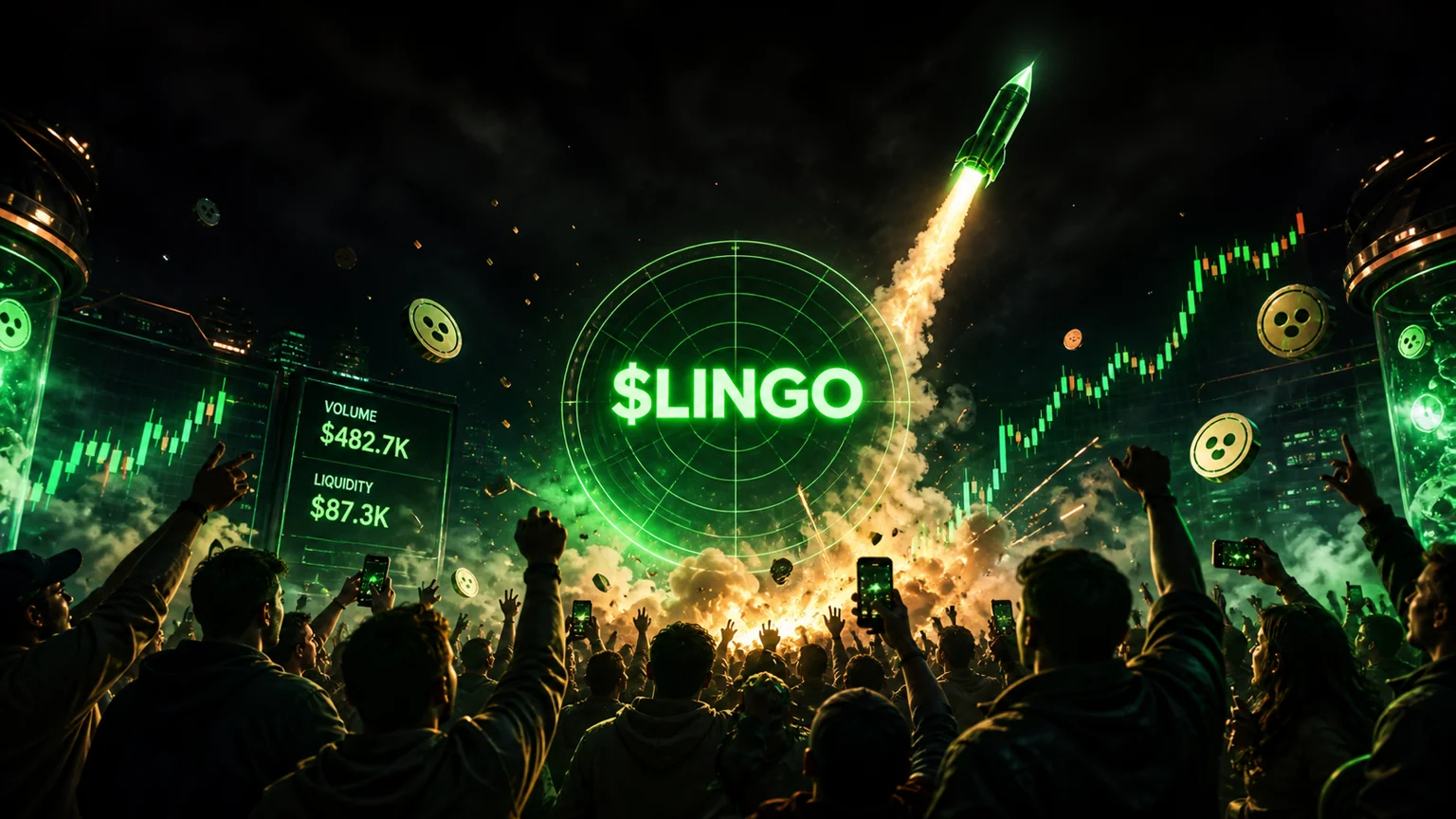
$LINGO did not creep onto the Solana radar. It arrived like a tiny pump.fun match dropped into dry grass: a 493.1% one-hour move, roughly $490K in 24-hour volume, and almost 10,000 tracked transactions while the pair was still barely old enough to have a chart. That is the kind of launch that forces attention before a broader narrative has time to form. It also creates the first hard question: when a token at a roughly $117K market cap is moving that much volume through about $12.7K of liquidity, is the market discovering a new meme bid, or is it building a very crowded doorway?
The answer is not clean enough for a green light. $LINGO has useful early positives: 625 holders, a buy/sell split that is active rather than dead, no visible dev balance, mint authority disabled, freeze authority disabled, and a Rugcheck score sitting at 1 in the available profile. Those are better ingredients than the average five-minute Solana coin. The issue is that the trading velocity is already much larger than the liquidity cushion. When volume runs at more than 38 times the pool depth, every candle can look decisive until a single coordinated exit makes the chart admit how shallow it really is.
- → $LINGO is up 493.1% in the first tracked hour, with about $490K in 24-hour volume against a roughly $117K market cap.
- → Liquidity is only about $12.7K, so the current tape can move fast in both directions and slippage matters more than the headline percentage.
- → The on-chain profile is cleaner than many launches: mint and freeze authority are disabled, the dev balance is listed at 0%, and the top three holders combine for about 16.8%.
The Liquidity Trap Under the Candle
The cleanest way to read $LINGO is as a liquidity-trap story, not a simple momentum story. A 493% hourly print tells you demand showed up. It does not tell you whether that demand can absorb sellers once early entrants start marking profit. On a deeper pool, $490K of volume might suggest a broad market discovering fair value. On a $12.7K pool, it can also mean the same coin is being passed aggressively through a narrow lane while every buyer believes the next buyer will pay higher.
The buy/sell mix helps explain why the chart kept moving without becoming an obvious one-sided wash. The latest one-hour window shows 5,063 buys and 4,920 sells, a near-even fight with buyers slightly ahead. That is not a silent bundle sitting untouched. It is an active market. But active does not automatically mean healthy. In thin Solana launches, equal activity can still be dangerous because it means there are enough sellers to test every green candle, and not enough pool depth to make that test graceful.
This is where a lot of launch coverage gets lazy. The market cap is small enough for degens to imagine a clean 10x path. The volume is high enough to make the ticker feel alive. The authority flags are clean enough to remove the easiest contract-risk objection. But the liquidity number is the center of the article. If $LINGO is going to turn from a fast pump.fun flare into something tradable beyond the first rotation, liquidity has to either grow or the candle will keep depending on a fragile stream of new buyers.
What the On-Chain Data Shows
The Solana profile is not screaming rug on the basic checks. Freeze authority is disabled, which means the deployer is not showing an obvious ability to freeze holder transfers. Mint authority is disabled, which removes the most direct unlimited-supply risk. The listed dev balance is 0%, and the available Rugcheck profile gives $LINGO a score of 1. For a brand-new pump.fun name, that is a cleaner base than the usual mess of hidden permissions and giant creator inventory.
Holder concentration is also workable at this stage. The top wallet is listed around 12.04%, with the next two around 2.44% and 2.30%, putting the top three near 16.8%. The broader enrichment read shows top holders around 21.9%. That does not make $LINGO safe. It does mean the danger is less about one obvious whale owning the whole chart and more about whether a thin pool can survive normal early profit-taking. A 12% top holder can still matter when liquidity is only five figures, but the map is not the kind of instant-disqualifier concentration that turns the story into a warning label by itself.
Why the Volume Looks Bigger Than the Market
The strange part of $LINGO is that its volume is already several multiples of its market cap. That can happen in violent launches because the float is constantly repriced by short holding periods, quick flips, and repeated entries. It can also reflect automated churn around a new token that is easy to trade but hard to trust. The organic label in the enrichment data is low, and that should keep the read grounded. A low organic read does not prove the move is fake, but it weakens the case that this is a broad community accumulation phase.
That distinction matters because the meme itself has not yet done the work. $LINGO has a simple name, a clean ticker, and pump.fun velocity. It does not yet have a visible culture hook strong enough to explain why buyers would keep rotating in after the first chart tourists leave. When the story is mostly price, price has to keep behaving. Once price wobbles, the thesis has nothing else to lean on except the next burst of volume.
The bullish version of $LINGO is a cleaner-than-average pump.fun launch that found attention before the broader crowd caught it. The bearish version is simpler: $490K of volume has already squeezed through a pool with only $12.7K of liquidity, and that can reverse faster than late buyers expect.
The Trade-Off for Degens
The practical read is that $LINGO is not a token to judge from the percentage candle alone. The percentage move is the advertisement. The pool depth is the risk. A trader watching this from here would want to see liquidity expand alongside holder count, not just another burst of buys. If market cap rises while liquidity stays pinned near the current level, the setup gets more fragile with every green candle.
There is also a timing problem. A token that is only about 10 minutes old at the signal timestamp has not had time to prove how it handles a real sell wave. Early Solana launches can look distributed simply because the first holder map has not yet had time to settle into its final shape. The next meaningful data is not another screenshot of the pump. It is whether the holder count rises without the top wallets swelling, whether the pool deepens, and whether volume stays active after the first adrenaline leaves.
Verdict
$LINGO earns a speculative watch, not a clean endorsement. The contract-side profile is better than average for a fresh Solana meme: mint and freeze authority are disabled, the dev balance is listed at 0%, and the top three holders are not absurdly dominant. But the liquidity trap is real. A $117K market cap token doing $490K in volume through $12.7K of liquidity can look explosive and still be extremely fragile. The upgrade path is simple: deeper liquidity, more holders, and price holding after the first wave. Until then, $LINGO is a fast tape with a narrow exit.
Why is $LINGO on MemeDesk radar?
$LINGO posted a 493.1% one-hour move with about $490K in tracked volume while still sitting near a $117K market cap.
What is the biggest $LINGO risk right now?
Liquidity. The pool is only about $12.7K, so normal profit-taking can move the chart sharply.
Does $LINGO have obvious authority risks?
The available Solana profile shows mint authority and freeze authority disabled, which removes two common launch risks, but it does not remove market or holder risk.