$KIRBY Has the Kind of Clean Solana Runner Tape Traders Keep Hunting, but the Holder Map Still Has Work to Do
$KIRBY reached the 2026-06-21 16:05 UTC selection snapshot at roughly a $157.1K market cap with about $453.3K in 24-hour volume and close to $29.6K in liquidity. The contract read is cleaner than average for a same-day Solana board, yet concentration near the top of the holder map means this is still a live test, not a solved breakout.
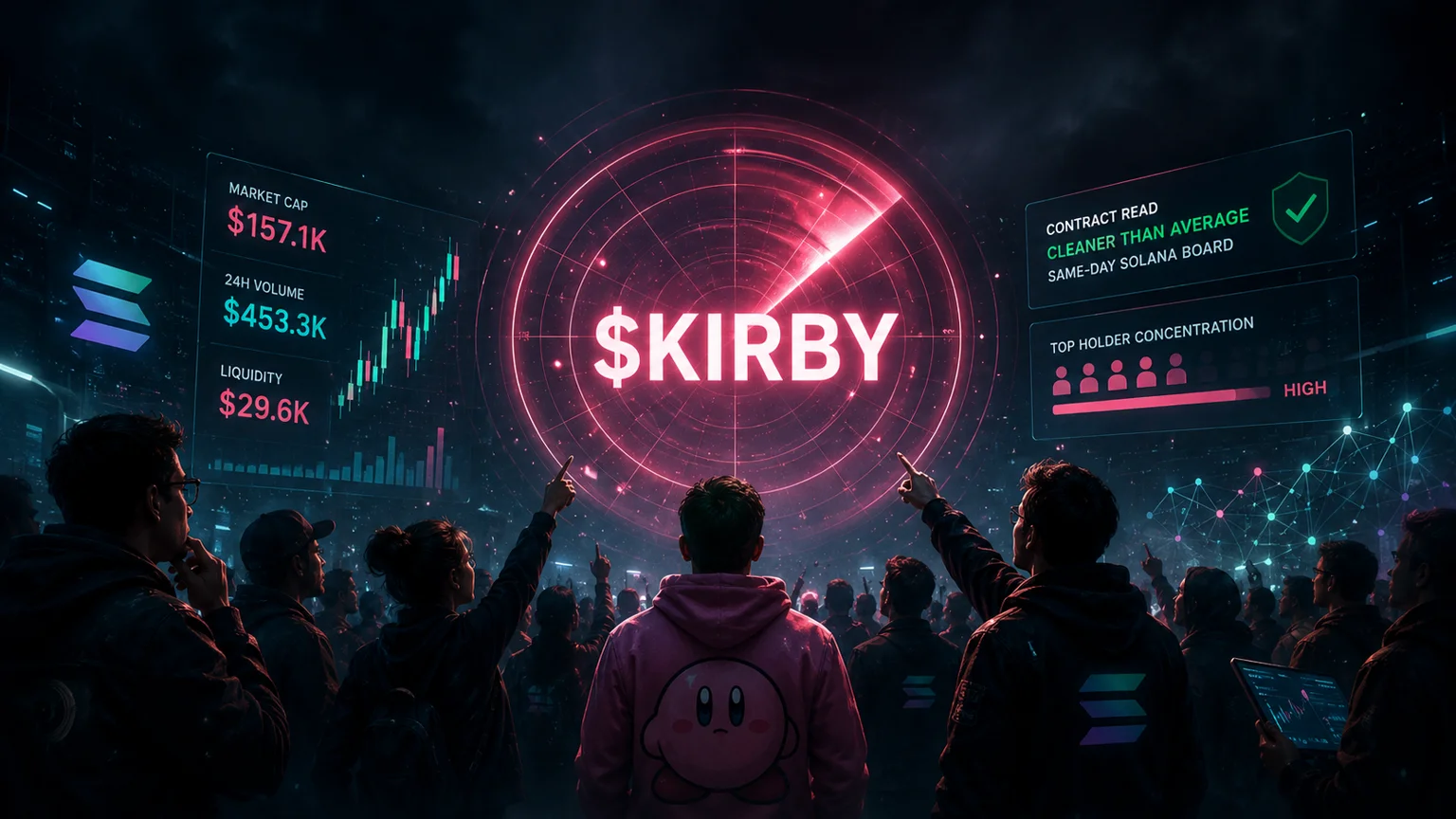
$KIRBY looks cleaner than most fresh Solana launches on contract settings, but the top wallet still controls 20.69% of supply and the top three wallets sit near 37.3%, so the board still needs broader ownership before the move can be treated as fully stable.
The right way to read $KIRBY is not as a guaranteed moonshot and not as another disposable launch-day blur. It is a cleaner-than-average Solana runner that still has to earn a looser holder map. At the 2026-06-21 16:05 UTC selection snapshot, $KIRBY was sitting near a $157.1K market cap after roughly $453.3K in 24-hour volume with close to $29.6K in liquidity. That is enough churn to make the chart relevant fast, especially only 3.82 hours into its life. The reason this board is worth more than a passing glance is that the contract-level profile does not immediately scream trouble. Freeze authority is off. Mint authority is off. Rugcheck scored the token 1. Those are the kinds of basic settings traders keep hoping to find before the crowd fully crowds in. The catch is that cleaner settings do not automatically create broad ownership, and broad ownership is still the part $KIRBY has to prove.
That distinction matters because the market is already paying attention. A 422% daily move with about $136.9K in the last hour alone says this is not a sleepy pair being kept alive by one or two wallets moving inventory around. Real interaction is happening. The danger is that strong early interaction can make traders stop asking the harder question, which is whether the board is actually distributing or simply circulating inside a setup that still depends on a few large holders behaving well. $KIRBY looks better than the average same-day launch in the obvious places. The actual trade read depends on whether that cleaner tape can survive the less obvious structural stress.
- → $KIRBY reached roughly a $157.1K market cap with about $453.3K in 24-hour volume and nearly $29.6K in liquidity at the 2026-06-21 16:05 UTC snapshot, which is real activity for a pair only 3.82 hours old.
- → Freeze authority is off, mint authority is off, and Rugcheck scored the token 1, giving the contract profile a cleaner read than many same-day Solana launches.
- → The top wallet still controls 20.69% of supply and the top three wallets hold about 37.3%, so the clean-runner angle only upgrades if ownership broadens instead of getting tighter.
Why $KIRBY Looks Better Than the Average Fresh Board
A lot of launch-radar names get attention for the wrong reasons. They print a vertical candle on very little real depth, rely on scary contract settings, or leave a visible serial-deployer trail that forces every buyer to wonder whether they are simply stepping into someone else's monetization plan. $KIRBY is more disciplined than that on first read. The pool had almost $29.6K in liquidity at the selection snapshot, which is still thin in absolute terms but not cartoonishly thin relative to a $157.1K market cap. Volume at about $453.3K also means the pair already processed nearly three times its valuation in turnover. That kind of participation does not guarantee durability, but it does tell you the board earned genuine market contact rather than a vanity spike no one will remember an hour later.
There is also a style difference to the tape. Some boards feel noisy from the start, with price action that looks like pure extraction. $KIRBY reads more like a board traders are genuinely trying to price. Buy ratio was around 55.45% at the snapshot, which is constructive without looking fake-perfect. The one-hour volume line at roughly $136.9K says attention had not fully rolled off after the first rush. The chart has not become effortless, but it has become legible.
What the On-Chain Data Shows
The on-chain profile is the cleanest part of the story. Freeze authority is disabled. Mint authority is disabled. Rugcheck scored the token 1. Creator token count sits at zero in the available profile, which removes the easiest serial-deployer warning that often poisons these setups before the candle has time to mature. None of that makes $KIRBY safe. It does mean the obvious contract mechanics are not the primary problem. If this board fails, it is more likely to fail because the market structure gets too crowded or too concentrated, not because a hidden switch suddenly turns the trade toxic.
The concentration numbers are where the excitement has to slow down. The top wallet controls 20.69% of supply. The next two visible wallets hold another 10.52% and 6.07%, taking top-three concentration to about 37.3%. For a token barely four hours old, that is not the ugliest map MemeDesk will ever see, but it is tight enough to matter. A single holder with more than one-fifth of supply can change the whole tone of the chart quickly, especially when total liquidity is still under $30K. The holder map therefore acts like a governor on the clean-runner thesis. Freeze authority and mint authority are calm. Holder concentration is the part keeping traders from treating the chart like a free pass.
Why the Holder Map Matters More Than the Headline Pump
Launches like $KIRBY get mispriced when traders only look at the headline speed. Yes, 422% daily performance is exactly the kind of number that drags attention in from across the timeline. But percentage moves are cheap when the underlying board is small. What separates a cleaner runner from a temporary chase is whether the chart can keep recruiting new owners without asking one or two oversized wallets to stay perfectly cooperative. That is why the top-holder number matters more than the flashiest candle. If ownership broadens, then today's clean contract settings become part of a stronger second-day case. If ownership stays narrow, then the same green tape starts reading like an invitation to crowd into a trade that only works while the biggest wallets refuse to press their edge.
This is also where the current liquidity level changes the emotional read. Nearly $29.6K in liquidity is enough to make the chart tradable and too much to dismiss as a pure ghost pool. It is not enough to neutralize concentration risk. In a deeper pool, a 20.69% top holder would still matter, but it would not feel as immediate. Here it stays front and center because the exit door can still get narrow fast if sentiment wobbles. The board is good enough to watch and still fragile enough to punish lazy conviction. That combination is why $KIRBY belongs in speculative territory even though the clean-runner case is real.
The best bull case for $KIRBY is simple: a cleaner contract profile than most same-day Solana launches plus enough real turnover to attract broader demand. The best bear case is just as simple: a board can look clean on paper and still get bent by concentration before the next wave of buyers arrives.
What Would Upgrade the Read From Speculative to Clean
For $KIRBY to earn a cleaner label, traders need evidence that the market is widening rather than just spinning. That would look like liquidity building from the current zone instead of draining, volume staying relevant without becoming purely exit-driven, and the holder map loosening as new wallets absorb supply. None of that requires an instant vertical breakout. In fact, a steadier handoff would probably be healthier. A board that can pause, hold attention, and keep its structure intact after the first attention spike usually tells you more than a board that only knows how to go straight up until it snaps.
Until that happens, $KIRBY is one of those launches that deserves respect without getting a blind endorsement. The current setup is cleaner than average, and that matters in a lane full of ugly contract settings and disposable charts. But cleaner than average is not the same thing as solved. The token is still young, the pool is still relatively thin, and the top of the holder map is still heavy enough to keep the board honest. Traders hunting the next real runner should understand both halves of that sentence. The reason to keep $KIRBY on watch is that it has already done enough to separate itself from forgettable launch noise. The reason not to overstate it is that the market has not yet proved the ownership story can match the tape.
🟡 $KIRBY stays speculative because the contract profile is cleaner than average, the pool has real turnover, and the board has enough liquidity to stay relevant, but the holder map still does too much of the talking. Freeze authority is off, mint authority is off, and Rugcheck scored the token 1, yet a 20.69% top wallet and 37.3% top-three concentration mean this move still needs broader ownership before it can graduate from promising launch tape to a cleaner runner.
Why is $KIRBY not rated clean if the contract settings look good?
Because clean contract settings only solve one part of the risk. $KIRBY has freeze authority off, mint authority off, and a Rugcheck score of 1, but the top wallet still controls 20.69% of supply and the top three wallets hold about 37.3%, which is enough concentration to keep the board in speculative territory.
What is the strongest bullish argument for $KIRBY right now?
The strongest bull case is that $KIRBY already has better contract hygiene than most same-day Solana launches and still managed about $453.3K in 24-hour turnover with roughly $136.9K in the last hour. If that activity converts into broader ownership and deeper liquidity, the board can keep upgrading.
What would break the current $KIRBY setup fastest?
A sharp loss of liquidity or a concentrated holder leaning on the chart would change the read fastest. With only about $29.6K in liquidity and a top wallet at 20.69% of supply, the board can lose its cleaner-runner feel quickly if exits become more urgent than new entries.