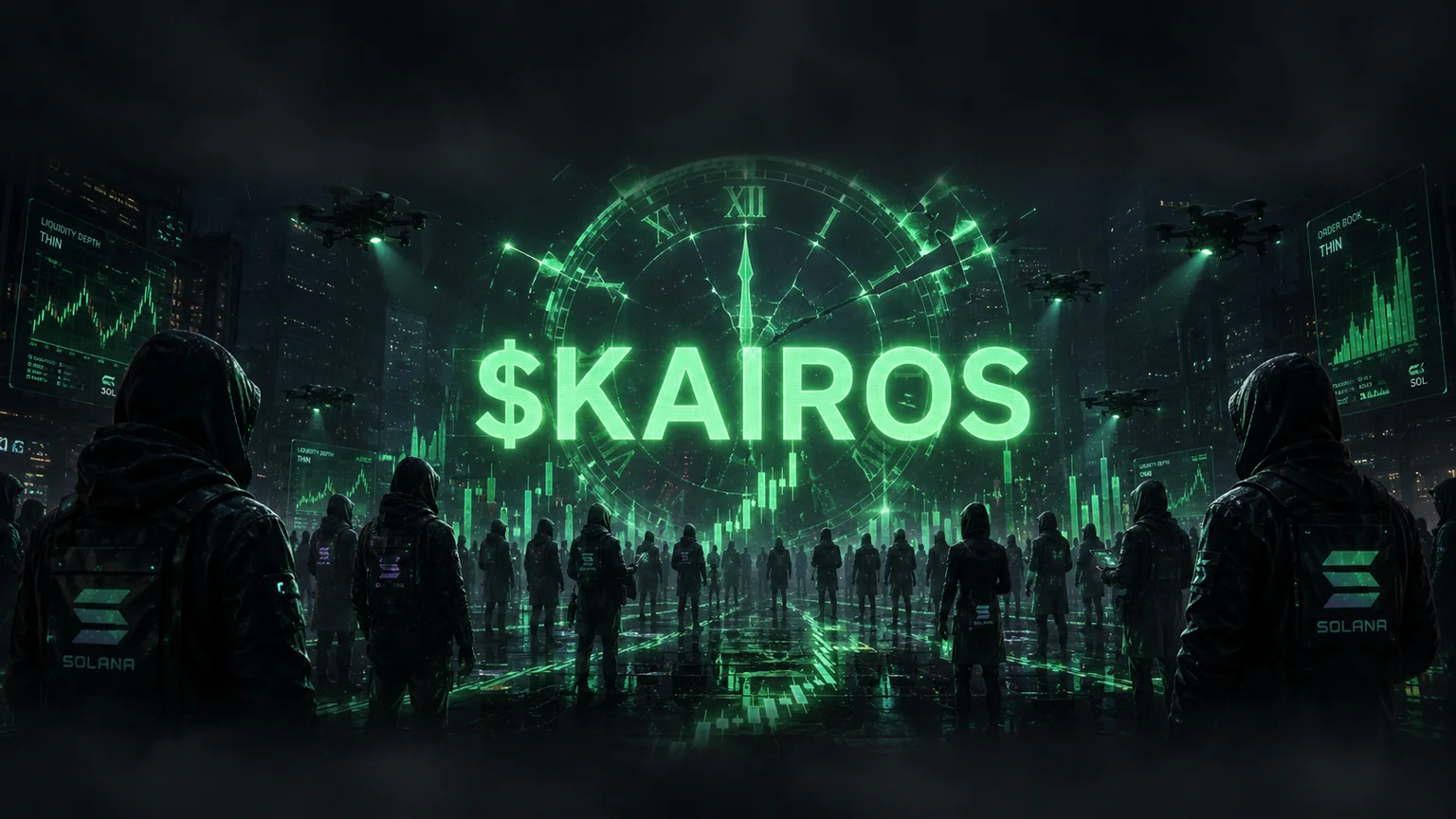
$KAIROS Is Acting Like a Three-Day Solana Board That Refuses to Fade, and That Makes the Next Move Matter More
$KAIROS pushed roughly $199.1K in market cap with about $309.0K in 24-hour volume and only around $16.6K in liquidity as of 1:15 PM UTC on June 5. The contract profile looks cleaner than most fresh pump.fun graduates, but the board still needs to prove this is real rotation instead of a crowded timing joke.
Rugcheck scores $KAIROS at 16 with freeze authority disabled, mint authority disabled, and no obvious insider tag on the top visible wallets. The structural risk is still microcap depth: liquidity sits near $16.6K, the largest wallet controls 20.69% of supply, and the top three holders own about 32.5% combined.
$KAIROS is no longer in the easy part of a pump.fun story. Anybody can print one noisy candle in the first hour, especially when the ticker is short and the meme wrapper is clean enough to travel fast through Solana group chats. Holding attention into day three is different. By 1:15 PM UTC on June 5, $KAIROS was trading near a $199.1K fully diluted value with roughly $309.0K in 24-hour turnover, up 44.0% on the day and 278.6% over the last six hours. That is the kind of tape that forces a decision. Either this is a real second-wave reprice where new buyers are still willing to pay up, or it is the last attractive moment before shallow liquidity reminds everyone how small the board really is.
The reason $KAIROS belongs on radar is not that the numbers are perfect. They are not. Liquidity around $16.6K is still thin, the top wallet still owns 20.69% of supply, and the last hour showed 162 buys against 170 sells instead of a clean buyer stampede. What makes the setup worth respect is the way those imperfections are sitting next to a board that keeps attracting business anyway. Nearly 5,928 transactions in a 24-hour window for a sub-$200K token is a real market, not just one dev and a few tourists passing the same chips around. That gives the move a more interesting editorial angle than the usual fresh-launch adrenaline piece. $KAIROS looks like an organic volume anomaly: a small board behaving as if the crowd has decided it deserves another round.
- → $KAIROS reached roughly a $199.1K fully diluted value with about $309.0K in 24-hour turnover as of 1:15 PM UTC on June 5, which is meaningful size for a pair that is only about 64 hours old.
- → The board is not being carried by a single vertical candle anymore. The saved read shows a 278.6% six-hour expansion and a 44.0% 24-hour gain, which points to a real second rotation rather than a one-minute screenshot move.
- → The contract profile is cleaner than average for this part of the curve because freeze authority is off, mint authority is off, Rugcheck scores the token at 16, and the dev balance reads as zero, but liquidity depth and a 20.69% top wallet still matter.
Why This Board Is Catching a Second Rotation
A lot of three-day Solana boards disappear into silence before the wider market has time to make up its mind. The chart stalls, the room gets bored, and the only remaining volume is exit traffic from wallets that were lucky enough to arrive before the first screenshot hit X. $KAIROS is behaving differently because it is getting stronger after the period when attention usually weakens. The timing matters. When a token can re-accelerate after the easiest momentum window should already be over, it suggests the market is still discovering it instead of just recycling the first launch cohort.
The name helps more than purists will ever admit. Kairos is one of those words that already carries a built-in story even before traders pretend to understand it. It sounds thematic, it sounds deliberate, and paired with the Swarm tag it slides neatly into the kind of AI-adjacent language that Solana traders keep rewarding whenever they want a meme with just enough narrative clothing. That does not make it profound. It makes it easy to repeat. In a market where most microcaps die because nobody can summarize them in one line, the ability to be instantly legible is a real advantage.
The Numbers Support the Curiosity
Those numbers tell a useful story when you read them together instead of cherry-picking the greenest line. The volume is bigger than the market cap, which is what gives the board its urgency. People are not just parking here and waiting. They are actively trading it. The six-hour burst shows there was a decisive reprice in the middle of the cycle rather than a gentle drift higher. At the same time, liquidity is still only about $16.6K, which means the token remains highly sensitive to any cluster of market sells. This is why the board can deserve a clean label without becoming safe. $KAIROS is tradeable and active. It is not insulated.
The buy and sell split adds another layer. A 48.8% buy ratio is not the kind of stat that screams perfect momentum, but in this context it is almost healthier than a cartoonishly one-sided print. The board is seeing two-way business while price still trends up, which usually means buyers are absorbing supply instead of only bidding an empty book. That is a better sign for durability than a launch where buys dominate for fifteen minutes because nobody on the other side exists yet. $KAIROS still has to prove that the next stretch of trading can keep that balance. The point is that the current move looks negotiated, not fabricated.
What the On-Chain Data Shows
This is where $KAIROS earns most of its clean rating. Rugcheck scores the token at 16, which is low enough to avoid the usual contract-level panic. Freeze authority is disabled, mint authority is disabled, and the selection file does not flag the top visible wallets as insiders. The dev wallet balance reads as zero, so there is no obvious creator overhang sitting on the board waiting for the first emotional green candle. That combination does not guarantee honest behavior, but it does remove some of the fastest ways these launches go bad.
The holder map is not perfect, but it is better than the average microcap that wants attention this early. The largest visible wallet controls 20.69% of supply, while the next two hold 8.28% and 3.52%, leaving the top three at about 32.5% combined. That is still enough concentration to matter. If the first wallet decides to press the board, the market will feel it immediately because the liquidity pool is not deep enough to absorb a careless exit. But the distribution is not so extreme that the whole chart looks pre-solved. With around 500 holders and no obvious permission trap in the contract, the structure reads as speculative but workable rather than structurally broken.
The key on-chain tension is depth, not permissioning. A token sitting near a $199.1K fully diluted value with only $16.6K in liquidity can still produce nasty air pockets even when the contract itself is boring in the best possible way. That is the distinction traders need to keep straight. Good freeze and mint settings do not save a board from thin books. They only remove one class of disaster. For $KAIROS, the bullish argument is that the ownership map is clean enough for momentum to keep working. The cautious argument is that one ugly hour can still do far more damage than the current headline numbers imply.
The Real Question Is Whether Attention Is Still Expanding
The most encouraging part of the setup is that $KAIROS does not look like a board surviving on nostalgia from its own launch. Pair age sits near 63.96 hours, yet the strongest move in the saved read happened in the latest six-hour window. That usually means one of two things: either the market found a new reason to care, or enough fresh eyes arrived that the old supply was not heavy enough to stop the repricing. Both possibilities are constructive in the short term. They also matter more than grand theory about what the brand is supposed to mean. For a coin this small, fresh demand is the only ideology that counts.
The best confirmation would be $KAIROS holding volume above the current range while liquidity firms up and the top-three concentration does not creep materially higher on the next snapshot.
The failure case is equally simple. If turnover cools and the board starts relying on the same concentrated wallets to keep price pinned, this quickly turns from an organic volume story into another microcap timing exercise that was only fun for the first arrivals. That is why the clean label here is narrow and conditional. It reflects the current state of the tape and the on-chain file, not a promise about the next candle. Right now $KAIROS looks like one of the more orderly sub-$250K Solana boards on the screen. If the liquidity hole widens or concentration worsens, that read can change fast.
🟢 $KAIROS gets the organic-volume-anomaly label because the board is still expanding after the usual first-wave attention window, the contract permissions are clean, the dev balance reads as zero, and the holder map is manageable enough for momentum to remain believable. The caution is straightforward: liquidity near $16.6K and a 20.69% top wallet mean the chart can still punish late entries if attention slips. This is not a safety badge. It is a small Solana board with a cleaner-than-average on-chain file and a second-rotation tape that currently deserves respect.
FAQ
What is $KAIROS on Solana?
$KAIROS, short for Kairos (Kairos-Swarm), is a Solana meme token trading under contract address Fyc2fmukseRMx5k2Pk4MXBpzzEbmaECBUHQDDh89pump. At 1:15 PM UTC on June 5 it was valued near a $199.1K fully diluted value.
Why is $KAIROS on launch radar?
Because the token was still accelerating roughly 64 hours after launch, with a 278.6% six-hour move and about $309.0K in 24-hour turnover. That is unusual for a board this small and this old by pump.fun standards.
What does the on-chain profile look like?
The saved read is cleaner than average. Rugcheck scores $KAIROS at 16, freeze authority is disabled, mint authority is disabled, and the dev wallet balance is recorded as zero.
What is the biggest risk on $KAIROS right now?
Liquidity depth. The pool sits near $16.6K, so even with a relatively tidy contract setup the board can still move violently if a concentrated holder sells into a softer hour.
What would strengthen the bullish case from here?
A stronger case would be continued high turnover, wider holder distribution, and price staying resilient without the top visible wallets gaining a larger share of supply on the next on-chain snapshot.