
$JTVO Caught a Fresh Watched-Wallet Bid, but an Old Solana Board Still Has to Earn Its Narrative Reprice
At the 2026-06-22 19:15 UTC read, $JTVO was trading near a $2.40M market cap after roughly $1.15M in 24-hour volume with about $213.9K in liquidity. A watched wallet stepped in earlier at 5:33 PM UTC, yet the real trade now is whether an older meme board with a notably calm holder map can turn renewed attention into a durable reprice.
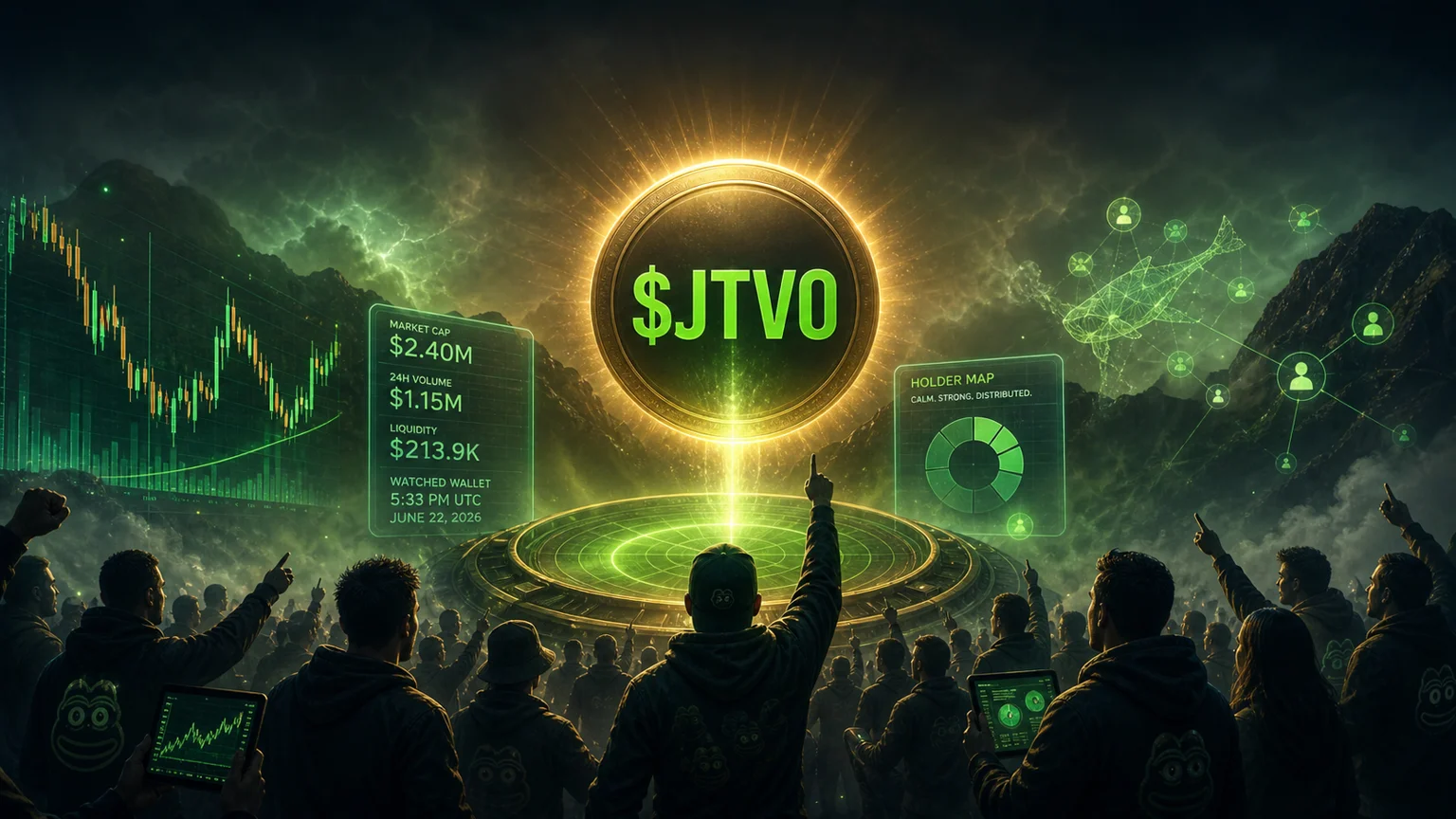
$JTVO reads cleaner than most same-session Solana chases. Freeze authority is off, mint authority is off, Rugcheck scored the token at 7, and the top three visible wallets control only about 12.9% combined. The risk is less about hidden permissions and more about whether an old board can convert renewed attention into sustained demand.
Most Solana meme stories try to sell traders on youth. They want the chart to feel untouched, the holder map to feel undiscovered, and the upside case to lean on the fantasy that nobody important has arrived yet. $JTVO is the opposite setup. Jatevo has been around for roughly 386 days, which means the market has already had time to forget it, misprice it, and file it away as yesterday's board. That is exactly why the latest move matters. At the 2026-06-22 19:15 UTC read, $JTVO was trading around a $2.40M market cap with about $213.9K in liquidity and roughly $1.15M in 24-hour volume. Those are not ghost-chart numbers. They are the kind of figures that force traders to ask whether an older board just found a believable second life.
The fresh hook came at 5:33 PM UTC, when a watched wallet tied to Cupsey stepped in for roughly $720.6 worth of $JTVO at a price near $0.002305. The dollar amount is not life-changing by itself. The significance is contextual. When a known on-chain watcher touches an older board instead of the usual brand-new lottery ticket, it reframes the trade. The read stops being “can this launch survive its first hour?” and turns into “is the market re-rating a survivor because the structure looks stronger than the average fresh chaos?” That distinction is the whole story here.
- → A watched wallet entered $JTVO at 5:33 PM UTC, while the token was already carrying about $1.15M in daily turnover and roughly $213.9K in liquidity, which is enough depth to make a reprice story feel tradable instead of cosmetic.
- → $JTVO still looks unusually calm on the first contract read: freeze authority is off, mint authority is off, Rugcheck scored it at 7, and the top three visible wallets control only about 12.9% combined.
- → The reason the rating stays speculative is tape quality, not obvious contract danger. The 24-hour move was strong at 68.8%, but the six-hour change had already slipped 14.7% and the 24-hour buy ratio sat almost perfectly balanced, which means conviction still needs to overpower churn.
Why an Older Board Suddenly Feels Tradable Again
There is a certain point in every meme cycle where traders start paying up for familiarity again. After enough thin-pool experiments and enough first-day charts built entirely on surprise, a board with real liquidity and a surviving brand can start looking premium simply because it already made it through the ugly part. That is the lane $JTVO is trying to occupy. Roughly $213.9K in liquidity does not make the token bulletproof, but it does make exits and entries more believable than the average same-evening chase.
That matters because the token is not asking for a discovery premium. It is asking for a narrative premium. A reprice like this only works when the market decides the surviving board now looks cleaner, more liquid, or more culturally usable than it did during its first life. The watched-wallet bid helps because it signals that somebody scanning the tape saw enough structure to click buy even after the easy novelty was long gone. It is a small receipt, but it points in the same direction as the broader data: this is not a dead relic catching one lucky candle. It is a board being reconsidered.
What the On-Chain Data Shows
For a Solana meme board, the first relief point is how little obvious danger shows up at the contract level. Freeze authority is off. Mint authority is off. There is no screaming permissions trap sitting under the ticker. That does not make $JTVO safe, but it dramatically changes the editorial burden. Instead of spending the whole piece explaining why traders should fear the shell, the conversation can focus on whether the market wants the asset badly enough to reward its cleaner profile. In a space where weak contracts usually disqualify a token before the tape can even be interpreted, that is a real advantage.
The holder map is even more important here. The biggest visible wallet sits at 4.95%, followed by 4.44% and 3.50%. That puts top-three visible concentration near 12.9%, which is remarkably normal by meme standards. Most speculative Solana boards that sprint back onto trader screens carry far uglier ownership tables. They ask you to believe in momentum while a couple of wallets still own the sentence structure of the chart. $JTVO does not have that problem to the same degree. The holder picture looks dispersed enough that price can actually say something about broad demand instead of just reflecting a handful of insiders passing a ball between themselves.
The clean read is not perfect, though. The 24-hour buy ratio sat just under 49.5%, which tells you the board was attracting just as much sell pressure as buy pressure across the full day. Volume was also front-loaded. Roughly $93.3K came in over six hours, but only around $4.4K over the most recent hour at the saved read. That does not disprove the reprice. It does mean the market has not yet decided this is the next obvious continuation board. A real upgrade from here needs either another visible demand wave or a better-quality stretch of tape where buyers stop looking evenly matched with profit-takers.
What the Watched Wallet Actually Changes
It also fits the broader psychology of rotation. Traders eventually tire of pretending every new ticker deserves a premium just because it is new. When that fatigue builds, capital starts hunting for names with deeper pools, cleaner ownership, and enough residual cultural memory to wake up quickly if the tape turns. $JTVO checks those boxes better than most revival attempts.
Why the Reprice Is Still Not Automatic
$JTVO looks cleaner than most same-session Solana chases, but clean structure is not the same thing as active demand.
The six-hour tape was already softer than the 24-hour headline, and the full-day buy ratio remained close to even.
If buyers do not return in size, the market may simply decide $JTVO is respectable but not urgent.
That is the central tension. $JTVO does not need to overcome a glaring contract flaw or a cartoonishly ugly holder map. It needs to overcome indifference. Old boards only get repriced when enough traders agree that surviving was not an accident and that the present structure deserves a better multiple than the market is currently assigning. The watched-wallet entry helps tell that story, but it cannot finish it by itself. What finishes it is sustained participation: more turnover, stronger one-hour prints, and evidence that new buyers are arriving because the setup feels cleaner than the average alternative.
The good news for bulls is that the board does not have much hidden baggage to explain away. The dev profile shows no freeze authority, no mint authority, no creator-token sprawl, and a Rugcheck score of 7. The less comforting truth is that clean boards can still stall. If the next sessions do not produce another convincing demand pulse, traders can easily conclude that $JTVO is one of those sensible-looking names everyone respects for a day and then abandons for something louder.
$JTVO earns a speculative rating because the structure is strong enough to justify attention, but the reprice is not fully won yet. Roughly $213.9K in liquidity, about $1.15M in 24-hour volume, freeze authority off, mint authority off, Rugcheck at 7, and top-three visible holder concentration near 12.9% give this board a materially cleaner profile than most Solana rotations. What keeps it out of the clean bucket is the softer six-hour tape, the nearly even buy-sell split, and the fact that an old board still has to prove fresh demand can stick.
What is $JTVO on Solana?
$JTVO is the ticker for Jatevo on Solana, trading under contract address 9VY2rDbtsBmTsBxoRF8hWSEUKGqnoQoe9V6W3JnjNgfm. At the saved 2026-06-22 19:15 UTC read, it was trading near a $2.40M market cap.
Why does the watched-wallet buy matter for $JTVO?
Because it happened on an older board rather than a brand-new launch. The entry at 5:33 PM UTC suggests at least one closely watched trader saw a cleaner reprice setup in a token that already has real liquidity and a relatively calm holder map.
Does $JTVO look risky on-chain?
The contract shell looks cleaner than most fast Solana chases because freeze authority is off, mint authority is off, and Rugcheck scored the token at 7. The bigger issue is whether demand can stay strong enough to keep the reprice alive.
What would make the $JTVO setup look stronger from here?
A renewed one-hour demand pulse and steadier turnover after the first headline burst would strengthen the case for a durable narrative reprice.