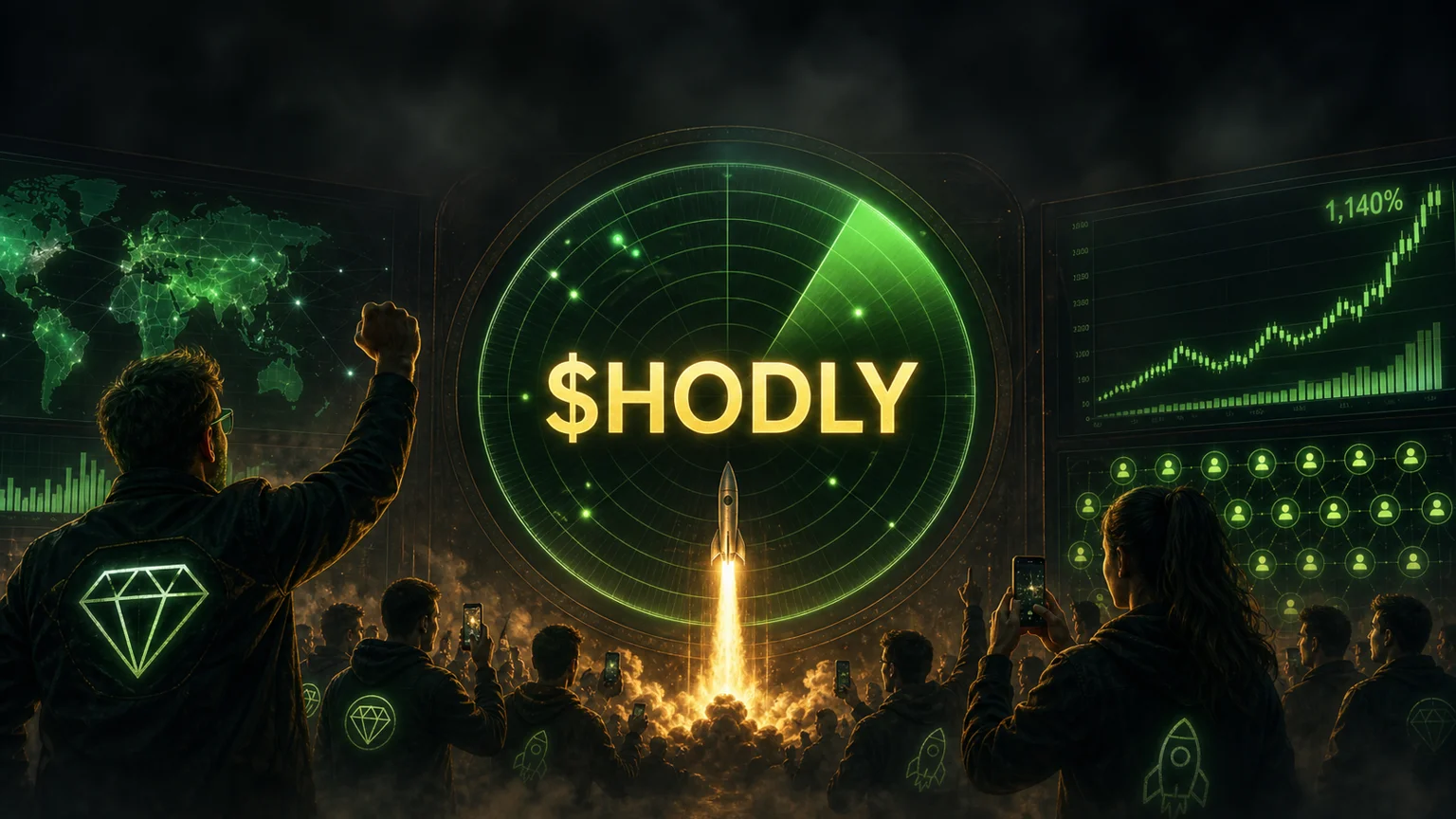
$HODLY Is Holding Its Day-Two Solana Reprice Better Than Most Fresh Meme Runners
$HODLY carried nearly $931K in turnover and a 1,140% daily move into 2026-06-27 13:15 UTC. If the holder map stays this orderly, the board can keep repricing. If the early crowd starts unloading into a still-thin pool, the clean look can vanish fast.
$HODLY shows no active freeze authority, no active mint authority, and a Rugcheck score of 1. The top three visible holders control about 28.0% of supply, which is still concentration worth respecting but cleaner than the average same-day Solana meme launch.
$HODLY has already survived the hardest part of the average meme launch: the moment when the first absurd candle fades and the market has to decide whether there is an actual second session underneath it. By 2026-06-27 13:15 UTC, the token was still carrying roughly $931K in 24-hour turnover on a market cap near $370K, with liquidity around $45.5K and a pair age just over 22.6 hours. That matters because the board is no longer asking traders to judge a six-minute novelty spike. It is asking them to judge a day-two market that has already processed a first crowd, a first round of profit taking, and a first round of skepticism. In that context, $HODLY looks cleaner than most same-cycle Solana memes. Not risk-free. Just cleaner.
The distinction is important. A 1,140% daily move sounds cartoonish until the underlying tape proves it can keep functioning after the screenshot merchants leave. Plenty of launch-radar names print outrageous percentages and then die the moment their first audience cashes out. $HODLY is still moving, but it is doing so with a less frantic shape than the raw headline suggests. One-hour momentum remained positive near 9% in the saved snapshot, the five-minute move was still green, and total tracked transactions pushed above 21,000. That is not what a dead board looks like. It is what a board looks like when the market is still testing whether the first repricing was overdone or only the beginning.
- → $HODLY kept nearly $931K in 24-hour turnover alive into 2026-06-27 13:15 UTC, which is real second-session participation rather than a launch-only flash.
- → The contract read is stronger than average for this lane: freeze authority is off, mint authority is off, and Rugcheck scores the token at 1.
- → The main caution is still structure, but the visible holder map is comparatively orderly because the top three wallets hold about 28.0% of supply instead of the far uglier concentration usually seen on brand-new meme boards.
Why $HODLY Survived the First-Day Sugar Rush
The board survived because the market found a reason to keep trading it beyond novelty. Meme launches that endure into a second session usually do one of two things well: they either pull a broad enough crowd that sellers cannot choke the tape, or they present a structure clean enough that traders are willing to keep rotating through them while they search for the next bigger leg. $HODLY appears to be doing a bit of both. The turnover is large relative to capitalization, which says strangers are still arriving. The liquidity is not enormous, but at roughly $45.5K it is materially sturdier than the hyper-thin pools that fuel many first-day traps. Most importantly, the tape is no longer entirely one-directional. There has been enough two-way interaction to suggest an actual market is forming instead of a one-note launch frenzy.
That matters because day-two price action is where the meme sector usually reveals whether it was driven by pure launch adrenaline or by a more persistent urge to own the ticker. In $HODLY's case, the board still looks wanted. A buy ratio near 58% is not the manic imbalance seen on minute-one pumps, but that is partly why it reads healthier. Extreme buy dominance can signal a one-sided chase with no real market depth behind it. A board that keeps volume elevated while allowing more balanced trade often has a better chance of stabilizing and repricing again. In other words, the tape is less euphoric than the first burst and more believable because of it.
Where the Board Looks Better Than the Average Sprinter
Start with the simple comparison. A lot of fresh Solana memes ask traders to underwrite huge uncertainty for very little evidence. $HODLY is at least offering evidence. The volume-to-market-cap relationship is still aggressive. The pair is almost a full day old instead of one hour old. Liquidity has reached a level where the chart can absorb more than toy-sized tickets. Even the social packaging helps; the project is not fighting for a narrative because the name and branding are already easy for CT to recycle. None of that proves long-term staying power. It does explain why $HODLY reads more like a clean runner than a disposable candle.
What the On-Chain Data Shows
The most important contract-level point is that the obvious admin-key threats are absent in the saved profile. Freeze authority is off. Mint authority is off. Rugcheck scores the token at 1. For Solana meme launches, those three facts immediately separate a board worth monitoring from the mass of names that never deserve serious capital. That is why $HODLY can earn a clean rating without anyone pretending the trade is safe. The contract does not show the classic shortcuts scammers rely on when they want optionality over holders. It simply shows a standard high-risk meme board with fewer immediate hidden levers than usual.
Holder concentration is the next question, and here the picture is not perfect but it is better than average. The largest visible wallet holds 20.89% of supply, which is meaningful enough to monitor closely. After that, though, the distribution relaxes quickly: the second-largest visible wallet holds 5.57% and the third 1.53%, leaving the top three at roughly 28.0% combined. That is still real concentration. It is just a manageable kind relative to the usual day-one board where a tiny inner circle often owns the entire trade. When the top-holder issue is singular rather than systemic, the market at least has a chance to absorb it if broader demand keeps arriving. That is the constructive read here.
Why the One Big Holder Matters Less Than It Usually Does
One large wallet does not automatically ruin a setup. What ruins a setup is a large wallet combined with weak turnover, shallow liquidity, and a contract profile full of ways to change the rules. $HODLY does not currently stack those negatives. The liquidity pool is still only mid-sized by mature-token standards, but it is strong enough to be taken seriously for a sub-$400K board. The turnover is big. The permissions are clean. And the concentration beyond the largest wallet falls off fast enough that the supply does not look fully captured by insiders. That combination gives the token room to keep repricing as long as the market keeps treating the board as a rotation destination rather than a quick scalp.
That is also why the clean label is conditional rather than promotional. If the biggest holder starts distributing aggressively into a cooling tape, this read changes quickly. A clean board can still become an ugly chart. But the current evidence says the structural burden is lower here than it is on the average same-cycle meme launch. Traders are not staring at a mystery box. They are staring at a board that already passed its first stress test and still holds a comparatively decent holder profile for this stage.
$HODLY does not need a perfect holder map to keep working. It only needs the current distribution to stay stable while liquidity keeps climbing.
How the Next Rotation Decides the Upgrade
The cleanest upgrade from here would be simple: hold volume, deepen liquidity, and avoid a sharp deterioration in the holder map. If $HODLY can do that, the market will have a much easier time treating the 1,140% move as the first chapter of a broader repricing instead of the whole story. If it fails, the failure probably will not come from hidden contract poison. It will come from the ordinary physics of meme trading, where early winners cash out and late buyers discover that structure mattered more than narrative. For now, though, $HODLY looks like one of the stronger day-two reads in the current Solana launch crop. That is enough to justify a clean rating, and more importantly, enough to keep it on the serious side of the watchlist.
🟢 $HODLY earns a clean rating because the current evidence shows a relatively orderly board for a fresh Solana meme runner. Freeze authority is off, mint authority is off, Rugcheck scores the token at 1, liquidity is approaching $45.5K, and the visible top-three holder concentration sits around 28.0%, which is not ideal but is materially better than most same-stage launches. The biggest risk is still that a large holder or fading rotation can turn a strong day-two setup into ordinary meme exit pressure. Until that happens, $HODLY looks cleaner than the average first-wave board without pretending to be anything other than a high-risk token.
What is $HODLY on Solana?
$HODLY is a Solana meme token that drew attention after carrying a 1,140% daily move and nearly $931K in turnover into 2026-06-27 13:15 UTC. The current story is a day-two runner that still has real market participation behind it.
Why does MemeDesk rate $HODLY clean instead of speculative?
The rating comes from structure. The token shows no active freeze authority, no active mint authority, a Rugcheck score of 1, and a holder map that is more distributed than most same-cycle launches. That does not remove risk, but it does make the opening board cleaner than average.
What does the on-chain read say about $HODLY?
The latest saved profile shows freeze authority off, mint authority off, and a low Rugcheck score. The largest visible holder owns 20.89% of supply, while the top three combined hold about 28.0%, which is still worth watching but is not the kind of concentration that automatically invalidates the setup.
What would break the $HODLY bull case from here?
The easiest way this setup degrades is if liquidity stalls while the largest holder starts selling into weaker volume. If the holder map worsens or the turnover collapses, the board can lose its clean read even without any contract-level red flags appearing.