$GRVT Is Still Printing Giant Solana Turnover, but the Board Is Starting to Read Like Post-Pump Exhaustion
At 2026-06-27 04:15 UTC, $GRVT was trading near a $23.9K market cap after roughly $11.1M in 24-hour volume and a 245% intraday move, yet the pair was still leaning on only about $15.1K in liquidity while Rugcheck kept flagging fully unlocked LP. The chart remains loud enough to attract fresh eyes. The structure underneath it still looks like a board asking late buyers to do all the emotional labor.
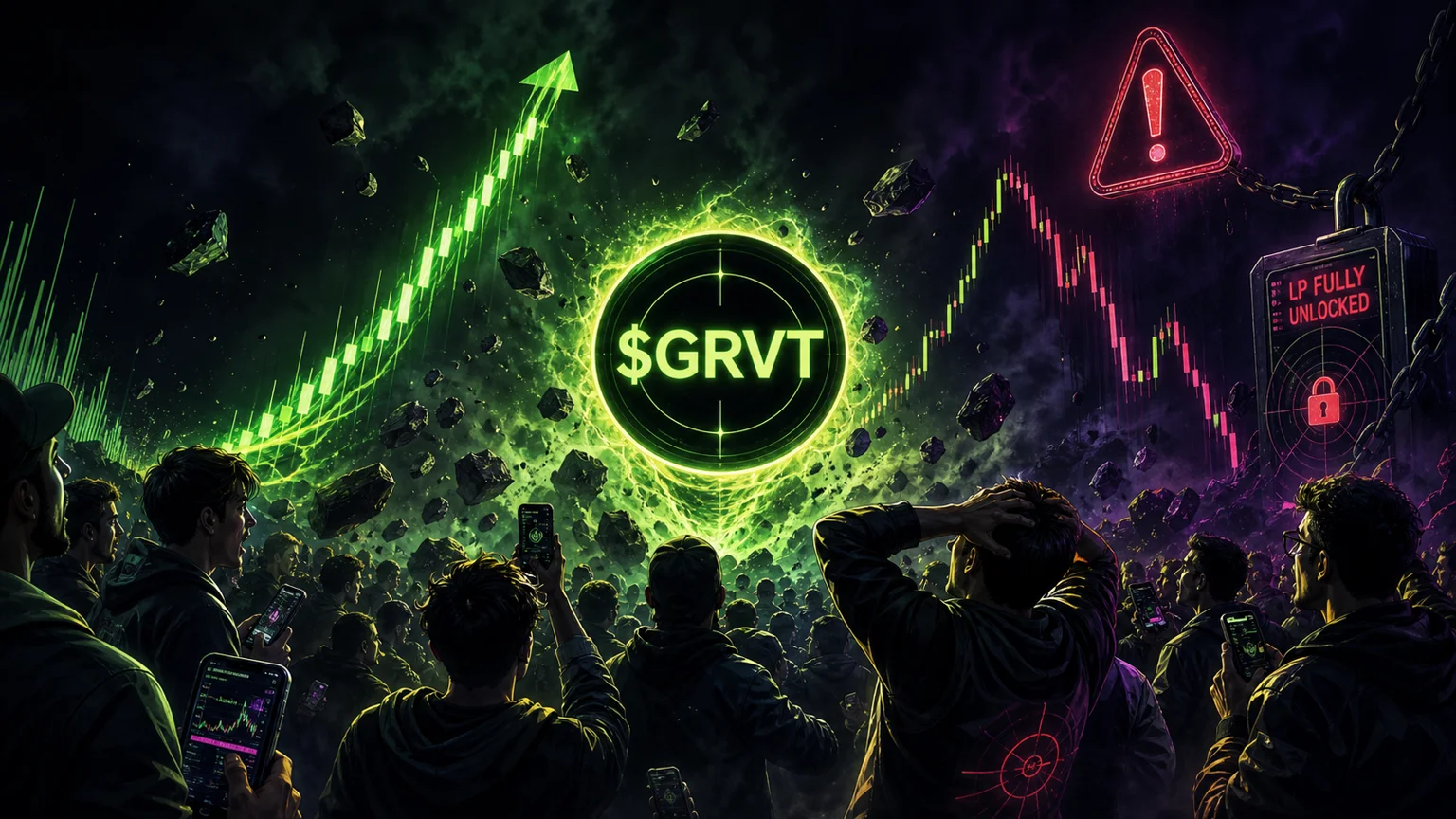
$GRVT has no active freeze authority and no active mint authority, but the cleaner contract flags stop there. Rugcheck scores the token at 52, the visible top three holders control about 35.8% of supply, and the main pool remains fully unlocked, which keeps the chart vulnerable to a fast liquidity shock.
$GRVT is still doing the one thing that keeps fragile Solana boards alive longer than skeptics expect: it is printing a turnover number too big to ignore. By 2026-06-27 04:15 UTC, the token had pushed roughly $11.1M in 24-hour volume while the chart remained up about 245% on the day. That headline alone is enough to pull fresh traders into the room, because the market is conditioned to treat huge volume as proof that a board has become more important than its tiny market cap suggests. The trouble is that $GRVT no longer reads like a token climbing into price discovery. It reads more like a token burning through attention faster than the underlying structure can replenish it.
That is what turns this from a simple liquidity-trap story into a post-pump exhaustion story. If the volume explosion were translating into a sturdier floor, deeper liquidity, or a stronger ownership map, traders could argue the market was slowly upgrading the board in real time. Instead, the market cap was still sitting near only $23.9K and liquidity was only about $15.1K on the saved read. In other words, the token keeps producing spectacle without building much extra support underneath the spectacle. That is the classic shape of a board where the chart can stay exciting for a while even as the quality of the move quietly degrades.
- → $GRVT kept pushing absurd headline activity into 2026-06-27 04:15 UTC with roughly $11.1M in 24-hour turnover and a 245% move, which explains why the chart still attracts fresh attention.
- → The on-chain profile remains uncomfortable: freeze authority is off and mint authority is off, but Rugcheck scores the token at 52, the main liquidity pool is fully unlocked, and visible top-three holder concentration sits near 35.8%.
- → The real editorial shift is exhaustion. Volume keeps refreshing while market cap and liquidity remain tiny, which suggests the board is consuming attention rather than converting that attention into a sturdier market.
Why the Tape Still Looks Irresistible
There is a reason $GRVT continues to survive the first skeptical glance. The board offers traders a very easy sales pitch. A live CT mention gives the token social oxygen, the intraday percentage move gives it urgency, and the massive turnover number gives people a fact they can repeat without having to defend the full chart. In trench markets, that is often enough. A token does not need clean structure to command another hour of attention. It only needs a story that feels portable. $GRVT still has one, and that is why late participants keep convincing themselves the chart must be more durable than the raw market cap implies.
The problem is that volume can hide decay as easily as it can signal momentum. When a board is genuinely improving, the attention usually leaves some residue behind. Liquidity thickens. Valuation steps up into a more believable range. Ownership either disperses or becomes less menacing. With $GRVT, the opposite feeling dominates. The same headline metric that looks bullish at first glance starts to feel suspicious once it keeps arriving without those secondary upgrades. If $11.1M in turnover still leaves the token hugging a sub-$24K market cap and a five-figure pool, then the market is not building confidence. It is just running hard inside a very small room.
What the On-Chain Data Shows
The contract layer is not the worst possible version of a meme launch. Rugcheck shows no active freeze authority and no active mint authority, which means there is no obvious admin switch ready to freeze holders or expand supply. That is the good part of the read. The less friendly part is everything that comes after it. Rugcheck still scores the token at 52, which is not catastrophic but clearly not the kind of profile traders use to argue that a board is quietly pristine under the hood.
Liquidity is where the stress becomes real. DexScreener showed only about $15.1K in pool depth on the saved snapshot, while Rugcheck continued flagging a large amount of LP as unlocked and also warned about a low number of LP providers. That combination matters more than any social post attached to the token. A board can survive uneven holder distribution if the pool is healthy. It can even survive mediocre contract optics for a while if liquidity is deep enough to absorb churn. What it usually cannot survive indefinitely is giant emotion flowing through a pool this small while the unlock risk remains visible on the same page.
Holder concentration is not apocalyptic, but it is meaningful. The visible top line held about 31.24% of supply in the saved profile, with the next two at roughly 2.27% and 2.25%, leaving the top three at about 35.8% combined. That is enough to keep the holder map relevant every time the board tries to squeeze higher. It also makes the exhaustion angle stronger. A token that keeps demanding new emotional buyers while a meaningful block of supply remains concentrated is not simply volatile. It is structurally dependent on fresh enthusiasm arriving before older wallets decide they have seen enough.
Where the Exhaustion Read Comes From
Post-pump exhaustion is not the same thing as a dead chart. In fact, the reason it traps people is that the board can continue to post dramatic numbers even as the underlying reward profile deteriorates. $GRVT looks like that now. The headline remains incredible enough to create FOMO. The supporting numbers remain weak enough to make each incremental buyer work harder for less structural upside. When a board lives in that state, it becomes increasingly dependent on narrative recycling rather than genuine improvement.
That distinction matters because traders tend to confuse persistence with health. A token that refuses to go away can feel bullish simply because it is still on the screen. But endurance alone is not the same as progress. If the board has already shown it can generate eight-figure turnover and still has not materially upgraded its floor, then the next burst of attention may be more about squeezing one last emotional wave out of the same setup than about beginning a new leg. $GRVT can absolutely keep moving. The question is whether the next move pays late entrants or merely gives earlier participants a cleaner exit.
That is why the speculative rating fits better than either a clean label or a full shill warning. The chart is not fictional. There is real participation, real turnover, and enough social energy to keep the market engaged. At the same time, the on-chain map does not justify comfort. Unlocked LP, shallow liquidity, and a middling Rugcheck score are exactly the sort of conditions that turn a loud board into an unforgiving one. $GRVT remains tradable because it is active. It remains dangerous because the structure keeps asking for trust it has not actually earned.
🟡 $GRVT belongs in the speculative bucket because the chart is still undeniably alive, but the market underneath it looks more exhausted than upgraded. Freeze authority is off and mint authority is off, yet Rugcheck still scores the token at 52, the main pool remains fully unlocked, visible top-three holder concentration is about 35.8%, and liquidity is only around $15.1K. That combination leaves the token capable of more volatility, but it also leaves late buyers leaning on a floor that has not improved enough to justify the size of the attention.
What is $GRVT on Solana?
$GRVT is the GRVT AI COIN token trading on Solana. At 2026-06-27 04:15 UTC, the token was priced near a $23.9K market cap while still processing roughly $11.1M in 24-hour turnover.
Why is $GRVT still getting attention?
The token combines a live CT bid, a dramatic intraday move, and a volume number that looks oversized for its valuation. That makes the board easy to talk about even though the underlying market structure is still fragile.
What does the on-chain read show on $GRVT?
Current checks show no active freeze authority and no active mint authority, but Rugcheck still scores the token at 52, the main liquidity pool remains fully unlocked, and visible top-three holder concentration is about 35.8%. Those factors keep the board tradable but uncomfortable.
Why does MemeDesk call this a post-pump exhaustion setup?
Because the headline activity keeps refreshing without the same improvement in market cap, liquidity, or structural comfort. The board can still move, but the quality of the move looks weaker than the volume number alone suggests.