$GO Just Turned a Pump.fun Launch Into a Seven-Figure Solana Tape, but the Real Signal Is Whether the Board Can Stay Cleaner Than the Crowd Chasing It
$GO ripped to roughly a $368K market cap on about $1.11M in 24-hour volume less than 10 hours after launch, pairing a violent momentum burst with a Rugcheck score of 1, disabled freeze and mint authority, and a holder map that is clean enough to matter but still concentrated enough to punish lazy entries.
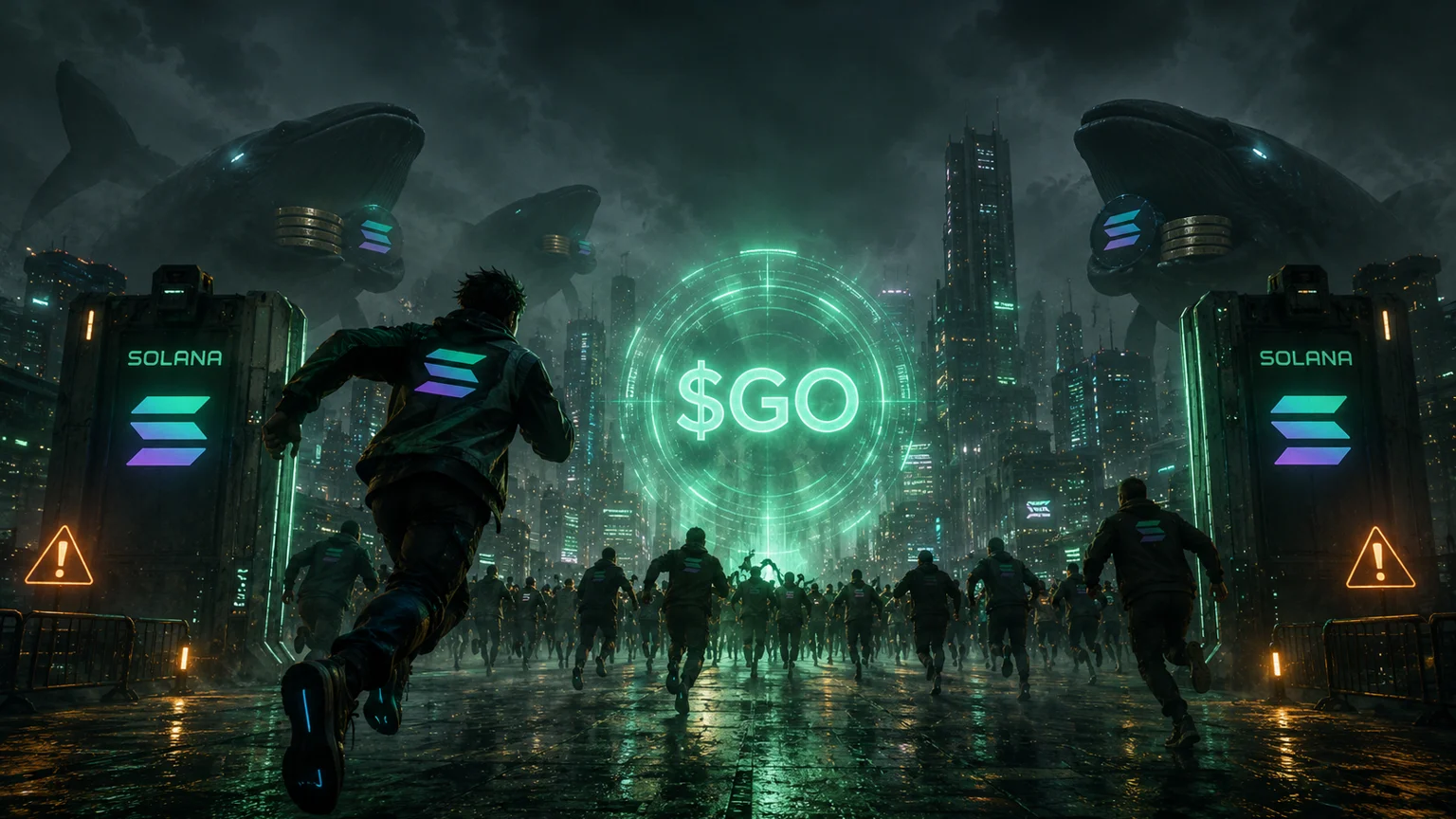
$GO has freeze authority disabled, mint authority disabled, and a Rugcheck score of 1, but the top wallet still controls 21.41% of supply and the top three wallets hold 42.2%, which means the board is cleaner than average, not loose enough to ignore.
$GO did not sneak onto the Solana board on a technicality. In the saved market snapshot, the token was already near a $368K market cap with about $1.11M in 24-hour turnover, roughly $62.0K of liquidity, and a same-session move that read like a full-on momentum event rather than a sleepy launchpad drift. When a board that is barely nine hours old is doing that kind of business, the right question is not whether traders noticed. The right question is whether the market is seeing the start of a cleaner runner or simply throwing itself at the most exciting chart in the room.
That distinction matters because pump.fun graduates are easy to romanticize after the first vertical push. A token can look brilliant in screenshots and still be one rotation away from feeling overcrowded. $GO has better evidence than that. The one-hour tape alone showed 1,434 buys against 1,146 sells, which is active enough to suggest real two-way participation instead of a tiny circle painting price. Holder count was already around 1,201 in the enriched snapshot. That is not a ghost board. It is a live market. The edge is figuring out whether the board is live in a durable way or just live enough to create a beautiful trap for late hands.
- → $GO reached roughly a $368K market cap on about $1.11M in 24-hour volume, around $62.0K of liquidity, and a 122% one-hour move while the pair was only about nine hours old, which is the kind of tape that forces a real launch-radar read.
- → The contract layer looks cleaner than the average same-day meme board because freeze authority is disabled, mint authority is disabled, the saved Rugcheck score is 1, and the deployer wallet balance is already zero.
- → The board still belongs in the speculative bucket because the top wallet held 21.41% of supply, the top three wallets controlled 42.2%, and a crowded momentum board can turn fast when concentration meets profit-taking.
Why $GO Graduated Out of Launchpad Noise
The first thing that separates $GO from routine launch clutter is the scale of participation relative to age. Plenty of day-one tokens can print a sharp candle. Far fewer can pair that candle with seven-figure turnover before the first session is even over. The move was not just up. It was busy. More than 23,900 total transactions across the 24-hour view and a buy ratio around 55.6% show a board that kept attracting fresh decisions instead of stalling after the first push. That matters because meme coins do not become meaningful because of price alone. They become meaningful because a crowd decides the symbol belongs in the rotation.
The other reason the launch matters is narrative compression. $GO is a ticker that almost invites traders to project their own thesis onto it. That can sound superficial, but in this market it is part of the mechanism. Simple symbols travel faster, get typed faster, and usually survive the first burst better if the chart gives people a reason to keep repeating them. $GO already had the chart. The open question is whether the ticker can now hold attention once the easiest part of the reprice is behind it. That is why the cleaner-runner angle fits. The token does not need a heroic backstory. It needs to prove the first wave was the beginning of a board, not the entire story.
What the On-Chain Data Shows
The bullish part of the file is easy to see. Freeze authority is disabled, which removes the ugliest kind of admin risk from the conversation. Mint authority is disabled too, so the market is not trading under the threat of surprise supply expansion. Rugcheck tagging the token with a score of 1 is about as calm as a same-day meme launch gets. There are no listed risks in the saved profile, the creator token count is zero, and the deployer wallet balance has already gone to zero. None of that makes $GO safe in an absolute sense, but it does mean the contract permissions are not the first thing traders need to fear.
The holder map is where the nuance comes in. The top wallet held 21.41% of supply in the saved profile, while the next two wallets held 12.49% and 8.32%. That puts top-three concentration at 42.2%. No insider flags were attached to those wallets, which matters, yet concentration is still concentration. When nearly half the board sits with three holders, every breakout has to be judged against the possibility that a few wallets can reset sentiment by leaning on the bid. That is especially true in a token that has already repriced this aggressively in under a day. Cleaner structure is not the same thing as loose distribution.
Liquidity sits in the middle. About $62.0K is enough to give the move some substance, especially against roughly $1.11M in turnover, but it is not deep enough to make exits painless if momentum pauses. That ratio is why the board feels tradable without feeling settled. The market has enough depth to support real engagement, yet not enough depth to absorb careless size. In plain terms, $GO can keep going if buyers stay organized. It can also snap harder than people expect if the chart starts offering excuses to take profit.
Why the Pump.fun Origin Still Matters
Pump.fun launches often get treated like disposable lottery tickets until one of them proves otherwise. $GO is far enough along that traders have to stop using the platform label as the whole analysis. The launchpad origin matters because it tells you where the first order flow came from, but the token is already trading on bigger criteria than novelty. Once volume clears seven figures and holder count clears 1,000, the question shifts from launch mechanics to market quality. Are people still buying because they see a second leg, or because the chart is forcing them to chase the thing everyone else already sees?
That is also where the cleaner contract setup becomes useful. Pump.fun graduates usually have to fight skepticism about whether the entire board is just another temporary spike. $GO at least has an argument against that cynicism. The contract file is tidy, the dev wallet is not sitting there with a giant visible bag, and the price action is backed by enough volume to look intentional. That does not guarantee a trend day tomorrow. It does mean the token has already earned a more serious read than the average launchpad headline.
Where the Trade Gets Sloppy
The danger is not mysterious. It is the same danger that ruins most same-day Solana winners after the crowd upgrades them too quickly. The 24-hour print was up more than 15,000%, the six-hour line was up about 846%, and the one-hour move still sat above 122% in the saved snapshot. That is not a calm entry profile. It is a board that has already paid early participants handsomely. When a token has done that much work that fast, new buyers are no longer paying for discovery. They are paying for continuation, and continuation is always a higher standard.
Concentration amplifies that risk. A top wallet at 21.41% and a top-three stack at 42.2% do not need to act maliciously to make the board ugly. They only need to react faster than the rest of the market. If the next buyers do not broaden the holder map and if liquidity does not expand alongside attention, the same structure that helped $GO move so violently on the way up can turn into the reason it feels airless on the way down. That is why the right posture is disciplined curiosity. The token has already earned the radar slot. It has not yet earned blind trust.
$GO looks stronger than a throwaway pump.fun breakout because the board paired real volume with disabled freeze and mint authority plus a very low Rugcheck score, but the top-three holder stack is still large enough that traders should treat continuation as something the market must prove, not something the headline already guaranteed.
Verdict
🟡 Speculative — $GO has a cleaner-than-average contract file, real same-day participation, about $1.11M in turnover, and enough liquidity to make the move matter, but the board still carries meaningful holder concentration with 21.41% in the top wallet and 42.2% across the top three. The setup deserves respect as a clean runner candidate, yet it still needs broader distribution and deeper liquidity before the read can move past disciplined speculation.
FAQ
What is $GO?
$GO is the ticker for PumpGO, a Solana meme coin trading under contract address CujZ5W6GWYb5XYe3hsTJ6kjiaw5MdZjbKQEuGA6jpump. In the saved market snapshot, it was priced around $0.0003675 with a market cap near $368K.
Why is $GO getting attention?
Because the token pushed to about $1.11M in 24-hour turnover less than 10 hours after launch, with around 1,201 holders, a 122% one-hour move, and the kind of speed that turns a simple ticker into a real Solana rotation candidate.
What is the main risk on $GO right now?
The main risk is structure, not contract permissions. Freeze authority is disabled and mint authority is disabled, but the top wallet held 21.41% of supply, the top three wallets held 42.2%, and the board still needs deeper liquidity if it wants to stay resilient after such a violent first repricing.