
$EMILIO on Solana Lost the Easy Pump, but the Clean Contract Keeps It on Watch
A watched early wallet got into $EMILIO before the board widened out, but by 2026-07-05 04:15 UTC the real read had shifted to roughly $59.9K of market cap, about $19.0K of liquidity, and a holder map where the top three wallets controlled roughly 46.23% of supply. The contract shell looks clean. The depth does not.
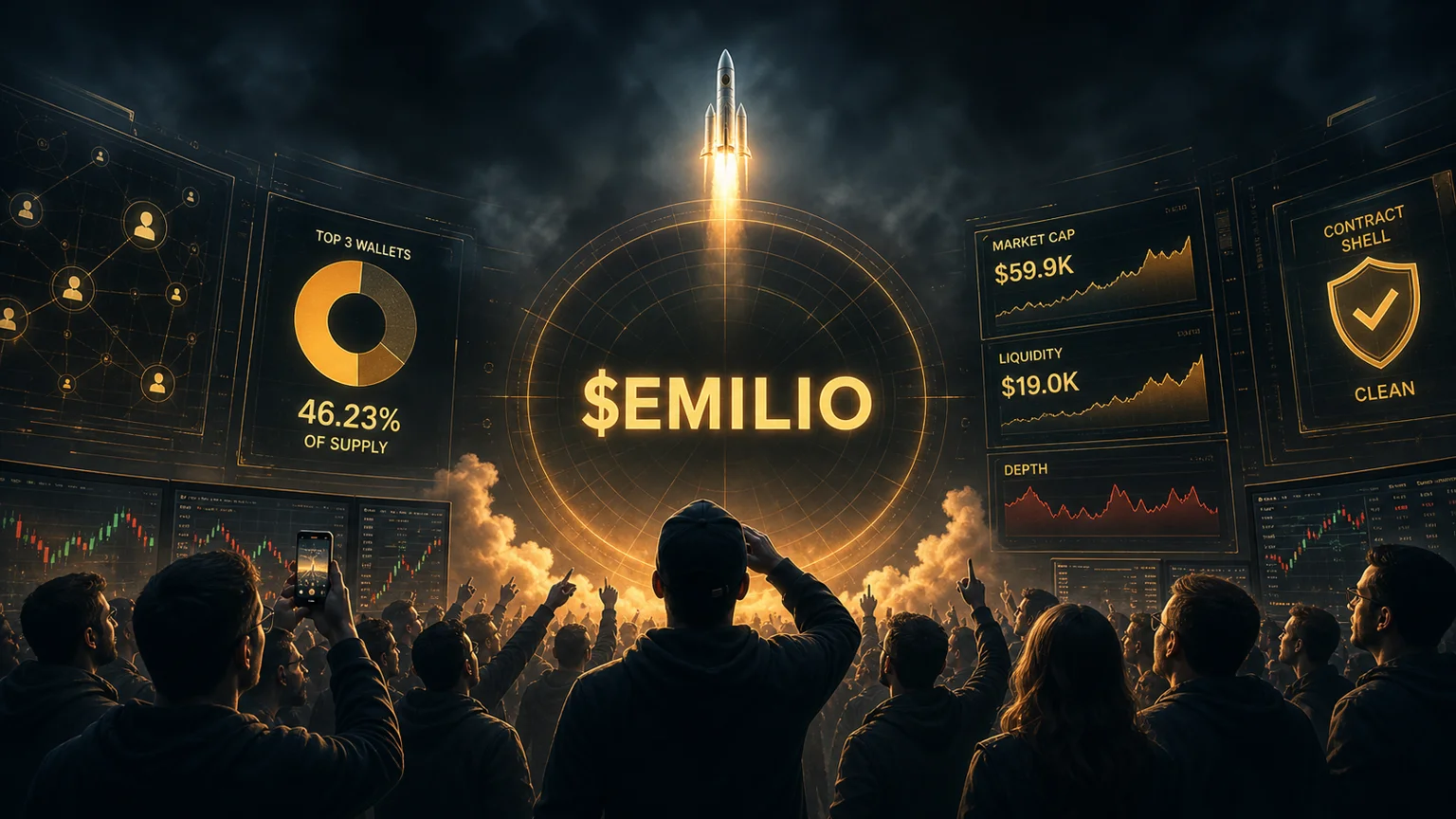
$EMILIO reads mechanically clean with freeze authority off, mint authority off, and a Rugcheck score of 1, but roughly 46.23% of supply sits with the top three visible wallets while the best-liquidity pair only holds about $19.0K in depth.
The easiest way to misread $EMILIO is to focus only on the first headline number and stop there. Yes, the token got attention because an early watched wallet was already in before the broader board caught up. Yes, the first burst was real enough to put the name into conversation quickly after the Solana pair went live at 2026-07-05 01:52 UTC. But by the time the trade reached the 2026-07-05 04:15 UTC reference window, the story had already moved past who touched it first. The real question had become whether public demand could hold the chart together after the easy part of the launch was gone.
That shift matters because the live board had already reset hard. The best-liquidity pair was showing roughly $59.9K of market cap, about $19.0K of liquidity, and close to $498.4K in 24-hour volume, while the one-hour move had rolled over more than 55%. Those numbers do not describe a dead token. They describe a token that now needs a second reason to stay relevant after the first emotional cycle of discovery.
- → $EMILIO still had meaningful churn at the reference window, with roughly $498.4K in 24-hour turnover on a board that was only a little over two hours old.
- → The contract read is unusually calm for a fresh Solana meme launch: freeze authority is off, mint authority is off, and Rugcheck scores the token at 1.
- → The setup stays yellow because the top three visible wallets control roughly 46.23% of supply while the deepest pair only has about $19.0K of liquidity to absorb the next real sell wave.
Why the First Wallet Matters Less Than the Next Buyer
Early-wallet validation is useful because it tells traders the token did not start as a random empty shell. Somebody paying attention took interest before the broadest part of the market arrived, and that can be enough to force a symbol onto nearby screens. The mistake is treating that kind of first touch like a permanent bullish verdict. In meme tokens, the first wallet can make the chart visible, but it cannot guarantee the second and third buyer waves will keep paying up after the initial surprise fades.
That is exactly where $EMILIO sits now. The board already proved it could attract attention. What it has not proved yet is that later entrants will keep defending value once the launch premium is gone. A quick rug look would be the cleanest explanation for a chart losing altitude this early, but that is not the case here. The token is harder than that. The market is not dealing with obvious contract poison. It is dealing with a meme that now needs real depth, better distribution, and a broader base of conviction than the opening move alone can provide.
What the On-Chain Data Shows
On-chain, $EMILIO looks cleaner than many fresh Solana launches that print comparable velocity. Freeze authority is disabled. Mint authority is disabled. Rugcheck assigns a score of 1. The token has roughly 746 holders already, which is enough to show the board reached beyond a tiny private circle in its first couple of hours. Those are all constructive details because they remove the most obvious contract-level failure modes that usually force a fast downgrade.
The complication is ownership shape. The top visible wallet holds about 22.31% of supply. The next visible wallet accounts for another 17.54%, and the third visible slot adds 6.38%, putting the top-three concentration near 46.23%. That is a heavy number for a micro-cap board with only about $19.0K of liquidity in the strongest pair. Freeze authority may be off and mint authority may be off, but control is still concentrated where it matters most: in the wallets that can decide whether the next bounce becomes continuation or a liquidity event.
The Liquidity Reset Is the Real Story
Fresh launches can survive ugly candles if the liquidity pool is deep enough to let price discovery breathe. $EMILIO does not have that luxury yet. About $19.0K of liquidity is fine for getting a board off the ground, but it is thin once ownership starts bunching up and the first pump is already behind the chart. In that setup, every rebound has to do two jobs at once. It has to attract new buyers, and it has to prove those buyers are not simply handing an exit lane to larger holders who entered earlier.
That is why the reset can actually be more informative than the initial spike. A meme can overshoot on launch for any number of emotional reasons. A market that stabilizes after the first overshoot is more revealing. If $EMILIO starts holding this smaller capitalization while volume stays active, the token earns a better second look because it would show the market can trade it without constant vertical rescue candles. If the liquidity keeps thinning while concentration stays elevated, then the same clean contract that looked encouraging at first becomes less important than the simple fact that there may not be enough depth for orderly exits.
Why the $EMILIO Story Can Still Work
There is still a credible bull case, and pretending otherwise would miss what makes the board worth covering. First, $EMILIO did not vanish after the reset. Roughly $498.4K in turnover on a token this young means traders are still interacting with it rather than abandoning it. Second, the contract shell is cleaner than average for the niche. $EMILIO does not ask traders to ignore freeze authority, mint authority, or an obviously ugly risk profile right from the beginning. Third, the holder count climbed quickly enough to suggest the meme reached real distribution channels instead of never escaping a tiny origin circle.
Those positives create a path for recovery if the token can rebuild around a tighter base. The best version of that path is not another giant candle out of nowhere. It is a more boring and more important sequence: smaller volatility, steadier liquidity, and signs that the market can absorb supply without turning every red move into a panic check. If that happens, the earlier wallet signal starts mattering again because it looks less like a one-off timing win and more like a useful first tell on a board that eventually found its footing.
$EMILIO deserves launch-radar attention because the board did not die when the first pump cooled off.
The contract side still reads cleaner than average, with freeze authority off, mint authority off, and a Rugcheck score of 1.
What stops this from graduating to a clean read is the combination of about 46.23% top-three concentration and only about $19.0K of liquidity, which keeps the next move highly sensitive to larger-wallet behavior.
Where the Read Breaks
The bear case is not subtle. If volume keeps looking large on paper but the main pair cannot deepen beyond the current liquidity band, the board becomes vulnerable to every concentrated seller. One-hour drawdowns of this size are manageable only if the market keeps replenishing itself with buyers who are willing to sit through chop. Without that replenishment, a token can keep printing nominal activity while still becoming less tradable by the hour. That is the trap with low-depth meme charts: the headline flow can stay impressive even as the actual exit door gets smaller.
There is also no reason to be casual about the holder map just because the authority switches are off. Clean contract settings reduce one set of dangers. They do not erase supply concentration. Nearly half of visible supply sitting with the top three wallets means any attempt at continuation has to negotiate with size. That alone is enough to keep $EMILIO in speculative territory.
So the right way to read $EMILIO is not as a solved runner and not as a write-off. It is a live launch-radar name caught between the opening excitement and a stable market structure. Traders are now finding out whether the board can turn first-touch attention into a durable bid, or whether the early signal was only good for the people who were already there.
🟡 Speculative — $EMILIO stays on watch because the board kept real turnover alive after the first reset and the contract reads cleaner than most fresh Solana launches, with freeze authority off, mint authority off, and a Rugcheck score of 1. It remains speculative because roughly 46.23% of visible supply sits with the top three wallets while the strongest pair only holds about $19.0K of liquidity, leaving the next move highly exposed to concentration risk.
What is $EMILIO on Solana?
$EMILIO is a Solana meme token trading under contract address ByJW8mYxC63m72t53u3PpmWbuFunw5nHeucFokHzpump, with its main active pair created at 2026-07-05 01:52 UTC.
Why is $EMILIO still on launch radar after the early pullback?
Because the token was still showing roughly $498.4K in 24-hour volume around the 2026-07-05 04:15 UTC reference point, which means the board remained active even after repricing sharply from its first burst.
Does $EMILIO have obvious contract-level risk flags?
The current contract read looks relatively clean for a fresh Solana meme launch. Freeze authority is disabled, mint authority is disabled, and Rugcheck scores the token at 1.
What is the main structural risk in $EMILIO right now?
The main risk is ownership and depth rather than contract permissions. The top three visible wallets control roughly 46.23% of supply, while the strongest pair only has about $19.0K of liquidity.
What would improve the $EMILIO read from here?
A deeper liquidity pool, steadier price action through the next UTC sessions, and evidence that the holder base is broadening beyond the current concentrated wallets would all improve the setup.