$DUPE Is A 481-Day Solana Survivor Suddenly Trading Like A Fresh Rotation
$DUPE is not the usual first-hour pump; it is an old Solana meme market repricing on renewed flow, with cleaner authority checks but a holder map that still controls the whole read.
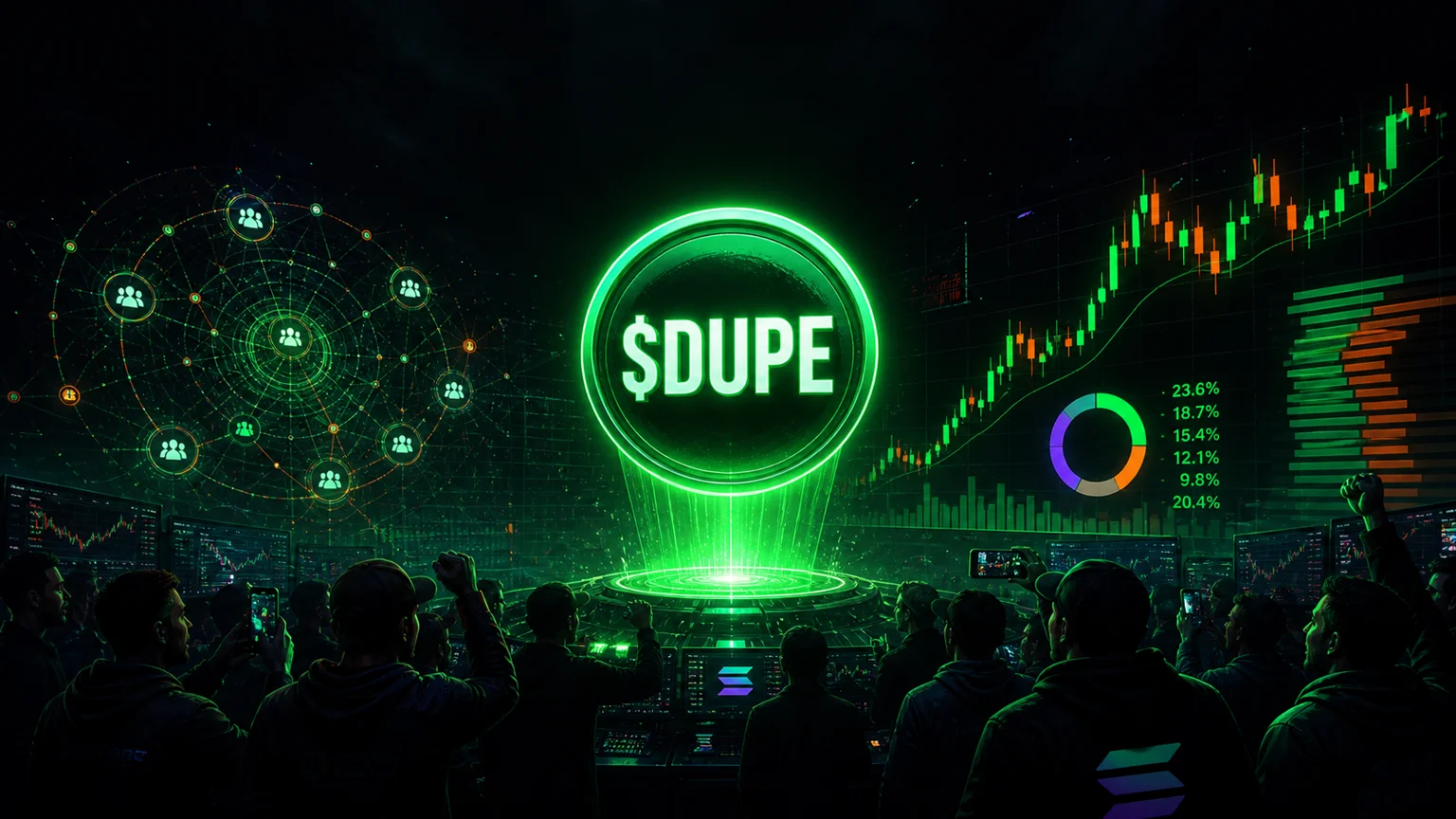
Top three known holders sit near 38.6%, with freeze authority and mint authority disabled.
$DUPE is the rare Solana meme setup where age is the story. Most coins that hit the radar are still warm from launch, which makes the first read simple: did volume arrive before the crowd got bored? $DUPE is different. The market is roughly 481 days old, and it just printed a 106.6% 24-hour move with $111.5K in volume against a $2.1M market cap. That is not a random birth candle. It is an old chart suddenly being repriced.
That matters because dormant survivors trade with a different psychology. Fresh launches need belief; older coins need memory. When a market has been around for more than a year and suddenly wakes up, the tape is asking whether someone found a forgotten brand, whether old holders are finally getting a bid, or whether a thin pocket of attention is enough to make the chart look alive again. The answer is not automatic, but the shape is worth tracking.
- → $DUPE is up 106.6% over 24 hours, with a 16.9% 1-hour push and 37.4% 6-hour move.
- → The token sits near a $2.1M market cap with about $167.8K in liquidity, giving the move more depth than most microcap revivals.
- → Freeze authority and mint authority are disabled, while the top three known holders control about 38.6% of supply.
The 481-Day Reprice
A 481-day-old meme token does not get the same benefit of the doubt as a launch. The chart has history. The early buyers, abandoned wallets, stale holders, and silent communities have all had time to settle into the cap table. That is why the first $DUPE read is less about discovery and more about whether the market is willing to revalue something it had already filed away.
The current numbers say the answer is temporarily yes. A $2.1M cap is not enormous by Solana meme standards, but it is high enough that a double in a day is not just one tiny pool getting dragged around by two wallets. The $167.8K liquidity base is also meaningful for this class of signal. It does not make $DUPE safe, and it does not protect buyers from a fast unwind, but it gives the move more substance than a five-figure pool pretending to be a market.
Why The Bid Looks Cleaner Than A Basic Nostalgia Pump
The buy side has been doing real work. The one-hour snapshot shows 142 buys against 54 sells, roughly a 72.4% buy ratio, with the market still pushing higher instead of simply recycling the same price range. That is useful because old-token revivals often fail at the first sign of sell pressure. If the book cannot absorb stale supply, the chart gives back the move almost immediately. $DUPE has not solved that test forever, but the current tape shows demand arriving while the price is already extended.
The cleaner part is the ratio between attention and liquidity. $111.5K in 24-hour volume is not wild relative to a $2.1M market cap, which means this is not just a giant turnover candle screaming exhaustion. The move is fast, but it is not absurdly overtraded compared with the pool. That gives $DUPE a more measured narrative-reprice profile: enough activity to matter, enough liquidity to avoid the thinnest traps, and enough age to separate it from the usual first-day scramble.
What the On-Chain Data Shows
$DUPE has the kind of on-chain profile that keeps it out of the obvious danger bucket, but not out of the risk bucket. The supplied profile shows freeze authority disabled and mint authority disabled, which removes two of the worst contract-level concerns for a Solana meme coin. The normalized rug score is 23, and the available risk list is empty. That does not mean the token is endorsed or protected; it means the most direct permission risks are not the lead problem in this read.
The actual pressure point is holder concentration. The largest known holder is listed at 18.66%, with the next two at 10.95% and 9.02%. Together, the top three known holders sit around 38.6%. That is not a single-wallet hostage situation, but it is enough to matter. A revival chart can invite old holders to press bids, and a concentrated board means the market has to keep proving it can absorb supply without turning every green candle into exit liquidity.
The holder count helps the case. Roughly 7,293 holders is a much wider base than the average tiny launch, and that matters for a coin this old. A broad holder count does not erase concentration, but it changes the shape of the risk. This is not a token that still looks trapped inside the deployer circle. It is a long-lived meme market with a wide crowd, a few large holders, clean freeze and mint authority checks, and a renewed bid that still needs to survive distribution.
$DUPE earns attention because the chart is old and the liquidity is real enough to matter; the holder map is the part that keeps the read from turning into blind confidence.
The Bear Case Is Stale Supply
The bear case is not complicated. A 481-day survivor can carry a lot of old bags. Traders who bought months ago may not care about the new narrative. They may see the same thing new buyers see, only from the other side: a sudden wave of liquidity after a long wait. If those wallets decide to sell into strength, the chart can look clean until it does not.
That is why the next phase has to be judged by absorption, not by the first green print. $DUPE already moved more than 100% in 24 hours. The better signal would be a higher-volume consolidation where liquidity stays near or above the current level, the holder count keeps expanding, and the top wallets do not turn the move into a one-session distribution event. Without that, the story becomes a nice repricing candle with a crowded cap table behind it.
The Editorial Read
$DUPE is a cleaner-than-average old-token revival, not a risk-free breakout. The difference matters. The market cap is large enough to take seriously, the liquidity is deeper than most microcap sprints, and the authority checks are quiet. The token also has a real holder base, which gives the market more routes to sustained attention than a same-day pump with fifty wallets and a logo.
Still, the top-holder map decides whether this becomes a proper narrative reprice or just a better-looking exit window. The first read is constructive because the move is not relying on a tiny pool and because contract permissions are not screaming. The second read has to be tougher: can $DUPE hold above the first rebid while larger wallets let the market breathe?
$DUPE gets a clean watch, with a concentration caveat. The revival has enough market depth to be more than random churn: $2.1M cap, $167.8K liquidity, 7,293 holders, and disabled freeze and mint authority. The risk is that top-three known holder concentration near 38.6% can still turn a dormant-survivor bid into a distribution event if demand fades.
What is $DUPE?
$DUPE is a Solana meme token with a roughly 481-day market history that is seeing renewed trading activity.
Why is $DUPE moving now?
The latest market data shows a 106.6% 24-hour move, a 37.4% 6-hour move, and $111.5K in daily volume against a $2.1M cap.
Is $DUPE a fresh launch?
No. The age profile is the point: this is an older Solana meme market getting repriced, not a first-hour launch chase.
What is the main $DUPE risk?
The biggest visible risk is holder concentration, with the top three known holders around 38.6% despite clean freeze and mint authority checks.