$DUCK Just Pulled a Watched Wallet Back In, but the Holder Map Is Still the Real Trade
The watched wallet behind @nyhrox bought roughly $3.27K of $DUCK between 12:40 PM and 12:42 PM UTC on June 9 as the Solana meme token traded near a $290K market cap with about $59.8K in liquidity and a 942% 24-hour move. The momentum is obvious, but the bigger question is whether a 34% top-three concentration can keep absorbing attention without turning the board into exit liquidity.
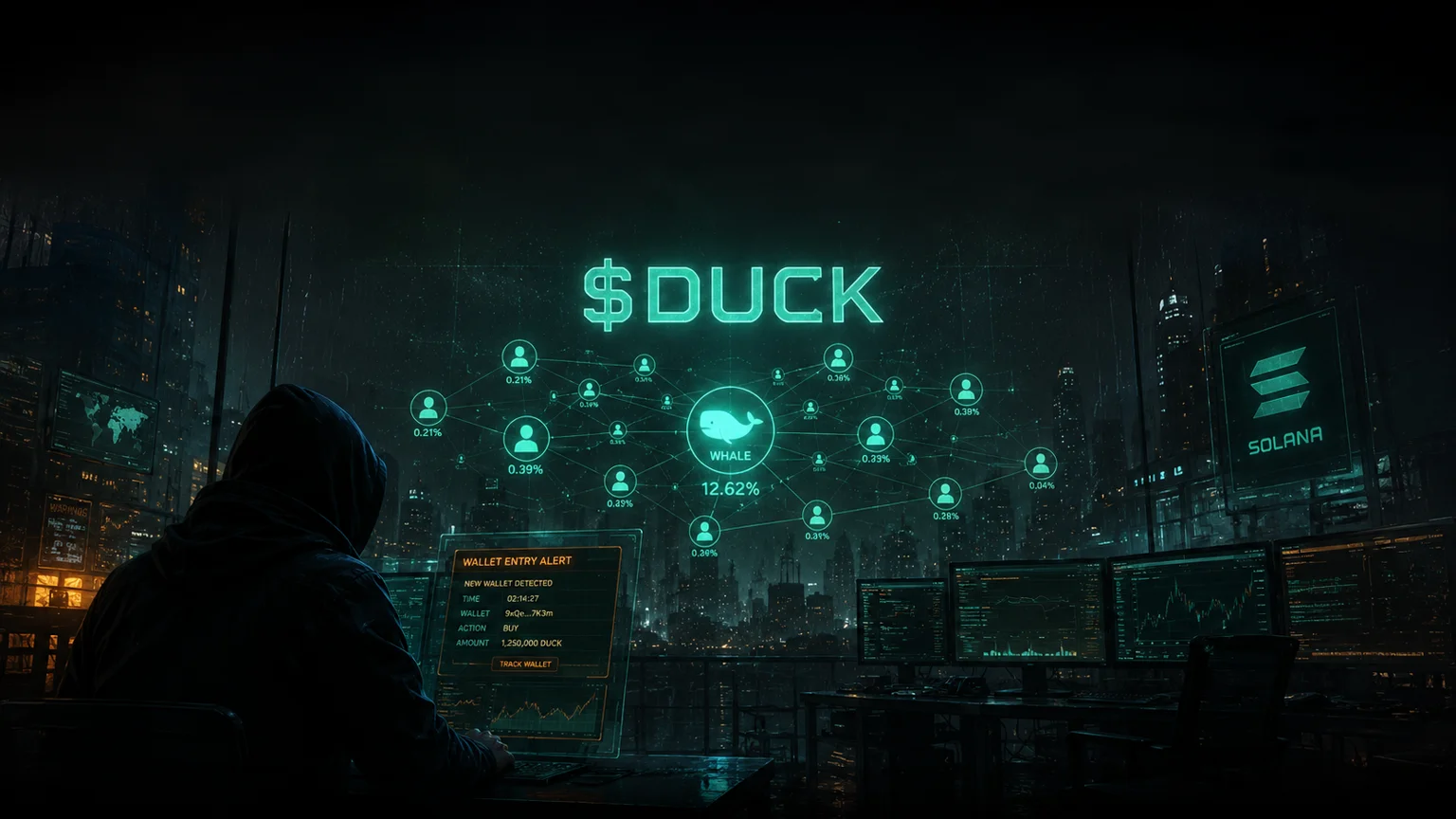
$DUCK carries a low Rugcheck score of 1 and both freeze and mint authority are disabled, but the top wallet still controls 20.69% of supply and the top three wallets hold about 34% combined, which keeps the board in speculative territory even with a cleaner-than-average contract profile.
By 1:15 PM UTC on June 9, the case for covering $DUCK was no longer about whether the chart had moved. That part was already settled. The Solana meme token was trading around a $290.5K market cap after a 942% move over the prior 24 hours, with roughly $251.1K in turnover and just under $60K in liquidity. What changed the tone was the timing of the wallet flow. Between 12:40 PM UTC and 12:42 PM UTC, the watched wallet tied to @nyhrox bought into $DUCK twice, committing a combined roughly $3.27K before the move had turned into a fully crowded CT staple. That does not automatically make the token good. It does make the board more interesting.
The easy mistake here is to see the green daily print and the wallet alert, then stop thinking. $DUCK is only compelling if the second layer still works after the screenshot. That second layer is simple: does the board have enough real demand to handle attention while the holder map stays somewhat tight? A low Rugcheck score and disabled authority keys keep the contract from looking toxic. The concentration stats are what stop this from turning into an easy green-light read.
- → A watched wallet linked to @nyhrox bought roughly $3.27K of $DUCK across two transactions between 12:40 PM and 12:42 PM UTC on June 9, which is the clearest reason the token moved from random chart to real watchlist candidate.
- → $DUCK had enough actual tape behind the alert to matter: about $251.1K in 24-hour volume, roughly $59.8K in liquidity, a 57.95% buy ratio, and a 492% six-hour surge on top of the 942% daily move.
- → The contract profile is cleaner than the average Solana meme sprint, but the top wallet still controls 20.69% of supply and the top three wallets hold about 34% combined, so the biggest risk is not permissions but concentration.
Why the Wallet Entry Matters More Than the Meme
A meme coin called $DUCK does not need much help getting people to click a ticker. It is simple, visual, and made for fast circulation. That is not the story. Plenty of boards with good names never become anything more than low-liquidity jokes that briefly light up a scanner. The reason $DUCK deserves airtime is that a watched wallet stepped in after the board already had some velocity, but before the structure had become fully obvious to everyone else. Two buys in two minutes is not random noise. It suggests conviction, or at least enough interest to pay attention to how the next wave reacts.
The first buy cost roughly $1,637.86 for more than 8.28 million tokens at around $0.0001976. The second came less than two minutes later for another roughly $1,635.09, this time at around $0.0002462 for about 6.64 million tokens. In other words, the buyer paid up on the second fill. That matters because it tells you the wallet was not passively nibbling a dead board at the lows. It was willing to chase a bit into strength. When a tracked wallet averages upward like that, the market usually takes notice, especially on a board this small.
The Numbers So Far
The ratio worth watching first is turnover relative to size. $DUCK processed roughly 86% of its market cap in 24-hour volume by selection time. That is a meaningful number for a sub-$300K Solana meme, even if it is not yet the kind of runaway churn that guarantees every feed starts posting the ticker. It says the board has found real participation instead of relying on one or two theatrical buys to print a screenshot. Volume also accelerated in the shorter window, with about $170.1K of the 24-hour total coming in the last six hours. That is the part that makes the wallet entry worth more than a curiosity.
The 57.95% buy ratio is healthy without looking cartoonish. That is a useful middle ground. An absurdly high buy ratio can sometimes mean a board has turned into a one-sided chase that is almost daring late buyers to become the liquidity event. Here the mix still shows more demand than supply, but not in a way that automatically screams blow-off top. Add the 492% six-hour move and you get the core tension in $DUCK: this is strong enough to justify attention, yet still early enough that one bad wave can rewrite the whole read.
What the On-Chain Data Shows
The contract-level read is cleaner than the rating might suggest at first glance. Rugcheck scored $DUCK a 1. Freeze authority is disabled. Mint authority is disabled. No obvious risk labels were attached in the saved profile. That strips out the easiest reasons to hard-fade a Solana meme token. There is no active admin lever hanging over the trade and no visible mint switch that can turn the supply into a joke. On pure permissions, $DUCK looks better than a lot of boards that get much louder marketing.
The concentration picture is where the read becomes more nuanced. The largest visible wallet holds 20.69% of supply. The pair address accounts for another 9.24%, and the third-largest visible slot is about 4.07%, leaving top-three concentration around 34%. That is not a disaster, but it is not nothing either. In practice, it means the board can still move hard if one big participant gets impatient. It also means the market does not need a malicious contract to create pain. Concentrated ownership is enough by itself when the capitalization is still this small.
That difference changes how the board should be traded. If freeze authority were active or mint authority were still live, the whole article would tilt toward avoidance. Instead, $DUCK sits in the messier category where the contract is mostly fine, but the holder map can still make the chart nasty. This is exactly why the wallet buy matters. On a cleaner holder map, the same watched-wallet activity might justify a stronger signal rating. With 34% top-three concentration and one wallet above 20%, traders still need proof that fresh demand can keep offsetting the risk of a sharp rotation.
Where the Next Repricing Could Come From
But the next catalyst does not have to be some giant headline. Sometimes the repricing on a small Solana board is simply the market noticing that the first wallet was not alone. If more tracked wallets lean in, or if the board keeps stacking volume while holding the market cap under the next obvious round-number threshold, $DUCK can start to look like a narrative reprice instead of a one-wallet alert. The difference is subtle but important. One says traders are reacting to a person. The other says they are reacting to the board itself.
The Counter-Signal
The bear case is not hard to state. $DUCK has already made a large move, and the board is still small enough that distribution from a few large holders could crack sentiment fast. A watched wallet buying does not erase that. In some cases it can even intensify the risk, because other traders crowd in assuming the wallet has perfect timing. If the next wave of demand shows up late or lighter than expected, the same social proof that pulled eyes to the token can become the reason people rush for the exit.
🟡 $DUCK deserves the watch because the wallet flow is real, the volume is respectable for the size, and the on-chain permissions look much cleaner than average. The problem is that the holder map still does a lot of the storytelling. A top wallet above 20% and top-three concentration around 34% mean this is still a board where ownership can matter more than meme quality. If fresh demand keeps arriving after the @nyhrox-linked buys, $DUCK can earn another repricing window. If the board stalls, concentration turns from footnote to main character very quickly.
FAQ
What is $DUCK on Solana?
$DUCK, branded as The Duck, is a Solana meme token trading under contract address 236ziZWiNPWeNk8aNB7abJpv4A6vHNP2XpxHH9VUpump. At selection time it was near a $290.5K market cap with about $251.1K in 24-hour volume.
Why is $DUCK on MemeDesk radar?
Because a watched wallet linked to @nyhrox bought the token twice between 12:40 PM and 12:42 PM UTC on June 9 while the chart already had meaningful momentum, volume, and enough liquidity to make the alert worth more than a novelty.
Is the $DUCK contract risky?
The contract profile looks relatively clean. Rugcheck scored $DUCK a 1, freeze authority is disabled, and mint authority is disabled. The bigger risk is concentration, not contract permissions.
What is the biggest risk on $DUCK right now?
The holder map. The largest visible wallet controls 20.69% of supply and the top three wallets hold about 34% combined, which means a few participants can still move the board sharply if momentum cools.
What would improve the $DUCK read from here?
More volume, sustained buy-side pressure, and evidence that the board can absorb attention without concentration becoming the story would all help. Another round of demand after the watched-wallet buys would be the clearest constructive signal.