$DOLLY Turns A Fake Mourning Joke Into A Sevenfold Solana Bid
$DOLLY ripped through a one-hour pump.fun window with nearly $2.0M in turnover, a $213K market cap, and a cleaner on-chain profile than the headline joke deserves.
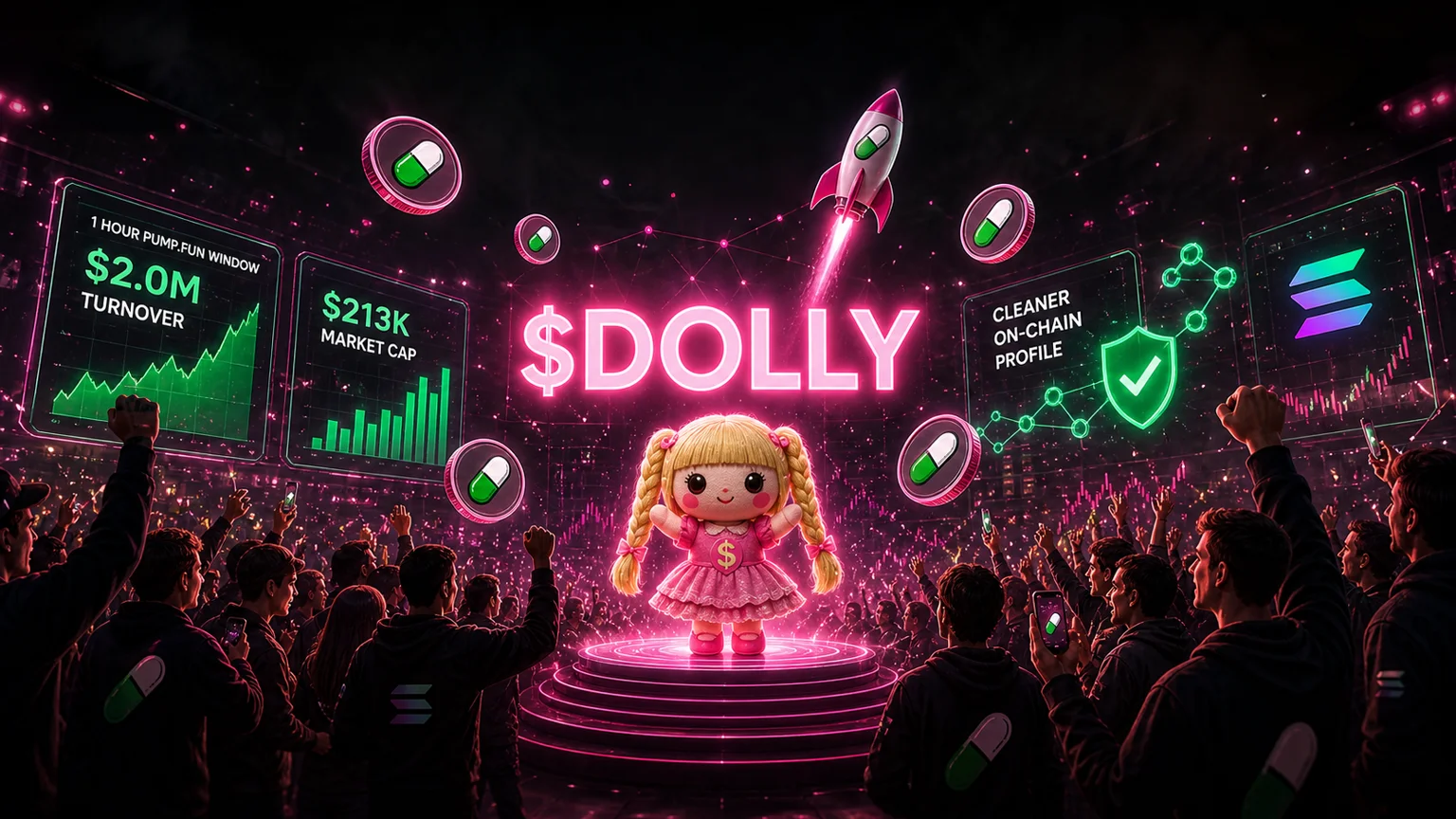
Top three holders sit near 14.0%, with mint and freeze authority disabled and no listed Rugcheck risks.
$DOLLY is not bidding because anyone suddenly discovered a balance sheet. It is bidding because Solana found a shock-meme with a name people instantly understand, then ran a full-speed auction around it. The token, officially labeled RIP Dolly Parton, hit the market through pump.fun and was already showing about $1.96M in 24h volume against a roughly $213K market cap at the 5:55 PM UTC signal timestamp. That is the whole setup: a tiny coin, a culturally loaded joke, and enough turnover to make the market decide whether the gag has another leg.
The clean read is not that $DOLLY is safe. It is that the first hour looked unusually crowded without the most obvious Solana contract warnings showing up. A +732% one-hour move is exactly where late buyers get punished if the crowd blinks, but 36,337 total transactions and 2,911 holders make this more than a single-wallet chart trick. The angle is culture-meme bid: not a tribute, not a fundamentals story, just a fast and slightly uncomfortable internet joke finding liquidity before the market can decide whether it should exist.
- → $DOLLY printed roughly $1.96M in 24h volume while sitting near a $213K market cap, an extreme turnover profile for a launch barely older than an hour.
- → The one-hour tape showed 18,404 buys against 15,476 sells, so the move had real two-sided churn rather than a quiet mark-up.
- → Rugcheck data shows a score of 1, mint authority and freeze authority disabled, and top-three holder concentration near 14.0%.
The Joke Moved Faster Than The Market
Culture coins do not need elegance. They need recognition, timing, and a ticker that compresses a whole conversation into one word. $DOLLY has that for a very specific reason: the name is jarring enough to make traders stop scrolling. That does not make it tasteful, durable, or even coherent. It does make it tradable in the only way these launches usually care about during their first session. The market sees a phrase, understands the emotional charge, and starts bidding the screenshot before the story has time to mature.
That is why the speed matters. At about 1.1 hours old, $DOLLY was already up more than 3,100% across the available 24h window. The usual response is to dismiss that as a cooked chart, and often that is the correct instinct. Here, the counterpoint is the depth of participation. More than 18,000 buys in the one-hour window is not normal background noise for a throwaway launch. It suggests the token became a live object for short-term Solana traders almost immediately.
Why Turnover Is The Signal
The strongest number on $DOLLY is not the percentage gain. Percentage gains on pump.fun can be cartoonish before there is any real market. The stronger number is volume relative to size. A token near $213K in market cap doing almost $2.0M in reported 24h turnover is being passed around at high speed. That can mean the market is stress-testing a real meme, or it can mean early wallets are using excitement as a conveyor belt. The difference will show up in whether holders continue to broaden after the first violent candle.
Liquidity is the uncomfortable part of the read. $DOLLY had about $24.7K in liquidity, which is enough to keep a micro-cap market alive but not enough to make entries forgiving. When volume dwarfs liquidity this aggressively, the chart can look deep until the exact moment sellers arrive together. A bid this fast can become a liquidity trap if buyers treat the headline turnover like real exit depth. The coin can trade a lot and still punish anyone who assumes the pool can absorb size.
What the On-Chain Data Shows
$DOLLY's Solana profile is cleaner than the name suggests. The available Rugcheck data shows mint authority disabled and freeze authority disabled, which removes two of the loudest contract-level problems from the first read. The normalized Rugcheck score is 1, with no listed risks in the profile. The top holder sits at 10.26%, while the next two top holders are 1.92% and 1.87%, putting top-three concentration near 14.0%. For a token barely past its first hour, that is a more balanced holder map than many launches that try to look serious.
That does not mean the holder map is finished. Early Solana launches can decentralize for an hour, then reconcentrate once impatient wallets sell into stronger hands. The broader market data also listed top-holder concentration around 14.23%, and the dev balance was shown at 0%. There is no notable serial-deployer pattern in the available dev profile, and the creator token count is listed as zero. The important point is narrower: the visible authority and holder data do not contradict the culture-meme bid yet.
How The Bid Gets Stronger
$DOLLY gets a better read if the market cap can cool without volume disappearing. The current chart already gave early buyers a massive move, so the next useful signal is not another vertical candle. It is digestion. If holders keep climbing, liquidity improves, and the buy/sell split stays close enough to show real debate, the token can become a broader culture trade instead of a one-hour screenshot. The name gives it reach; the tape still has to prove retention.
The social mechanic is simple. Shock-memes spread when people argue about whether they should be traded at all. $DOLLY can benefit from that kind of attention, but only if the market keeps seeing fresh participation rather than the same early wallets cycling inventory. A stronger bid would look less like pure panic and more like rotation: new holders, thicker liquidity, and a slower grind after the first ridiculous markup.
Where The Trade Can Fail
The bear case is obvious and serious. $DOLLY is a meme coin built around a sensitive, headline-style phrase, already up thousands of percent in a tiny window, with liquidity that can vanish in practical terms if sellers stack together. Clean mint and freeze authority settings do not stop profit-taking. A low Rugcheck score does not create buyers. If the joke stops traveling, the chart is left with a thin pool and a lot of wallets holding a move that already happened.
There is also headline decay. Some culture coins become recurring symbols; most become a single moment. $DOLLY has to convert immediate recognition into repeatable meme use. If the token only worked because the first phrase was shocking, traders should expect the attention cycle to compress fast. The cleaner holder map gives the coin room to trade, but it does not give the joke a second act by itself.
$DOLLY's best signal is the mismatch between tiny market cap and huge turnover, backed by disabled authorities and a top-three holder map near 14.0%.
$DOLLY gets a clean launch-radar read because the visible contract profile is cleaner than average, the holder spread is not immediately alarming, and the first-session volume is real enough to track. The risk is still high: this is a shock-meme with thin liquidity after a violent move. Treat it as a culture bid under observation, not a green light.
Why is $DOLLY on MemeDesk radar?
$DOLLY combined a +732% one-hour move with roughly $1.96M in turnover, 2,911 holders, and clean mint and freeze authority data.
Is $DOLLY a low-risk meme coin?
No. The on-chain data is cleaner than average for a launch this young, but the token still has thin liquidity, extreme early gains, and pure meme-cycle risk.
What would weaken the $DOLLY read?
Shrinking liquidity, falling holder growth, top-wallet concentration rising, or volume fading after the first shock cycle would make the bid much weaker.