A 637-Day-Old Solana Token Nobody Was Watching Just Ripped 160% on $1M Volume
DollarMoon sat dormant for nearly two years. Then something changed — and $1 million in volume hit in 24 hours. Accumulation or exit liquidity?
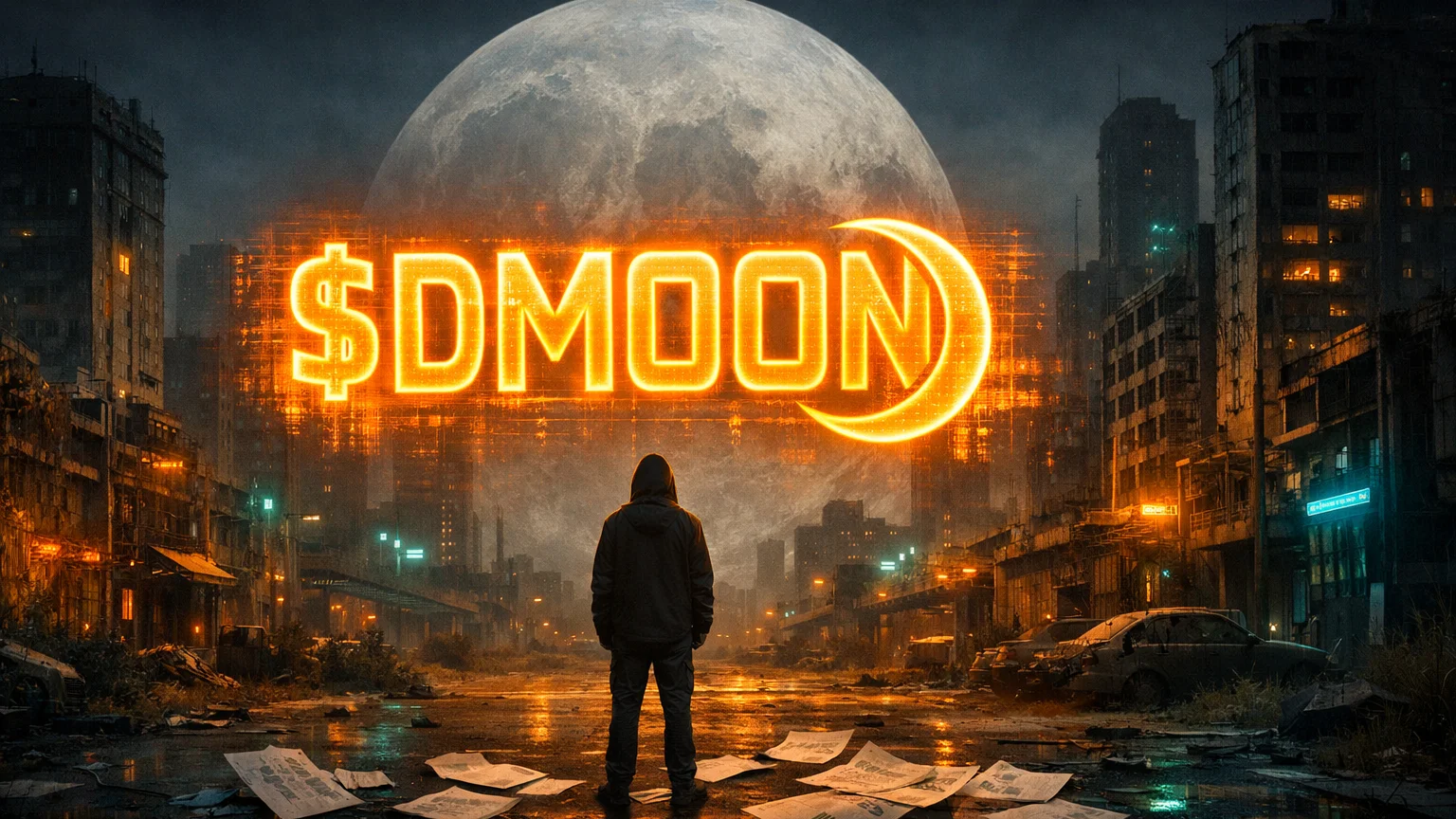
DollarMoon launched 637 days ago on Solana. For most of that time, it did what the vast majority of meme tokens do after the first week: nothing. Volume dried up. Holders stopped caring. The chart flatlined into the kind of horizontal line that usually precedes a quiet delisting from price trackers. Then on March 8, 2026, someone — or more likely, a coordinated group of someones — decided DMOON wasn't dead. $1 million in volume hit in 24 hours. The price ripped 160%. And over 21,800 transactions flooded a token that had been functionally comatose.
- → DMOON surged 160% in 24 hours with $1M volume after 637 days of near-zero activity
- → Buy pressure dominates at 56% of transactions with 13,595 buys vs 8,222 sells — accumulation signature
- → Mint and freeze authority disabled, 70.8 organic score — the token's fundamentals are cleaner than most new launches
The Resurrection Pattern
Dead token revivals aren't new in meme coin culture, but they follow a specific pattern that separates genuine accumulation from manufactured pumps. The pattern looks like this: volume appears out of nowhere on a token with disabled mint authority, a small but loyal holder base, and enough liquidity to actually trade. The first movers are usually wallets that have been sitting on bags for months, suddenly reactivating. Then new buyers arrive, drawn by the spike on aggregator trending lists.
DMOON fits this pattern almost perfectly. The token has 1,300 holders on DexScreener — a number that suggests a community existed at some point, even if it went dormant. Mint authority is disabled, meaning no one can inflate the supply. Freeze authority is disabled, meaning no one can lock wallets. These are the basic hygiene checks that separate tokens worth investigating from ones that should stay dead.
The Numbers Behind the Move
The volume-to-market-cap ratio here is nearly 3:1 — meaning the entire market cap traded almost three times over in a single day. That level of turnover on a 637-day-old token is extraordinary. It's not the kind of activity that happens organically from a handful of holders deciding to trade. Something triggered this.
The buy/sell split tells the more interesting story. With 13,595 buys against 8,222 sells, and buy volume of $545K versus sell volume of $512K, there's a clear accumulation bias. More wallets are buying than selling, and they're buying in slightly larger clips. The spread isn't extreme enough to suggest a single whale pushing the price — it looks distributed, which is what genuine accumulation looks like.
Maker count hits 16,501 with 10,785 unique buyers against 6,533 unique sellers. That buyer-to-seller ratio of roughly 1.65:1 is significant. When nearly twice as many unique wallets are buying compared to selling, the pressure is real. The question is whether these are new wallets entering for the first time or existing holders averaging down.
What Changed After 637 Days?
This is the question that matters, and it's the one without a clean answer. DollarMoon's branding — a rocket heading "the safe way to the moon" — is straightforward meme territory. No unique mechanic. No AI angle. No celebrity endorsement. The project's DexScreener profile shows an active Twitter account but nothing that would explain a sudden $1M volume day.
The most likely explanation is a community-driven revival — what CT calls a "community takeover" or CTO. A small group of holders who never sold decide to breathe life back into a dead project, coordinate on Telegram or Discord, and start generating volume. The disabled mint and freeze authorities make DMOON a candidate for this type of revival because the fundamentals can't be weaponized against holders.
Another possibility: a large holder or group of holders accumulated during the dormant period at essentially zero cost basis, and the current pump is the beginning of a distribution phase. At $358K market cap, even a modest exit of $50-100K would constitute a significant portion of the total liquidity. The 160% move could be the setup, not the payoff.
The Organic Signal
DMOON carries a 70.8 organic score out of 100. This isn't elite — tokens above 80 get the "high" label — but it's solidly above the bot-farm threshold. A 70.8 on a 637-day-old token having its biggest volume day ever suggests the activity is predominantly real. Bots don't typically target tokens at this market cap; the slippage risk makes it unprofitable for most automated strategies.
The 21,817 transactions in 24 hours on a sub-$400K market cap token is also noteworthy. That's roughly one transaction every 4 seconds. The sheer velocity indicates either a very active trading community or significant interest from new participants discovering the token through aggregator trending feeds.
Who's Calling It
No detected KOL coverage as of publication. DollarMoon's 160% move happened without a single notable CT account calling it, which is both bullish and bearish. Bullish because organic price discovery without influencer amplification is the cleanest signal type. Bearish because without KOL amplification, sustaining momentum past the initial spike becomes entirely dependent on the community's ability to self-organize.
The absence of KOL calls at this stage means DMOON is still in what you might call the "discovery window." If a mid-tier CT account picks up the story — a 637-day-old token reviving with clean fundamentals and real volume — the next leg could be substantial. The narrative of a dead token coming back to life is catnip for meme coin culture. But the window closes fast. If no amplification comes within 24-48 hours, the revival could stall.
Historical Context — When Dead Tokens Come Back
Meme token revivals have a mixed track record. The most successful cases — tokens like BONK in its early CTO phase, or various community-takeover projects on Ethereum — typically share three characteristics: disabled admin functions, a holder base above 1,000, and a clear narrative for why "this time is different." DMOON checks the first two boxes. The third is where it gets speculative.
The failure mode for revivals is straightforward: early holders dump into the new volume, the price crashes back to pre-pump levels, and the revival narrative dies. The data suggests DMOON hasn't entered this phase yet — the buy/sell ratio still favors accumulation. But at $358K market cap, it wouldn't take much selling pressure to shift that balance.
🟡 Speculative — DollarMoon's revival from 637 days of dormancy is genuinely interesting. The disabled mint/freeze, 70.8 organic score, and accumulation-heavy buy/sell ratio all point to real interest rather than a pure pump-and-dump. But "interesting" doesn't mean "safe." Early holders sitting on near-zero cost basis could dump at any moment. No KOL has touched this yet. The 160% move could be the start of a sustained revival or the peak before a crash back to irrelevance. If you're trading this, the key metric to watch is the buy/sell ratio over the next 12-24 hours. The moment sellers start outpacing buyers, the revival is over. Set alerts. Size accordingly. Don't be the exit liquidity for someone who bought at $0.000001.
What is DollarMoon (DMOON)?
DollarMoon is a Solana-based meme token that launched approximately 637 days ago. After an extended period of dormancy with minimal trading activity, it experienced a sudden 160% price surge on March 9, 2026, with over $1M in 24-hour volume.
Why is DMOON pumping today?
The exact catalyst is unclear. The most likely explanation is a community-driven revival, where existing holders coordinated to restart trading activity. The disabled mint and freeze authorities make it a viable candidate for a community takeover (CTO) play.
Is DollarMoon a good investment?
DollarMoon is an extremely speculative meme token with no stated utility or development roadmap. While the current metrics (70.8 organic score, accumulation-heavy trading) are positive signals, the token has no KOL backing and carries significant distribution risk from early holders.
How old is DollarMoon crypto?
DollarMoon launched approximately 637 days before its March 2026 revival, placing its origin around mid-2024 on the Solana blockchain. It traded on Raydium DEX through its entire lifecycle.