$DAB67 Printed Real Solana Turnover, but the Post-Pump Exhaustion Is Already Testing How Thin This Board Is
At the 2026-07-09 22:06 UTC selection snapshot, $DAB67 was trading near a $37.0K market cap on about $2.01M of 24-hour turnover with roughly $16.3K of visible liquidity. That is enough flow to matter, but after a brutal six-hour unwind the real question is whether the board still has fresh demand or only recycled churn.
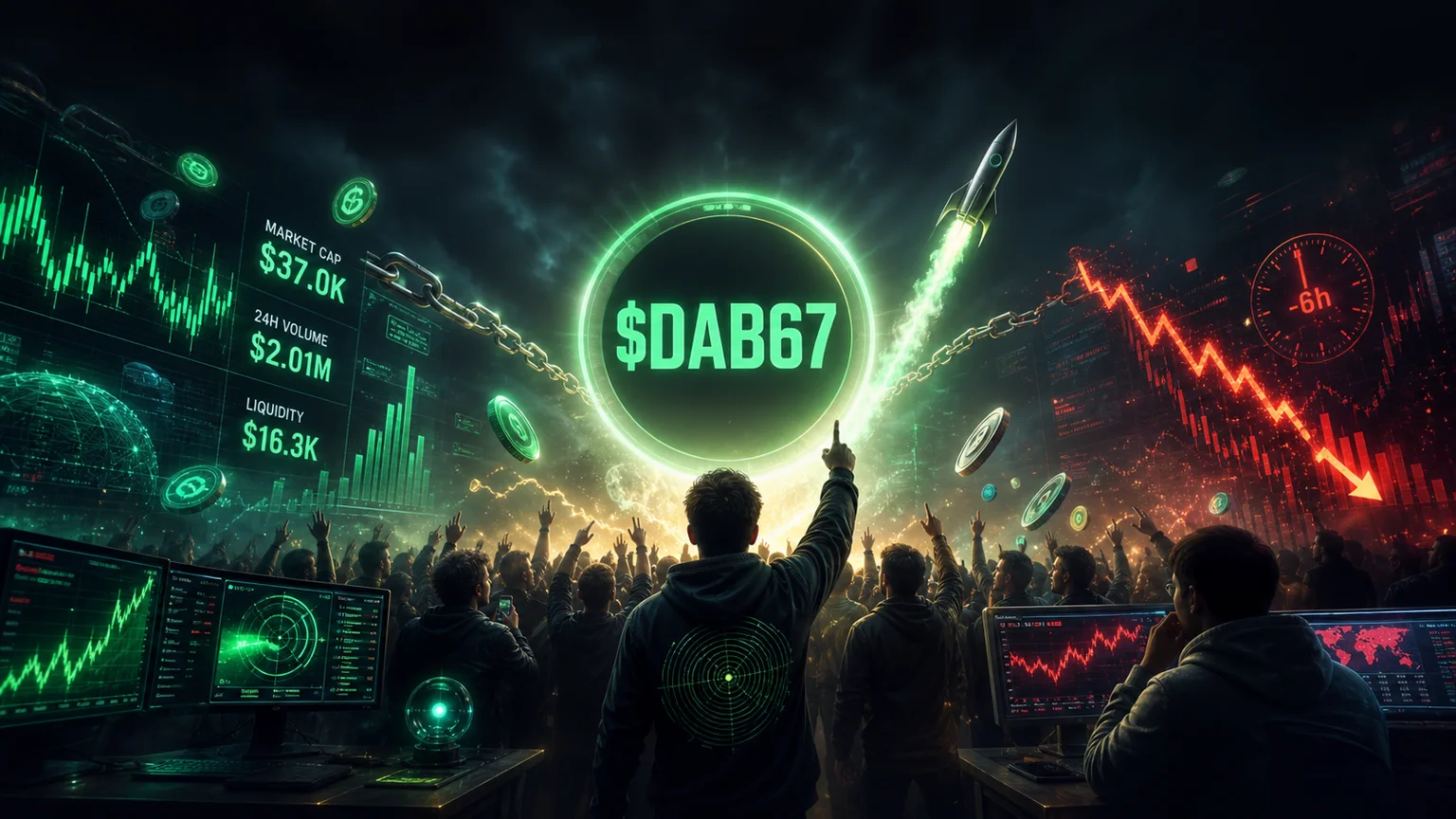
The contract shell for $DAB67 is cleaner than the average panic-chase Solana launch because freeze authority is off, mint authority is off, the creator wallet balance is zero, and Rugcheck scores the token at 1. The harder issue is structural: the top visible wallet still controls about 22.3% of supply, the top three hold about 27.6%, and only about $16.3K of visible liquidity is absorbing a board that already churned more than $2.0M in a single day.
The fastest way to get trapped by $DAB67 is to look at the raw turnover and stop the read there. At the 2026-07-09 22:06 UTC selection snapshot, the Solana token was trading near a $37.0K market cap while carrying about $2.01M of 24-hour volume and roughly $16.3K of visible liquidity. That is a ridiculous amount of circulation relative to the capital base. It means the board got real attention, real clicks, and real money through it. It does not automatically mean the attention is still fresh.
That distinction matters because the latest shape of the tape is not a simple breakout. $DAB67 was up 17.54% on the 24-hour read and bouncing 25.73% over the latest hour, but that bounce came after a vicious 68.11% six-hour unwind. When a micro-cap board takes that kind of hit less than a day after launch, the story stops being "can this thing wake up traders" and becomes "how much of the day was genuine demand versus one hard circulation burst that already spent its best energy."
- → $DAB67 processed about $2.01M of 24-hour turnover on only a $37.0K market cap, which is a real circulation signal and not the kind of sleepy board that survives on one wallet trading with itself.
- → The market already forced the token through a deep stress test because the tape was still down 68.11% across six hours even after a 25.73% one-hour rebound, making post-pump exhaustion the cleanest way to frame the setup.
- → The contract shell is cleaner than the average panic-chase launch with freeze authority off, mint authority off, a Rugcheck score of 1, and zero creator balance, but the board is still thin with only about $16.3K of liquidity and a top visible wallet controlling roughly 22.3% of supply.
Why $DAB67 Earned a Real Look in the First Place
A token does not stumble into two million dollars of daily turnover on a sub-$40K capital base by accident. That kind of ratio means the market kept returning to the same board over and over again, which usually only happens when the ticker is easy to pass around, the pool is active enough to invite momentum traders, and the chart gives people multiple reasons to believe they are still early. In other words, $DAB67 was not ignored. The crowd definitely found it.
The timing also matters. The main PumpSwap pair appeared around 2026-07-09 12:53 UTC, so by the selection snapshot a little after 22:06 UTC the token was only about nine hours old. For a board that young, heavy turnover proves people found it fast. It also raises the harder question of whether the first wave already did most of the emotional work.
The Turnover Is Real, but the Reset Already Changed the Read
If the only number on the board was the 24-hour volume, $DAB67 would read like an easy momentum continuation candidate. The problem is that volume without sequence can fool people. Two million dollars of turnover can be the sign of a board building a broad audience, or it can be the residue from one violent run that already went through its best phase and is now trapping whoever mistakes leftover noise for fresh energy. The six-hour drawdown pushes the article firmly into the second conversation.
That is why post-pump exhaustion is the right angle instead of a generic runner label. $DAB67 already had its first explosion. Now it has to prove the board still deserves attention after the easy reflex trades have been burned through. That is a much tougher ask than printing the first candle.
What the On-Chain Data Shows
The on-chain shell is not the part of $DAB67 that raises the loudest alarm. Freeze authority is off. Mint authority is off. The creator wallet balance is zero. Rugcheck scores the token at 1 and does not attach active risk labels in the saved report. In a market full of low-effort launches that look fine for fifteen minutes and then reveal hostile permissions, that matters. The contract is not screaming at traders to leave.
The holder map is more mixed. The top visible wallet controls about 22.3% of supply, while the next two visible wallets sit around 2.73% and 2.54%. That leaves the top three at roughly 27.6% combined. This is not the cartoonishly bad version of concentration where one wallet and one pool practically are the project, but it is still enough concentration to matter when liquidity is this shallow. A top holder that large can make every bounce feel tighter than it looks on the surface.
Rugcheck counted about 1,517 holders and showed the main PumpSwap liquidity as fully locked, with most of the visible dollar depth sitting in the primary pool. That is cleaner than a launch where unlocked liquidity or mint permissions become the whole thesis against the board. But clean permissions do not rescue a thin market. If the token starts leaning on a narrow set of repeat buyers, the lack of depth becomes the bigger risk.
The creator history is also quiet. The current report does not surface a leftover creator balance or a meaningful serial-deployer footprint, so the read stays focused on market structure instead of dev behavior. That is useful because it narrows the real argument. The bear case on $DAB67 is not "the shell looks hostile." The bear case is "the shell looks acceptable, but the board may already have spent most of its emotional fuel while still being thin enough to slip hard on the next rotation."
Why the Next Bounce Has to Be Earned, Not Assumed
This is the stage where weak reads get expensive. Once a token has already processed enormous turnover relative to its size, traders can confuse familiarity with strength. They know the ticker, saw it move, and watched it survive one bounce. For $DAB67, the next meaningful signal would be sustained trade after the reset, not a single sharp candle that re-excites the same wallets who already touched it.
The reason this matters more than usual is liquidity. About $16.3K of visible depth is enough to keep upside dramatic, but it also keeps exits fragile. Boards like this can look heroic right until they do not. If fresh buyers step in, the small float can work in the token's favor. If they do not, the same thinness that powered the squeeze becomes the thing that turns every seller into a problem.
$DAB67 does not read like an obvious contract trap. It reads like a real turnover event that already burned through a lot of energy and now has to prove the rebound is attracting new demand instead of just replaying the same small room.
The Bear Case Is Already Visible
The harsh read is simple: $DAB67 may have already shown traders its entire trick. A board that can be down more than 68% across six hours that early in life has already told the market how unstable the ride can get. If the next bounce fails to stick, the huge 24-hour turnover starts looking less like broad adoption and more like evidence that the launch already over-traded its best narrative window.
The second risk is concentration meeting shallow depth at exactly the wrong moment. A top visible wallet around 22.3% is manageable when attention is rising and the tape is liquid enough to absorb moves. It becomes more dangerous when the token is tired and every exit has more impact than the headline volume suggests. That is why the rating stays speculative. The shell is cleaner than average, but the board is still thin enough that structure alone cannot rescue a fading crowd.
🟡 Speculative — $DAB67 deserves the watch because the board processed about $2.01M of 24-hour turnover on only a $37.0K market cap, the contract shell is cleaner than average with freeze authority off, mint authority off, and a Rugcheck score of 1, and there is at least some rebound demand after the washout. The caution is the actual story: the token was still down 68.11% across six hours, visible liquidity was only about $16.3K, and the top visible wallet controlled roughly 22.3% of supply. That makes this a post-pump exhaustion read, not a blind continuation setup.
What is $DAB67?
$DAB67 is a Solana meme token trading under contract 9QNz5x4wmUWgpaF2zx7UtLvzvgyDzzVznpdJ85cNayZC. The tracked primary market on DexScreener is the PumpSwap pair Hx64vH7Yzq2c9UWqLvfpBtb3HhEFYbMELDyFnecCcGJ3.
Why is $DAB67 on launch radar?
Because by the 2026-07-09 22:06 UTC selection snapshot, the token had processed about $2.01M of 24-hour turnover on a market cap near $37.0K while still active enough to print a 25.73% one-hour rebound after a brutal intraday reset.
What does the on-chain profile look like for $DAB67?
The contract shell looks cleaner than average for a fresh Solana board: freeze authority is off, mint authority is off, the creator wallet balance is zero, Rugcheck scores the token at 1, the main visible liquidity is locked, and the top three visible wallets account for roughly 27.6% of supply.
Why is the rating speculative instead of clean?
Because the market-structure risk is still too obvious to ignore. $DAB67 had already dropped 68.11% over six hours, visible liquidity was only about $16.3K, and the largest visible wallet still controlled about 22.3% of supply.
What would improve the read on $DAB67?
The strongest upgrade would be evidence that the rebound can hold while bringing in fresh demand instead of only recycling the same early participants.