$CMNS Ripped Into Jupiter Flow, But the Holder Map Is the Whole Trade
$CMNS has the volume and liquidity to deserve attention, but three visible wallets controlling roughly two-thirds of supply turns this Solana runner into a concentration test.
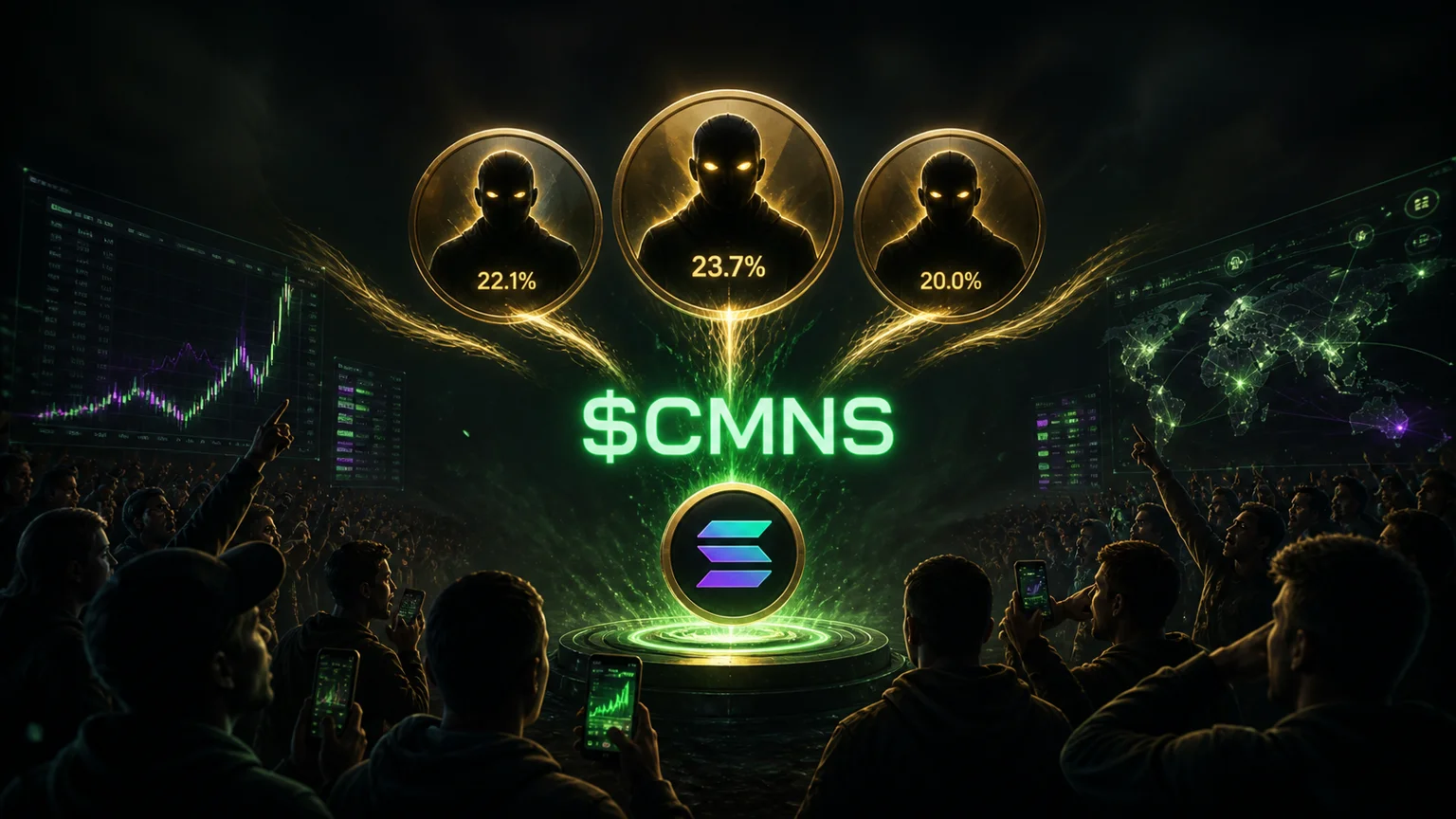
$CMNS has disabled freeze authority and mint authority with no listed Rugcheck risks, but the top three visible holders control roughly 67.6% of supply.
$CMNS is not hard to notice. Commons by Virtuals pushed into the current Solana runner lane with about $3.97M in 24-hour volume, a $3.66M market cap, and $157.6K in liquidity at the saved 2026-08-24 15:38 UTC market read. That is enough size for traders to treat the ticker as more than a random launchpad flare. It is also exactly the kind of market where the first green number can hide the real question. The chart says attention arrived. The holder map says the trade is still being decided by a small group of wallets.
That is the editorial angle: holder concentration. $CMNS has the activity profile to justify coverage, but the supply profile keeps it firmly in speculative territory. A token can have disabled authorities, millions in volume, and a clean-looking risk list while still carrying a brutal overhang if too much supply sits near the top. In this case, the top three visible holders account for roughly 67.6% of supply. That does not automatically mean a rug, and the saved profile does not mark those wallets as insiders. It does mean every new buyer is trading beneath a heavy ceiling until distribution improves.
- → $CMNS came through the Solana runner flow with roughly $3.97M in 24-hour volume against a $3.66M market cap.
- → The price action is already violent: about +5,143.9% over 24 hours, while the latest one-hour read was down roughly 17.0%.
- → The contract-control read is better than the holder read: freeze authority and mint authority are disabled, but the top three visible holders sit near 67.6%.
The Runner Case
The bullish version of the $CMNS story starts with turnover. Daily volume sitting above current market cap is not background noise. It means the market is actively repricing the token instead of simply leaving a thin pool marked at a fantasy number. For meme tokens, that matters because attention is the product. A board with nearly $4M changing hands in a day can pull fresh eyes, feed screenshots, and keep short-term traders engaged even after the first candle cools.
Liquidity also gives $CMNS enough room to be taken seriously. A $157.6K pool is not deep in any mature-market sense, but it is not a dust-bin exit either. It gives buyers and sellers a visible venue to fight over price. That does not remove slippage risk. In a market moving this quickly, the pool is still thin compared with the amount of daily volume cycling through it. But it does put $CMNS above the lowest-quality launch names where one medium wallet can make the chart look alive or dead by itself.
Why the Pullback Matters
The one-hour move is the part that keeps the article from reading like a victory lap. $CMNS was still up more than 5,100% over 24 hours, but the most recent short window showed roughly a 17.0% drawdown. That is not fatal after a move this vertical. It is normal profit-taking behavior. Still, the timing matters because the pullback is happening while the market is already aware of the ticker. The easy stealth bid is gone. From here, $CMNS needs proof that buyers can absorb distribution rather than just chase the earlier mark-up.
This is where meme traders often get trapped. They see a huge 24-hour percentage and assume the next leg is automatic because the token has momentum. In reality, a +5,143.9% move changes the game. Early holders are no longer deciding whether they are in profit. They are deciding how much profit to realize and how aggressively to sell into new demand. That makes the next phase less about discovery and more about absorption. If $CMNS can keep volume high while the top of the holder map loosens, the setup improves. If volume fades while concentrated wallets remain heavy, the chart can turn from runner to exit route quickly.
What the On-Chain Data Shows
The Solana contract-control picture is not the main problem in the saved read. Freeze authority is disabled, so the issuer does not appear to retain a live transfer-freeze switch. Mint authority is disabled too, which removes the obvious unlimited-supply concern from the immediate risk stack. Rugcheck score is 30, with no listed risks in the saved profile. That is not a green light, but it does mean the obvious authority traps are not what define the $CMNS story right now.
The holder concentration is the issue. The largest visible wallet holds 25% of supply. The second sits at 22.61%. The third holds 20%. Together, those three wallets control roughly 67.6%. None of the three are flagged as insiders in the saved profile, and that distinction matters. A large holder is not automatically a malicious holder. But from a trading perspective, concentration does not need bad intent to become a problem. It only needs one or two large wallets deciding the liquidity is good enough to leave.
That is why liquidity depth and holder concentration need to be read together. $157.6K in liquidity looks respectable for a young Solana meme until it is measured against a top-three cluster that large. The pool can support active trading, but it cannot make a two-thirds supply overhang disappear. If those wallets are benign, patient, or structurally locked in a way the current snapshot does not explain, $CMNS can keep building. If they are simply large holders waiting for volume, the same activity that makes the token attractive also gives them the exit.
$CMNS has cleaner authority settings than many fast Solana memes, but its speculative label comes from the supply map: three visible wallets near 67.6% is too large to ignore.
The Commons by Virtuals Angle
The name gives $CMNS a slightly different flavor from the usual animal, typo, or celebrity-adjacent Solana ticker. Commons by Virtuals reads like a culture-meme bid wrapped around a broader crypto-native brand reference. That can help a token move because it gives traders more than a random four-letter symbol to repeat. The market does not need a white paper; it needs a phrase that people can recognize quickly enough to share. $CMNS clears that low but important meme threshold.
Still, the narrative is not strong enough by itself to erase the concentration problem. A clean phrase can bring attention, but attention is temporary unless the market structure gives new participants confidence that they are not just funding top-wallet exits. The better version of the $CMNS setup is simple: continued volume, a deeper pool, and visible supply moving away from the three largest holders. Without that, the narrative remains tradable but fragile.
What Would Improve the Read
The first improvement would be distribution. If the top-three holder share falls materially while price holds a reasonable range, that would be a constructive sign. It would suggest supply is moving through the market without breaking the chart. The second improvement would be liquidity growth that keeps pace with market cap. A larger pool would not solve concentration, but it would reduce the chance that every meaningful sell creates an outsized candle. The third improvement would be continued organic-looking turnover after the early percentage gain cools.
The failure case is just as clear. If $CMNS keeps bleeding in the short window while 24-hour volume falls, the runner story weakens fast. If the largest wallets stay static and the pool does not deepen, the market is basically asking new buyers to trust a concentrated supply stack during a post-pump phase. That is possible, but it is not the kind of setup that deserves a clean rating. The current data supports watchlist attention, not conviction.
Verdict
$CMNS is a real runner signal with enough volume, liquidity, and contract-control cleanliness to stay on the board. It is not a clean structure yet. The top-three holder cluster near 67.6% makes this a concentration test first and a momentum trade second. The better read is to watch whether distribution improves while the market keeps absorbing sell pressure. Until then, $CMNS belongs in the speculative bucket: active, visible, and potentially explosive, but still carrying a supply overhang that can matter more than the headline volume.
Why is $CMNS on MemeDesk radar?
$CMNS showed a live Solana runner profile with roughly $3.97M in 24-hour volume, a $3.66M market cap, and enough liquidity to make the market worth tracking.
What is the biggest risk in the current $CMNS data?
The top three visible holders control roughly 67.6% of supply. That concentration can pressure the chart if large holders sell into the current liquidity.
Does disabled freeze and mint authority make $CMNS safe?
No. Disabled freeze authority and mint authority reduce specific contract-control risks, but they do not remove liquidity risk, holder concentration risk, or post-pump exhaustion.
What would make the $CMNS read stronger?
A lower top-three holder share, deeper liquidity, and continued volume after the initial price surge would make the setup healthier.