$BULLTISM Is Printing the Kind of Solana Buy Pressure Degens Chase, but One Wallet Still Owns Too Much of the Story
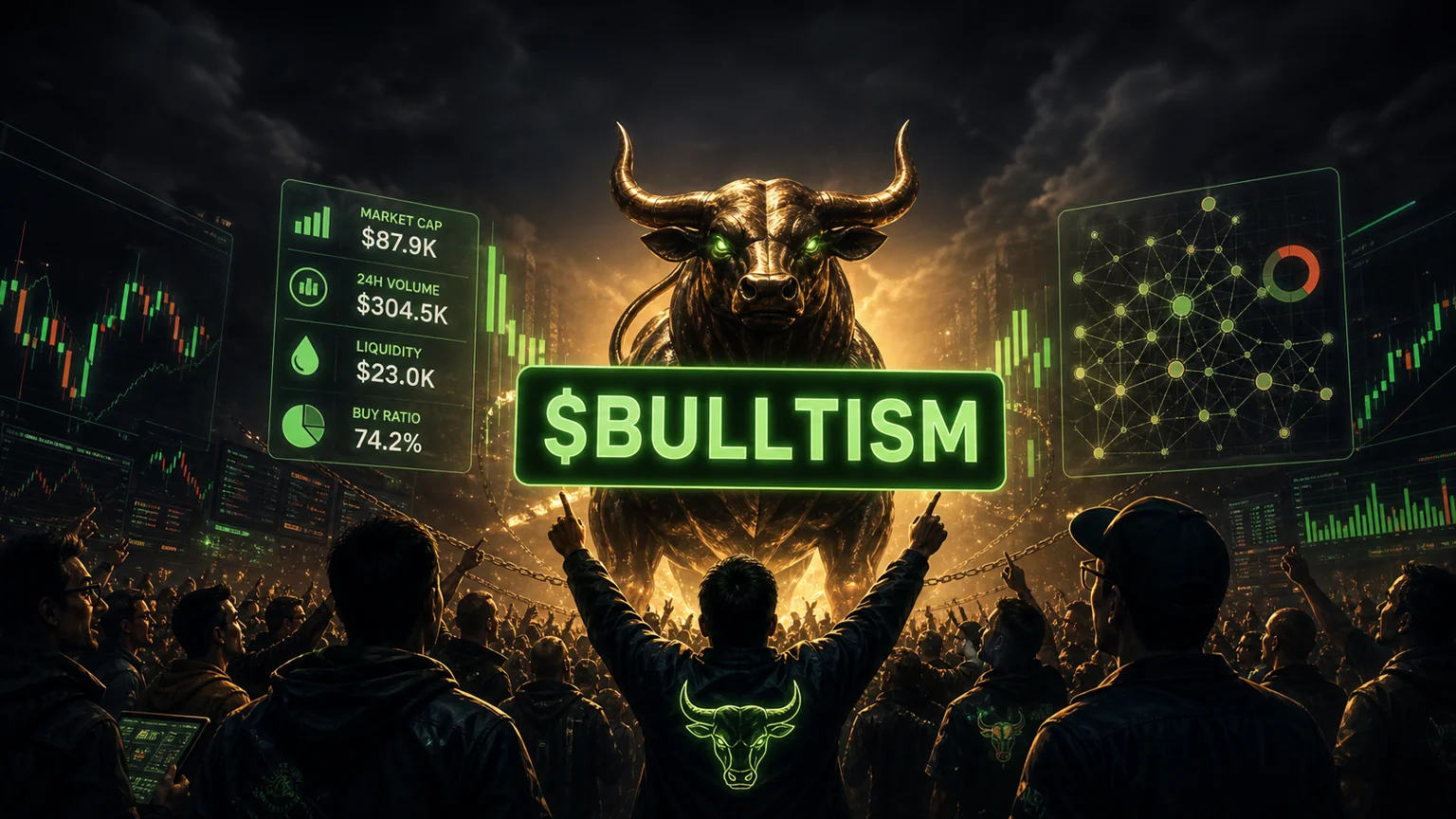
By 2026-07-07 22:03 UTC, $BULLTISM was trading near an $87.9K market cap with roughly $304.5K in 24-hour volume, about $23.0K in liquidity, and a 74.2% buy ratio. The contract read looks clean, but the holder map is still concentrated enough that this fresh bull-themed board needs a better handoff before the move deserves more confidence.
$BULLTISM carries a saved Rugcheck score of 1, with freeze authority disabled and mint authority disabled, but the visible holder map is much tighter than ideal: the top wallet alone controls 29.19% and the top three visible wallets sit near 43.8% combined.
$BULLTISM is doing what a lot of tiny Solana launches fail to do after the first hour: it is still attracting aggressive buy-side attention instead of fading into bagholder theater. By 2026-07-07 22:03 UTC, the token was trading near an $87.9K market cap with roughly $304.5K in 24-hour volume, almost 9,892 transactions, and a 74.2% buy ratio. For a board that small, that is enough activity to matter. The move says traders are not just watching the chart. They are actively pressing it, and they are doing it on a token with a symbol and theme that obviously fit the current bull-market meme reflex.
The reason the setup stays speculative is not hidden in the contract. It is hiding in the holder map. $BULLTISM has one of those reads that looks promising at first glance because the buy pressure is clean and the contract profile is calm, then turns more delicate once you look at how much supply a couple of wallets still control. That split matters. A board can be real enough to trade and still be too concentrated to trust. In other words, $BULLTISM has the velocity degens chase, but it has not yet earned the kind of ownership handoff that lets a tiny meme start acting bigger than its size.
- → $BULLTISM reached roughly an $87.9K market cap on about $304.5K in 24-hour volume by 2026-07-07 22:03 UTC, which is meaningful turnover for a board this small and still only modestly capitalized.
- → The order flow is the obvious hook: 7,339 buys against 2,553 sells produced a 74.2% buy ratio, while the one-hour move was already up 43.54%, showing that buyers kept leaning on the pair well after launch.
- → The contract read is calm, with Rugcheck at 1, freeze authority off, and mint authority off, but the holder map is crowded because the top wallet holds 29.19% and top-three visible concentration is around 43.8%.
Why the Buy Pressure Looks Better Than the Ownership Read
A 74.2% buy ratio gets attention because it suggests the board is being accumulated faster than it is being recycled. That matters even more on a token sitting below a $100K market cap, where small shifts in conviction can remake the chart in minutes. $BULLTISM was not just floating on a quiet pool. It was pulling in repeated flow, which explains why the pair still looked alive more than five hours into its visible life on DexScreener.
The branding helps, too. The ticker is blunt, on-theme, and tuned for a market that still responds to bullish self-reference. Degens do not need a deep lore package to understand the pitch. They see the word bull, they see the early green candles, and they understand the trade in one glance. That simplicity is powerful when a meme is small enough that psychology can still outrun fundamentals by a wide margin.
But the buy pressure story is only half the read. Small boards can print impressive ratios because the crowd is leaning on a narrow float. If supply is not genuinely distributing while the chart runs, then what looks like strong demand can really be a fragile contest over too few tokens. That is the central tension in $BULLTISM. The front-end tape looks better than average. The deeper question is whether ownership is broad enough for the next leg to be something other than a squeeze through a keyhole.
A Tiny Board Can Still Feel Crowded Fast
The raw turnover is strong enough to justify attention. About $304.5K in 24-hour volume against an $87.9K market cap means the board has already been recycled multiple times, which is often how a fresh meme proves it can keep attracting interest after the first candle. It is also useful that the pair age was already around 5.42 hours in the saved read. This is not a 20-minute wonder being judged before the market even knows it exists. Traders had time to rotate through the board, and they still kept buying more than they sold.
The issue is that only about $23.0K in liquidity sits underneath that action. That is thin even by Solana standards, which means price can look stronger than ownership really is. On boards like this, conviction often gets overstated because the chart moves beautifully until one meaningful seller arrives. Thin liquidity is not inherently bearish. It is just unforgiving. $BULLTISM can absolutely keep climbing from here, but the pool is still small enough that the wrong wallet deciding to exit can do more damage than the current momentum suggests.
The near-10,000 transaction count adds another layer. That kind of activity tells you the token is being touched constantly, which is bullish for relevance but not necessarily for quality. High transaction count can reflect broad engagement, or it can reflect a crowded scramble around a narrow float. Without better holder distribution, the board risks becoming one of those launches where everyone feels early until they discover they were just trading inside someone else's inventory.
What the On-Chain Data Shows
The cleanest part of the $BULLTISM read is the contract profile itself. Rugcheck scored the token at 1, freeze authority is disabled, and mint authority is disabled. Those are meaningful positives because they take away several of the easiest ways for hidden control to ruin the trade after momentum arrives. If the holder map looked healthier, those signals would give the board a much easier path toward a cleaner rating.
Instead, the holder map is where the risk concentrates. The largest visible wallet controls 29.19% of supply, and the second wallet adds another 12.88%, leaving top-three visible concentration around 43.8% before the rest of the board even gets a meaningful say. That is not a technical rug flag in the same way freeze or mint authority would be, but it is still an important structural risk. A board this small does not need malicious code to behave badly. It only needs too much emotional control in too few hands.
There is one modest positive inside that concentration risk: the visible top wallets are not flagged as insiders in the saved snapshot, and the deployer profile shows zero creator tokens tied to prior launches. That removes some of the ugliest interpretations. Even so, traders should not overcorrect into comfort. A non-insider whale with 29.19% of the supply can still dictate price action on a token where liquidity is only about $23.0K. Clean contract settings do not neutralize concentrated ownership. They simply narrow the list of ways the board can break.
The bullish read is that $BULLTISM has authentic buy-side pressure and a contract setup without obvious freeze or mint traps.
The bearish read is that one large wallet still owns too much of the emotional float, so the board can stay crowded even while the chart looks healthy.
What Would Upgrade the Read or Break It
For $BULLTISM to earn a better read, the next step is obvious: ownership has to disperse while liquidity gets thicker. If the board can keep its current energy while the biggest wallets shrink as a percentage of supply, the token becomes much easier to respect. A small-cap meme does not need perfect distribution to work. It just needs enough new ownership that the next move feels like market expansion rather than a squeeze around one dominant bag.
The break condition is just as clear. If the large holder decides to sell into the same thin pool that made the chart look exciting on the way up, the move can reverse faster than the crowd expects. That is why the right frame here is not bullish or bearish in the abstract. It is conditional. The tape says buyers care. The holder map says one wallet still matters too much. Whichever side changes first will probably decide whether this token becomes a stronger bull-board follow-up or another reminder that small-cap momentum can be structurally deceptive.
🟡 Speculative — $BULLTISM deserves attention because the buy pressure is real, the ticker fits the market's current reflexes, and the contract profile looks clean with Rugcheck at 1 plus freeze authority and mint authority both off. The reason it stays speculative is the holder map. A 29.19% top wallet and roughly 43.8% top-three visible concentration are too large to ignore on a board backed by only about $23.0K in liquidity. If ownership broadens, the read improves quickly. If it does not, the same concentration can capsize the move.
What is $BULLTISM?
$BULLTISM is a Solana meme token that was trading near an $87.9K market cap by 2026-07-07 22:03 UTC while printing about $304.5K in 24-hour volume. The token is being watched because it kept a strong buy ratio and high transaction count despite its very small size.
Why is MemeDesk watching $BULLTISM?
The token stands out because 7,339 buys against 2,553 sells created a 74.2% buy ratio, which is strong order flow for a board with less than a $100K market cap. That kind of imbalance can produce outsized moves if the structure underneath it improves.
Does $BULLTISM look safe on-chain?
Safe is the wrong standard for any fresh meme coin, but the contract profile itself looks cleaner than average. Rugcheck scored the token at 1, freeze authority is disabled, and mint authority is disabled. The bigger risk is not contract control. It is concentrated ownership combined with thin liquidity.
What should traders watch next on $BULLTISM?
The key checks are whether the biggest holder's share starts dropping, whether liquidity grows beyond roughly $23.0K, and whether the board can keep attracting buyers without relying on a narrow float. If those things improve together, the token's speculative read becomes more constructive.