
$Bullius Is Getting Bought Like a Solana Sprint, and Now the Question Is Whether the Board Can Stay Ordered
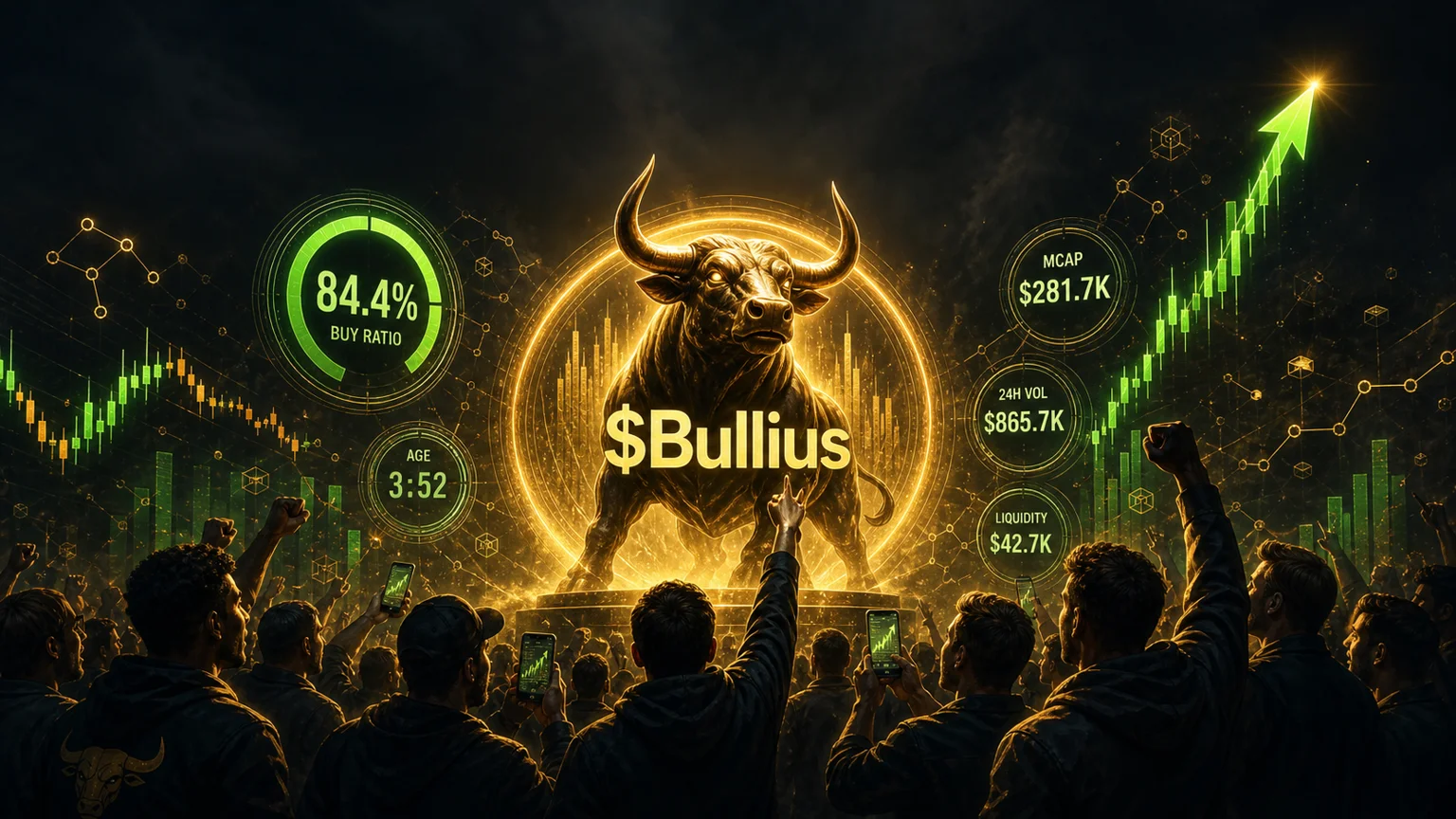
At roughly 7:00 PM UTC on July 6, $Bullius was trading near a $281.7K market cap after about $865.7K in 24-hour volume with roughly $42.7K of liquidity. The striking number is not just the 347% daily move. It is the 84.4% buy ratio on a token that was only about 3 hours and 52 minutes old, which makes this a live test of whether a clean cap table can survive reflexive demand.
Rugcheck scored $Bullius a 1, both freeze and mint authority are off, and the top three visible wallets control only about 9.4% of supply, which is unusually loose distribution for a first-session Solana meme launch.
$Bullius is the sort of Solana launch that can make a board look stronger simply by refusing to cool off when it should. By roughly 7:00 PM UTC on July 6, the token was trading around a $281.7K market cap after processing about $865.7K in 24-hour volume with roughly $42.7K in liquidity. The price was up 347% on the day and another 28.04% over the latest hour. Those are aggressive numbers on their own, but the more revealing detail is the buy ratio. Around 84.4% of the recorded 24-hour transactions were buys, which tells you this was not just a board that caught attention. It was a board still being chased.
That kind of one-sided pressure can mean two very different things. In the best version, the market has found a token with enough meme fit and enough structural cleanliness to attract repeated participation before the chart is widely saturated. In the worst version, a new launch is simply experiencing the most reflexive stage of its life cycle, where everybody arrives convinced there will be one more vertical leg because nobody wants to be the first person who sold a board that later became the day's big screenshot. $Bullius is compelling because the current read supports the first interpretation more than most first-session memes do, even if it has not escaped the second one yet.
- → At the 7:00 PM UTC read, $Bullius was trading near a $281.7K market cap with about $865.7K in 24-hour volume and roughly $42.7K of liquidity, giving the token enough depth to feel tradeable rather than purely theatrical.
- → The biggest standout metric is the 84.4% buy ratio across roughly 21,793 daily transactions, a sign that the board was still being accumulated instead of merely defended.
- → The structure underneath the move is unusually clean for a first-session Solana launch: Rugcheck scored the token 1, freeze authority is off, mint authority is off, and the top three visible wallets only control about 9.4% of supply.
Why Buyers Keep Reaching Higher
Meme tokens do not need deep lore to move, but they do need a simple hook the market can repeat. $Bullius Maximus has one of those names that travels well in a feed because it instantly tells traders what mood the board wants to project. It is not subtle. It does not need to be. Solana runners live and die on whether the chart and the branding can be understood in the same glance, and $Bullius passes that test easily. Once the token also started printing volume, the board gave traders a reason to do what they always do with simple tickers and rising candles: keep hitting buy because the thing is legible enough to be shared without explanation.
The stronger point is that the volume profile does not look random. About $865.7K in 24-hour turnover on a board this fresh matters because it suggests the token is getting revisited instead of merely sampled. If the move were built only on one burst of curiosity, the tape would usually show more hesitation after the first run. Instead, $Bullius was still up 28.04% over the latest hour at the selection snapshot. That says the board was not simply living on its opening reputation. It was still actively discovering price, which is exactly the state where small-cap Solana memes can recruit a much larger second wave.
The Board Is Getting Bought Faster Than It Can Rest
The key number here is not just the daily gain. It is the relationship between the buy ratio and the age of the pair. The board was only about 3 hours and 52 minutes old at the time of the snapshot. When a token that young is already processing nearly $866K in turnover and doing it with buyers overwhelming sellers, the market is not behaving patiently. It is behaving like a crowd that wants exposure first and analysis second. That can be a positive sign when the rest of the setup is clean, because speed matters in meme rotations. It can also be exactly what creates the first ugly air pocket if the crowd suddenly decides everybody else has already arrived.
Liquidity helps keep that risk from looking fatal, but it does not erase it. Roughly $42.7K is a respectable pool for a token at this size, especially compared with the paper-thin boards that often try to pass themselves off as major movers after one lucky candle. It means $Bullius has some room to absorb normal profit-taking without immediately becoming untradeable. The caution is that a board driven by 84.4% buy flow can feel deceptively easy while the pressure is one-directional. The first real question only arrives when the market finally asks the token to rest.
What the On-Chain Data Shows
On-chain, $Bullius looks cleaner than the average first-session meme and that is the main reason it earns a better rating than a lot of equally loud launches. Rugcheck scores the token a 1. Freeze authority is off, so holders are not staring at an obvious transfer-freeze threat. Mint authority is off as well, which removes the simplest supply-dilution risk from the board. The saved creator profile does not show a serial deployer angle and there are no listed risk flags demanding a more hostile interpretation. Those are basic boxes, but new Solana boards fail them more often than degens like to admit.
The holder map is even more interesting. The largest visible wallet controls 7.78% of supply, while the next two visible holders are only 1.02% and 0.63%. That leaves top-three concentration at roughly 9.4%, which is remarkably loose for a token this early in its life cycle. A board with that profile is much less vulnerable to one wallet dictating the entire next candle. Holder distribution does not guarantee clean trading, but it does change what traders need to fear. With concentration this light, the bigger risk is crowd exhaustion rather than a few dominant pockets using the bid as their exit.
That distinction matters because a clean cap table forces a more honest read. If $Bullius fails from here, it is less likely to fail because of hidden contract tricks, abusive mint settings, or a giant whale ceiling nobody bothered to notice. It is more likely to fail because meme boards can still outrun themselves. In other words, freeze authority being off helps, mint authority being off helps, and the loose holder map helps most of all, but none of those things can manufacture endless demand. They can only make it easier to trust that the next move, up or down, is coming from real market behavior.
Can the Market Turn Pressure Into Structure?
This is the real upgrade test for $Bullius. A token can look excellent during the phase where everybody still believes the path of least resistance is higher. What separates a watchlist-quality runner from a throwaway sprint is whether the board can keep acting orderly once the first wave of obvious gains is on the table. That does not mean the token needs to stop pulling back. Healthy runners pull back all the time. It means the chart has to prove it can digest profit-taking without the whole crowd suddenly discovering that the bullish case was just momentum borrowing confidence from itself.
Right now the evidence is good enough to keep $Bullius in the cleaner bucket. The liquidity is real enough for the size. The holder map is far better than the norm. The contract shell is clear of the usual immediate admin scares. Even the buy-heavy transaction mix can be read constructively because it suggests the board is still attracting new demand instead of merely surviving on stale holders. The only thing missing is time. A token that is not yet four hours old cannot prove durability no matter how pretty the first sprint looks. It can only show whether the setup deserves the benefit of a second look, and $Bullius does.
Verdict
🟢 Clean. $Bullius has the kind of first-session structure degens usually wish they saw more often: about $42.7K of liquidity supporting a roughly $281.7K market cap, an 84.4% buy ratio showing live demand, a Rugcheck score of 1, both freeze and mint authority off, and only about 9.4% of supply concentrated in the top three visible wallets. That does not make the token safe or finished. It simply means the bullish case is currently being powered by a cleaner board than most Solana launches get to claim. The next judgment is not whether it can print one more green candle. It is whether it can stay orderly once the market finally asks it to breathe.
FAQ
What is $Bullius on Solana?
$Bullius is the Solana meme token Bullius Maximus, trading under contract 6YZm2PVLBozyfvGrMTrZbZHxYQz8aFG3sm6rCfw3pump. At roughly 7:00 PM UTC on July 6 it was trading near a $281.7K market cap.
Why did $Bullius stand out on launch radar?
Because the board paired strong volume with an extreme buy imbalance. The token had about $865.7K in 24-hour turnover, a 347% daily move, and an 84.4% buy ratio while still under four hours old.
Does $Bullius look clean on-chain?
Cleaner than average, yes. Rugcheck scores the token a 1, freeze authority is off, mint authority is off, and the top three visible wallets only control about 9.4% of supply.
What is the main risk in $Bullius right now?
The biggest risk is not a hidden contract problem. It is exhaustion. A very young board with an 84.4% buy ratio can still lose order quickly if traders decide the easy chase is over.
What would confirm the $Bullius setup from here?
A controlled pullback, steady liquidity, and continued price discovery after early holders take some profit. If the token stays orderly through that process, the clean first read becomes much more meaningful.