$BREAD Drew a Watched Wallet Before the Crowd Arrived, but the Holder Map Still Deserves Respect
Bread Tycoon pushed toward roughly $154.4K in market cap after a Sunnyikes-linked wallet started buying at 2026-06-17 02:06 UTC, well before the tape had fully turned into routine timeline traffic. The opening read has real volume and clean contract permissions behind it, yet only about $29.2K in liquidity and a top visible wallet above 20% mean this Solana board can still get slippery if traders start treating an early catch like a solved story.
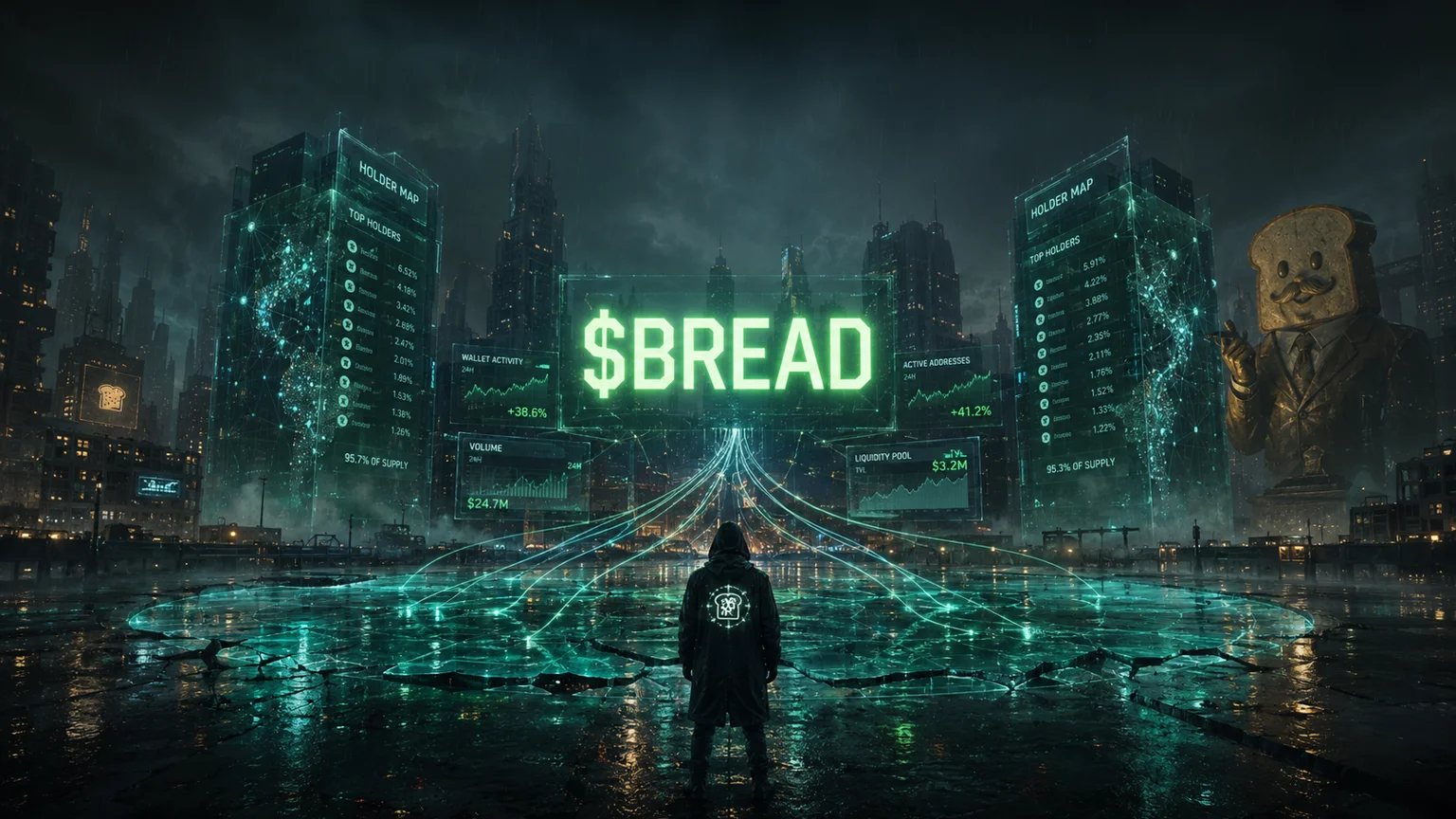
$BREAD shows no active freeze or mint authority and carries a rug score of 1, but the top three visible wallets still control about 35.6% combined while only roughly $29.2K in liquidity is supporting the current run.
$BREAD has the kind of first-session profile that can make Solana traders talk themselves into certainty too quickly. A Sunnyikes-linked watched wallet stepped in at 2026-06-17 02:06 UTC, paying just under $244 in total while the token was still cheap enough that the average degen feed had not fully latched on. From there the board ran toward roughly a $154.4K market cap, printed about $276.9K in 24-hour volume, and turned Bread Tycoon into something more than a random novelty ticker drifting through a sleepy launch window.
That is the good version of the story. The harder read is that early watched-wallet participation does not erase the mechanics underneath the chart. $BREAD still sits on only about $29.2K in liquidity, and the visible holder map is concentrated enough that the wrong kind of exit can reshape the entire candle in a hurry. This is why the token belongs in the speculative bucket instead of the cleaner one. It has enough evidence to justify a real editorial read, but not enough structure to let traders relax.
- → A Sunnyikes-linked wallet bought $BREAD at 2026-06-17 02:06 UTC before the board became ordinary timeline traffic, which matters because discovery is more useful than late applause.
- → $BREAD is trading around a $154.4K market cap with about $276.9K in 24-hour volume and a 404% price move, so the current interest is broader than one isolated wallet screenshot.
- → The issue is still structural: only roughly $29.2K in liquidity and about 35.6% top-three visible wallet concentration mean this run can stay exciting and still be fragile at the same time.
Why the Sunny Entry Still Matters
A watched-wallet entry does not magically transform a microcap meme into a durable market. It does, however, change the burden of proof. When a recognizable wallet shows up before the ticker becomes standard crowd repetition, the move stops looking like pure accident. In $BREAD's case, the wallet was not chasing a giant completed move. It was buying while the pair was still in a formative stage, at an implied price near $0.0000994. With the token now around $0.0001548, the entry reads less like a tourist touch and more like an informed attempt to catch the board before broader participation widened the spread.
That timing matters because meme markets are often backward-looking. Traders see a chart up hard, then search for a reason to explain it after the fact. An early watched-wallet fill reverses that sequence. It gives the token a live clue that someone willing to be monitored took the board seriously before the average reader even knew the name. That is one of the few details in launch tape that can carry real signal without needing a long story wrapped around it.
It also helps that the buy was not so large that it completely fabricated the market by itself. About $244 is not enough to brute-force a lasting meme narrative. What it can do is frame the board as a place worth taking a closer look if the tape starts proving itself. That is where $BREAD sits now. The early watched-wallet catch created context. The rest of the board still has to justify the excitement with actual depth and with holder behavior that does not immediately turn predatory once the first wave cools.
The Turnover Is Real Even If the Cushion Is Not
The argument for watching $BREAD seriously begins with turnover. A token sitting around a $154.4K market cap that has already processed roughly $276.9K in 24-hour volume is not surviving on one lucky print. The board has seen enough participation to confirm that traders are actually engaging with the ticker. Even the last hour alone logged about $63.6K in volume, which tells you the market did not instantly go dead after the earliest excitement passed through.
The problem is that turnover is only half the story on Solana launches. A board can look busy and still be dangerously thin underneath. That is exactly the tension here. Roughly $29.2K in liquidity is enough to let upside momentum feel much bigger than the board's actual durability. Traders see a fast candle, a decent volume figure, and a market cap that still sounds early. What they do not always price correctly is how little liquidity it takes for a small cluster of holders to turn a healthy-looking tape into a rush for the door.
That is why $BREAD reads more like a watched-wallet squeeze than a settled runner. The volume says people care. The liquidity says the market still has a narrow spine. Both can be true at once. In fact that combination is usually what creates the best short-term upside and the nastiest reversals in the same trade. A strong first session is valuable, but it does not become trustable until the pool grows enough that buyers are no longer doing all of the structural work for the chart.
What the On-Chain Data Shows
The on-chain profile gives $BREAD a better chance than many first-session boards get. Freeze authority is off. Mint authority is off. The saved Rugcheck read shows a rug score of 1. That removes several of the easiest reasons to instantly fade the setup. There is no live mint switch hanging over the token, and there is no freeze authority risk that can suddenly turn a market problem into a contract problem. For a Solana meme in its first hours, that is meaningful baseline hygiene.
The holder map is where the caution comes back in. The largest visible wallet controls about 20.75% of supply. The next visible line, which includes the pair, is another 11.77%, while the third visible holder sits around 3.09%. That puts the top three visible wallets at roughly 35.6% combined. On paper that is not catastrophic for a young board, but it is concentrated enough that the token still needs respectful handling. When liquidity is only around $29.2K, concentration figures that might feel manageable on a larger board become far more active risks.
The dev side does not currently add fresh drama. Creator token count is 0 in the saved profile, and there are no listed risk flags in the current enrichment. That keeps the main focus on market structure instead of on an obviously toxic deployer history. In practical terms, the contract profile is cleaner than the order book. If $BREAD loses traction from here, it is more likely to happen because the holder map leans on a thin pool than because some hidden authority suddenly ruins the token.
What Needs to Happen Before This Read Improves
The most important next step for $BREAD is not another dramatic candle. It is a thicker pool and a calmer holder distribution around that pool. If liquidity can keep climbing while the board holds its current range, the same watched-wallet signal that now looks merely interesting can mature into a much stronger launch read. That would tell traders the early entry did not just front-run attention. It would suggest the market is actually building underneath the first wave.
If that does not happen, the same setup can turn the other way just as fast. The crowd has a habit of treating early wallet catches like a cheat code, especially when the chart already shows triple-digit upside. But a watched-wallet fill is not a backstop. It is just one data point. If the board stalls and top holders decide the first-session move was good enough, the lack of depth will matter far more than who bought first.
$BREAD has earned attention because the earliest money did not arrive by accident. The upgrade from speculative to cleaner only comes if liquidity expands enough that the holder map stops feeling like a live source of slippage.
That is the real editorial read on Bread Tycoon right now. There is a legitimate reason the token is being watched. The timing of the Sunnyikes-linked buy gave the board signal before it had consensus. The contract permissions are cleaner than average. The turnover is active enough to matter. But the market is still young, the pool is still thin, and the holder map is still concentrated enough to turn enthusiasm into stress. $BREAD looks like a live speculative launch, not a solved one.
$BREAD earns a speculative read because the earliest watched-wallet interest was real, the board has processed meaningful volume, and the contract profile looks tidy on current data. The reason it does not move into the cleaner bucket is the structure underneath: only about $29.2K in liquidity and roughly 35.6% top-three visible wallet concentration leave plenty of room for a sharp reversal if the first-session bid cools.
What is $BREAD on Solana?
$BREAD, branded as Bread Tycoon, is a newly launched Solana meme coin trading around a roughly $154.4K market cap after an active first-session run.
Why does the Sunnyikes-linked buy matter for $BREAD?
The wallet bought at 2026-06-17 02:06 UTC before the token became standard crowd chatter, which makes the entry more useful as discovery context than a late reaction to a chart everyone already saw.
What is the biggest risk on $BREAD right now?
The biggest risk is mechanical rather than contractual. Liquidity is only about $29.2K, and the top three visible wallets still control roughly 35.6% combined, so the board can get thin quickly if early holders decide to sell.