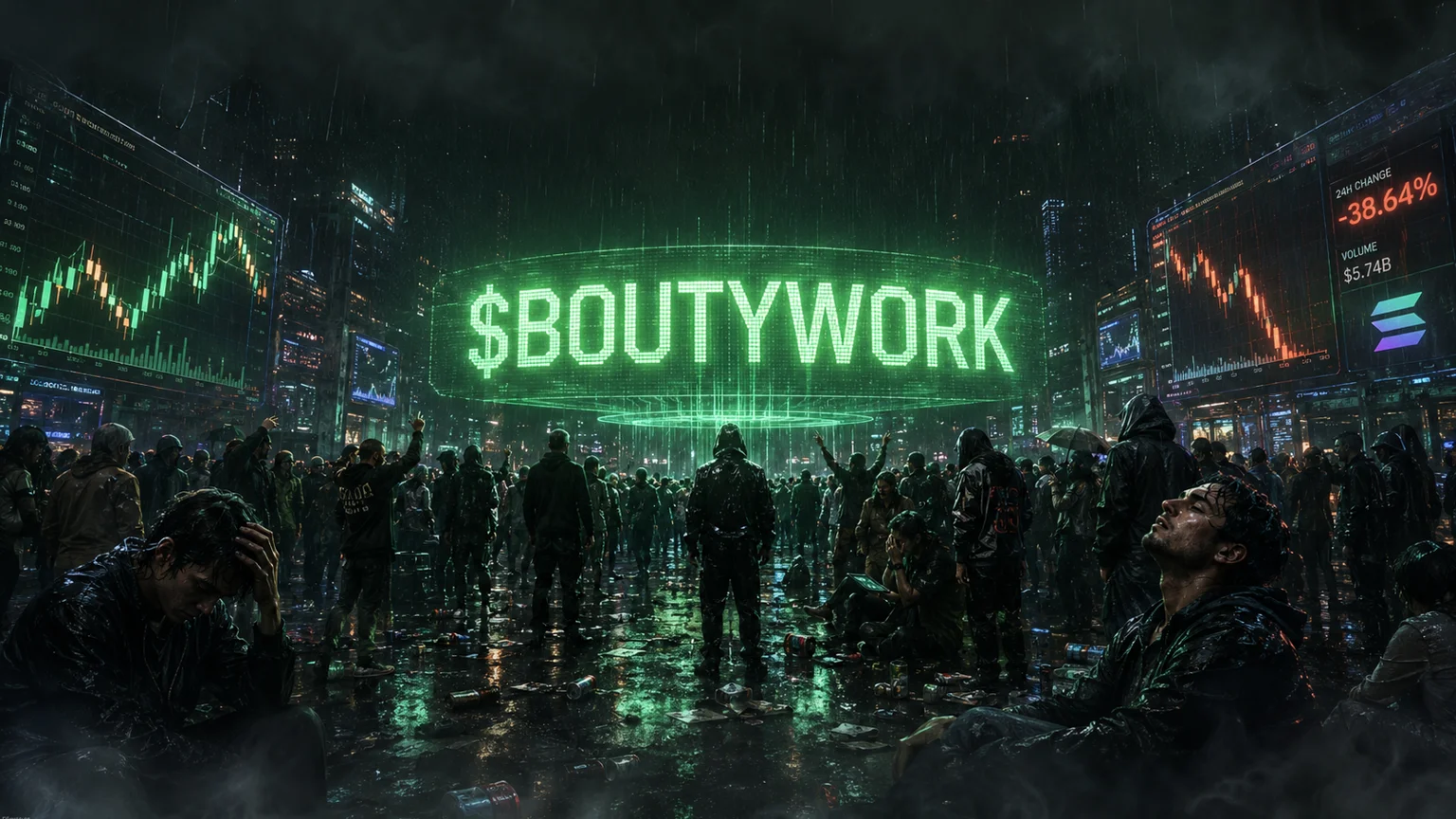
$BOUTYWORK Already Printed the Kind of Solana Spike Everyone Chases, but the Real Read Now Is Whether the Board Has Anything Left After a 13,000% Day
$BOUTYWORK pushed to roughly a $248K market cap on more than $5.57M of 24-hour turnover, yet the cleaner contract profile matters less than the fact that the token is already dealing with a 29.35% six-hour fade and only about $37.5K of liquidity under a move that may have spent its easiest upside early.
The contract permissions look clean, but one wallet still controls 20.69% of supply and the top three wallets hold 34.7%, which matters more once momentum slows.
$BOUTYWORK already did the part of the move that gets clipped into group chats. The saved market snapshot shows the Solana token around a $248K market cap with more than $5.57M in 24-hour turnover, nearly 93,400 transactions, and a one-hour move that was still green even after the board had been trading for basically a full day. That is a loud tape for a sub-$300K meme coin. It means the token was not drifting along on a handful of emotional buys. It means the market found it, pushed it, and kept trading it hard enough to give the move real weight.
The harder question is whether any easy money remains after a 13,019% daily run and a 29.35% six-hour slide. That combination is why the right angle is post-pump exhaustion, not clean-runner celebration. The contract read is fine. Freeze authority is disabled. Mint authority is disabled. Rugcheck scores the token at 1. None of that changes the fact that a chart can be structurally clean and still be late. Once a board has already become the obvious winner on volume, the job changes from discovery to absorption. Can new buyers keep taking inventory from the first wave, or did the market already spend its best energy getting here?
- → $BOUTYWORK exploded to roughly a $248K market cap on about $5.57M in 24-hour turnover and more than 93,000 transactions, so this was a real attention event rather than a dead launch trying to cosplay momentum.
- → The contract layer looks cleaner than average because freeze authority is disabled, mint authority is disabled, and the saved Rugcheck score sits at 1, which removes the easiest contract-risk reasons to dismiss the board.
- → The trade still leans speculative because liquidity was only about $37.5K, the top wallet held 20.69% of supply, and the token was already down 29.35% over six hours despite the giant 24-hour number staying intact.
The Big Green Candle Already Happened
A lot of fresh meme boards never graduate from screenshot bait into actual market structure. $BOUTYWORK did. More than 93,000 transactions in the saved window and a buy ratio just under 53% tell you the token hosted a genuine two-way market. That matters because the chart was not built by one-sided spoof activity or a tiny pack of wallets passing tokens around. People actually showed up to trade this thing. On Solana, that is the minimum requirement for a move to deserve editorial attention. Without broad traffic, a vertical chart means almost nothing.
But once a token clears that first test, the board stops being about whether it can attract eyes and starts being about whether it can survive its own fame. A 13,000% day is not a gentle uptrend. It is a blow-off style event unless the market proves otherwise. The six-hour drawdown is the detail that makes the tape worth slowing down for. If a board is still losing nearly 30% across that window while the headline number remains huge, that usually means a meaningful chunk of early traders already treated the first manic leg as exit time. Late buyers are no longer front-running discovery. They are negotiating with profit takers.
What the On-Chain Data Shows
The cleanest part of the file is still the contract permissions. Freeze authority is disabled, so there is no obvious transfer kill switch hanging over the market. Mint authority is disabled too, which matters because it removes one of the fastest ways a meme coin can destroy trust right after a breakout. In a market full of flimsy launches, those two details are not minor. They are the reason $BOUTYWORK cannot just be dismissed as another obvious trap with a hidden admin lever waiting off screen.
Rugcheck backing that up with a score of 1 gives the board even more credibility on a purely technical read. That is about as calm as this part of the market ever looks. The developer profile also does not point to an obvious serial-launch machine. Creator token count is zero in the saved data, and the developer balance read sits at zero as well. In plain terms, the setup does not scream that a known deployer is farming a repeat playbook across a dozen nearly identical boards. That matters because it shifts the discussion away from contract danger and toward market behavior.
The holder map is where the story stops being comfortable. The top wallet controlled 20.69% of supply in the saved profile, while the next two wallets held another 8.88% and 5.15%. Top-three concentration at 34.7% is not fatal on its own, but it is large enough to matter every time momentum weakens. Concentration risk does not need insider labels to become a problem. Even if none of the top holders are flagged as insiders, a wallet north of 20% can still become the emotional center of the market. If that wallet sells, tests the bid, or even just moves, traders notice immediately.
Liquidity depth is the other reason the board stays fragile. Around $37.5K in liquidity is enough for a fast meme token to look impressive on the way up, but it is not enough to make the move forgiving once the trade gets crowded. This is the classic mismatch that traps people after the first vertical leg: millions in turnover create the feeling of safety, while a much thinner liquidity base underneath means exits can turn ugly fast. The number to respect is not only the volume total. It is the relationship between that volume and the actual cushion available when traders decide they would rather lock gains than keep cheering.
Why Volume This Big Can Still Be a Late Trap
The seductive read on $BOUTYWORK is simple. If a token can print more than $5.57M in turnover while still sitting near a $248K market cap, then maybe the board has not even come close to its real ceiling yet. That argument sounds good because it contains a true detail. Enormous relative volume often does signal real obsession, and obsession is the oxygen that powers second and third legs on Solana. The problem is that relative volume loses predictive power once the market has already gone full stampede. At that stage, the same frenzy that made the token famous can also mean most of the obvious buyers already clicked.
That is where the six-hour drawdown becomes the most important number in the file. If the market were still in pure discovery mode, a token this loud would usually show stronger short-window control. Instead, the board is asking new buyers to step into a chart that has already rewarded the earliest traders and already started proving that sellers can hit back. There is nothing wrong with trading that setup. Degens do it every day. The mistake is treating it like the same opportunity it was twelve hours earlier. It is not. The risk has changed, and the edge has to change with it.
The constructive sign would be a steady base after the six-hour pullback, liquidity staying near or above the current pool, and holder count rising without the top wallet concentration getting worse.
The Only Bull Case That Matters From Here
The bullish case is not that $BOUTYWORK once went vertical. The bullish case is that the board might still be able to digest the first mania phase without breaking its market structure. That would mean turnover remains active after the initial euphoria, liquidity does not leak away, and the next push comes from fresh participation rather than the same early wallets recycling attention. If that happens, the token can still earn another leg because the contract setup is not fighting the market. There is no freeze authority problem, no mint authority problem, and no glaring deployer history stain dragging the narrative down.
What would improve the read most is simple: a calmer base and a less emotional chart. When a board survives the first parabolic burst and starts building higher lows instead of desperate spikes, that is when a token moves from spectacle into an actual market worth trusting for more than one trade. $BOUTYWORK has not done that yet in the saved read. What it has done is prove that people cared enough to create a serious event around it. For some traders, that is enough reason to keep it on the screen. For everybody else, it should be enough reason to demand more evidence before treating the next green candle like a fresh invitation.
The bearish path is easy to sketch too. If turnover cools, liquidity remains shallow, and the largest holders keep looming over the tape, then the market can spend the next session bleeding all the excitement out of a chart that once looked unstoppable. That does not require a rug, a contract exploit, or a dev wallet scandal. It only requires exhaustion. In meme coins, exhaustion does plenty of damage on its own. That is why the board deserves watchlist status without earning a clean badge. The token has already proven it can explode. It has not yet proven it can stay healthy after exploding.
Verdict
🟡 Speculative - $BOUTYWORK has real tape, a cleaner-than-average contract setup, disabled freeze authority, disabled mint authority, and a Rugcheck score of 1. It stays speculative because the board already looks late relative to its first move, liquidity was only about $37.5K under a token that traded more than $5.57M in the same window, and one wallet still controlled 20.69% of supply.
FAQ
What is $BOUTYWORK?
$BOUTYWORK is a Solana meme coin trading under contract address 3oL99tu2qnxka3HnxY8g1cXNpgBJ5ojoSWWFiDMopump. In the saved market snapshot, it was priced around $0.0002482 with a market cap near $248K.
Why did $BOUTYWORK get attention so fast?
Because the token printed roughly $5.57M in 24-hour turnover, more than 93,000 transactions, and a 13,019% daily move while the lead pair was only about 24 hours old, which is enough to separate it from routine launch clutter.
What is the main risk on $BOUTYWORK right now?
The main risk is post-pump exhaustion rather than contract permissions. Freeze authority is disabled and mint authority is disabled, but liquidity was only about $37.5K, the top wallet held 20.69% of supply, and the token was already down 29.35% over six hours.