
$BCAT Is Trying to Turn a Fresh Smart-Wallet Ping Into a Cleaner Second Leg on Solana
banana cat is still tiny enough to disappear in an afternoon, but the first read is better than the average trench launch. At the 10:05 AM UTC selection snapshot on July 7, $BCAT was trading near a $59.9K market cap with roughly $400.1K in 24-hour volume, about $20.5K in liquidity, and a Rugcheck profile that came back unusually light on obvious contract risk. That combination gives the board a cleaner second-leg case than most same-day animal launches get.
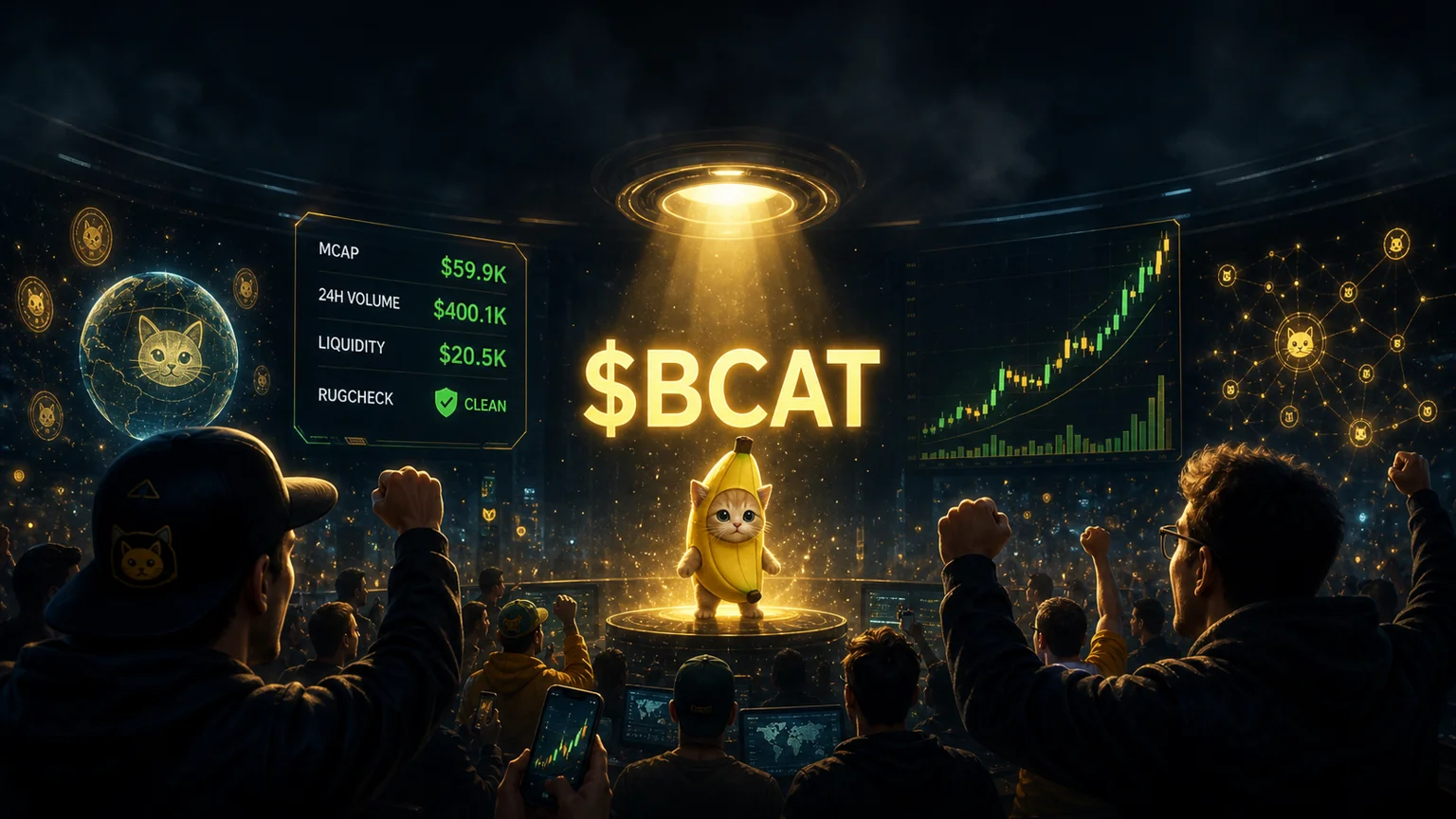
$BCAT came back with freeze authority disabled, mint authority disabled, and a Rugcheck score of 1, which is better than the average fresh Solana board. The trade-off is that the top three visible wallets still control 40.1% of supply and liquidity is only about $20.5K, so the setup is cleaner than most microcaps without becoming forgiving.
$BCAT is the kind of launch-radar board that only gets interesting once you realize it is not being graded against perfection. It is being graded against the rest of the Solana trench conveyor belt. On that scale, banana cat opened with a better first read than most same-day animal launches manage. At the 10:05 AM UTC selection snapshot on July 7, the token was trading near a $59.9K market cap with roughly $400.1K in 24-hour volume and about $20.5K in liquidity while the lead pair was only around 2.3 hours old. That is not enough size to make the board safe. It is enough to make the second-leg question real.
What separates it from the average noise hit is the combination of traffic and cleanliness. The board did not just blip on one green candle and vanish. It logged roughly 8,341 transactions, a 58.1% buy ratio, and a one-hour move near 58.84% even after the last five-minute read cooled off. The saved dev profile also came back with freeze authority disabled, mint authority disabled, and a Rugcheck score of 1. That does not make $BCAT a gift. It does mean the early read is cleaner than the microcaps that ask traders to ignore obvious contract problems before the meme has even earned a second look.
- → $BCAT was trading near a $59.9K market cap with roughly $400.1K in 24-hour volume and about $20.5K in liquidity at 10:05 AM UTC on July 7 while the lead pair was only around 2.3 hours old.
- → The chart still had live energy with a 58.84% one-hour move, about 8,341 total transactions, and a 58.1% buy ratio, which is enough activity to argue the board has more than one screen of interest behind it.
- → The contract read is cleaner than average because freeze authority is off, mint authority is off, and Rugcheck scored the token at 1, but top-three visible wallet concentration still sits at 40.1% and liquidity remains thin.
Why This Launch Got a Second Look
Most tiny Solana launches only get one chance to matter. They either detonate fast enough to force follow-up attention or they disappear into the chart graveyard before anyone can build a sentence around them. $BCAT earned a second look because it paired the usual meme familiarity of a cat ticker with a market structure that looked slightly more intentional than the average copy-paste board. It already had a watched-wallet buy attached to the setup, which matters less as a mystical smart-money prophecy and more as proof that someone active in the trenches thought the board was worth touching early.
The banana cat branding helps because it is simple without being overworked. There is no deep lore here, and that is fine. $BCAT does not pretend to be bigger than the joke supporting it. The ticker tells the story quickly, the board stays small enough for fresh buyers to imagine outsized upside, and the initial throughput makes the meme feel like it has already passed a basic relevance test. The appeal is that this looks like one of the rare low-cap boards where the contract shell is not immediately screaming louder than the meme.
The Numbers So Far
The turnover is the first reason this board deserves space. Roughly $400.1K in daily volume on a market cap below $60K means the market cycled through more than six times the token's size in a matter of hours. That is a serious number for a board this young because it tells you the meme is not just sitting on a stagnant pool with a few insiders passing tokens around. Traders kept showing up. More importantly, they kept showing up after the first burst. A one-hour move of 58.84% this late into a same-day board means the market still saw room for repricing rather than treating the launch as already exhausted.
The transaction mix looks constructive without becoming cartoonishly one-sided. About 4,845 buys against 3,496 sells means buyers were ahead, but not in the kind of absurd ratio that makes a chart feel fake on sight. Healthy early meme boards usually look messy, not perfect. The cooling five-minute read, down 7.91%, fits that pattern. It suggests the board is starting to test whether the first push can become a base instead of a memory.
What the On-Chain Data Shows
The best argument for $BCAT is not the meme. It is the absence of the loudest contract problems. Freeze authority is disabled. Mint authority is disabled. Rugcheck scored the token at 1. For a fresh Solana microcap, that is not just acceptable. It is notably light on obvious sabotage signals. Plenty of launches demand that traders hand-wave those checks away because the volume is moving too fast to care. $BCAT does not ask for that kind of suspension of disbelief. The shell looks cleaner than average, which is the main reason the board has room to be judged on tape rather than fear alone.
That said, the holder map still matters because clean permissions do not erase concentration. The top visible wallet controls 17.1% of supply. The second visible wallet controls 16.95%. Add the third row and top-three concentration reaches 40.1%. That is not a death sentence for a board this small, but it is enough to keep the trade unforgiving. If the first wave of attention stalls, those percentages can turn into gravity quickly. This is exactly why cleaner-than-average is the right phrase here. The token looks better than most fresh trench boards on the contract side while still carrying the normal microcap punishment for anyone who confuses clean structure with deep resilience.
It is also useful that the deployer history does not demand a paragraph of fear theater. The saved profile shows a zero-token creator history worth noting, which means the deployer is not the obvious headline. That lets the real read stay focused on what matters: thin but usable liquidity, a clean permission set, and a holder map that is manageable only as long as the crowd keeps rotating. The risk is mostly market structure, not a dramatic admin surprise.
Why the Smart-Wallet Angle Matters
The watched-wallet buy matters because it gives the second-leg story a reason to exist beyond raw velocity. In tiny meme boards, one of the hardest things to distinguish is whether a chart is attracting opportunists after the move or participants willing to touch it before the easy screenshots circulate. A tracked wallet showing up early does not prove greatness, but it does help separate a board being randomly churned from one that at least caught a sharper set of eyes before the crowd fully arrived.
The deeper point is psychological. Traders forgive a lot when they think a board has both a meme and a cleaner first read than the competition. $BCAT offers that combination in a market full of louder but sloppier launches. The chart is still fragile, but the setup is easier to believe in because the board does not force buyers to step over a freeze authority, a mint authority, or a disaster-level Rugcheck score before they can even argue the meme. That gives the smart-wallet angle more power than it would have on a dirtier launch.
How a Tiny Board Becomes Exit Liquidity
The danger is simple: microcaps this small do not need a scandal to break. They only need indifference. With only about $20.5K in liquidity, $BCAT can look healthy until the exact moment the bid thins out. The same turnover ratio that makes the board exciting also means a lot of traders have already touched it, and not all of them are looking for a multi-day hold. Some are looking for the first respectable green print they can sell into. Add a 40.1% top-three wallet concentration and the exit door gets narrow fast.
That is why calling the setup clean has to come with precision. It does not mean safe. It means cleaner than the average launch sitting next to it on the feed. There is a difference. If the market keeps rewarding the board with more transactions, steadier liquidity, and proof that the supply is distributing instead of tightening, the cleaner read can turn into a real second-leg trade. If attention fades, all the good contract checks in the world will not stop the chart from reverting to what it fundamentally is: a tiny Solana meme coin trying to survive the hour after traders stop being charmed by the name.
Verdict
🟢 Clean. $BCAT earns the cleaner-than-average label because freeze authority is off, mint authority is off, Rugcheck scored the board at 1, and the token is still printing enough turnover to argue that the second leg is a live question rather than a fantasy. That does not remove the microcap risk. Liquidity is only about $20.5K and the top three visible wallets still control 40.1% of supply. The right read is not that banana cat is safe. It is that the board looks cleaner than most same-day launches while remaining thin enough to punish anyone who forgets how small it still is.
FAQ
What is $BCAT on Solana?
$BCAT, also called banana cat, is a fresh Solana meme token trading under contract address 5whR534GcEEmrVPedDPZgWLXKQX3shhHMcdZ1FXCAMzi. At the July 7 selection snapshot, it was trading near a $59.9K market cap with roughly $400.1K in daily volume.
Why did MemeDesk put $BCAT on launch radar?
Because the board paired unusually strong turnover for its size with a cleaner-than-average contract profile and an early watched-wallet signal.
Does $BCAT look clean on-chain?
Cleaner than most fresh launches, yes. Freeze authority is disabled, mint authority is disabled, and Rugcheck scored the token at 1. The caveat is that top-three visible wallet concentration still sits at 40.1%.
What is the biggest risk on $BCAT right now?
Thin liquidity. With only about $20.5K in liquidity, the board can reverse quickly if attention fades or concentrated wallets decide to sell into the next push.
What would confirm the $BCAT thesis from here?
The strongest follow-up would be sustained turnover, more stable liquidity, and signs that ownership is broadening.