$BARK Turns a Dog-Meme Burst Into a Real Liquidity Test on Solana
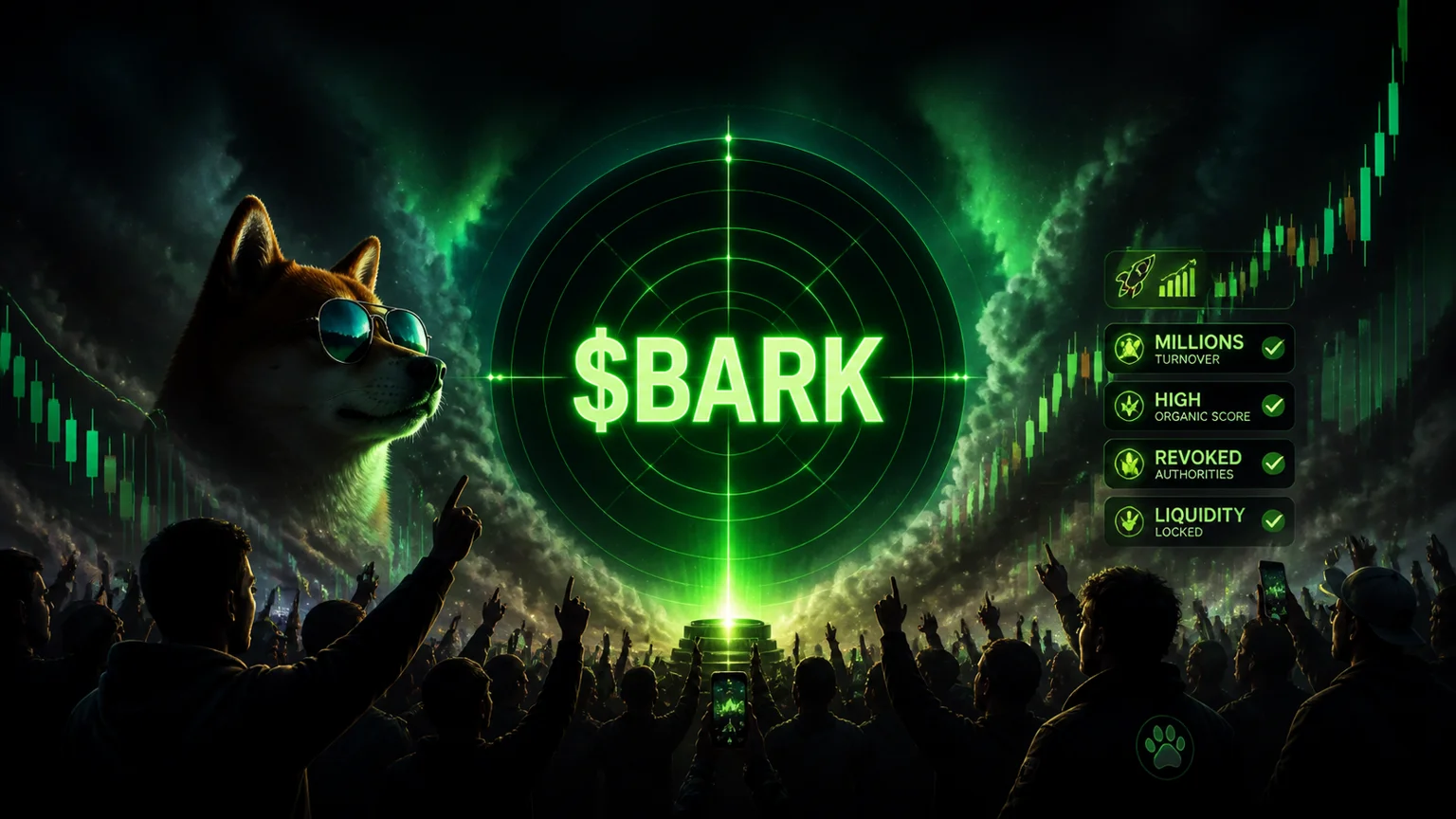
$BARK is only a few hours old, but the Bark for me chart already has multi-million-dollar turnover, a high organic score, revoked authorities, and enough liquidity to make the first cooldown worth watching.
Rugcheck shows a score of 1, disabled freeze and mint authority, no listed risks, and the top three visible holders around 9.1% combined.
$BARK is the kind of dog-meme launch where the joke is simple, but the early market structure is doing more work than the name. Bark for me is roughly three hours old in the supplied data, trading near a $940.7K market cap, and already pushed about $3.43M in 24-hour volume. That is not a sleepy launchpad coin waiting for attention. It is a fast Solana tape where traders have already fought over the chart, rotated through more than 64,000 transactions, and left enough liquidity behind to make the next range meaningful.
The editorial angle is the culture-meme bid meeting an unusually usable liquidity setup. Dog memes are never rare on Solana, but most of them either get immediate attention with awful exits or look clean because almost nobody is trading them. $BARK is sitting in the more useful middle. The market cap is still under $1M, liquidity is about $151.5K, holder count is above 4,300, and the organic score in the supplied market data is high. That does not make the token safe. It does make the next hour worth watching because the early move is not being carried by one thin pool and a screenshot.
- → $BARK is a fresh Solana dog meme trading near a $940.7K market cap with about $3.43M in 24h volume.
- → Liquidity is the standout number: roughly $151.5K against a sub-$1M market cap gives the chart more room than most first-day pump.fun names.
- → The visible holder map is cleaner than average, with the top three wallets around 9.1% combined and both freeze authority and mint authority disabled.
The Dog Meme Got Real Turnover
The first thing to separate with $BARK is meme quality from market quality. The meme itself is not complicated. Bark for me is direct, a little stupid, and built for the kind of fast repetition that Solana traders reward when the feed is moving. The market quality is the better story. A token around $940K in market cap doing more than $3.4M in daily volume is not just idling in a small chat. It is getting used as a trading vehicle.
That can be bullish or dangerous depending on what happens after the first burst. High turnover tells you attention is present. It also tells you inventory is changing hands quickly. The healthy version is a broadening base: early buyers sell into new buyers, liquidity stays firm, and the token builds a range without needing a vertical candle every few minutes. The unhealthy version is a churn machine where every bounce becomes exit liquidity. $BARK has not answered that question yet, but its liquidity gives the market a fairer test than the usual micro-pool launch.
Why Liquidity Is the Signal
$151.5K in liquidity is a serious number for a token still under $1M market cap. It does not remove slippage, and it does not protect anyone from a momentum break, but it changes how the chart should be read. Thin launches can print insane candles because there is almost no exit door. $BARK's pool is deeper than that. If buyers keep showing up, the token can compound without every small buy producing an absurd wick. If sellers arrive, the chart has more room to absorb them before the whole structure becomes a cliff.
That is why the liquidity trap angle cuts both ways. A deeper pool can make a launch look more trustworthy, which attracts later buyers. It can also give early winners a better place to unload without instantly breaking the chart. The next useful read is whether liquidity holds or grows while the market cap tests higher levels. If liquidity drains while volume stays loud, the clean read weakens quickly. If liquidity remains stable and price cools without collapsing, $BARK starts to look less like a one-candle dog and more like a real watchlist name.
What the On-Chain Data Shows
The on-chain profile is why $BARK gets a cleaner opening read than most fresh dog memes. Freeze authority is disabled, so the obvious transfer-freeze lever is not showing in the supplied profile. Mint authority is disabled too, which removes the simple risk of new supply being created after buyers arrive. Rugcheck shows a score of 1, with no listed risk items in the provided data. Those are baseline checks, not a guarantee, but they matter when the chart is moving this quickly.
Holder concentration is also manageable. The largest visible holder is around 4.64%, the second is about 2.67%, and the third is around 1.84%. Together, the top three visible holders control roughly 9.1% of supply. That is not perfectly distributed, but it is far away from the danger zone where one wallet can define the entire market. The supplied profile does not flag those top holders as insiders, and the creator profile does not show a serial-token history that deserves its own warning.
The dev wallet read is quiet rather than promotional. The creator token count is listed as zero, the risk list is empty, and the profile does not show an active freeze or mint authority. That means the bear case should focus less on a hidden contract switch and more on market behavior: whether early buyers distribute responsibly, whether liquidity remains real, and whether the holder map stays broad if $BARK tries to push beyond the first million-dollar valuation zone.
The Culture-Meme Bid
$BARK works because there is no onboarding problem. Traders understand the mascot before they understand the chart. Dog memes have a long advantage in crypto because they are visually immediate, easy to remix, and easy to chant in a crowded feed. Bark for me is not trying to build a complex lore system on day one. It is trying to be a ticker that people can repeat while the candle is still alive.
That simplicity is useful, but it also means the token has to keep proving itself through data. A dog meme without expanding attention becomes interchangeable fast. The market will not give $BARK a premium just because the ticker is clean. It needs volume to stay active, buys and sells to avoid flipping into one-sided pressure, and holders to keep expanding beyond the first few thousand wallets. The supplied buy ratio is close to balanced, which is healthier than a launch dominated by only panic buys or only exits.
$BARK's best early feature is not the candle. It is the combination of high turnover, deeper-than-usual first-day liquidity, and a holder map that is not obviously controlled by one cluster.
Where This Can Break
The main risk is that the liquidity read becomes bait. Traders see a cleaner pool, assume the move is more durable than it is, and chase just as early buyers start using that same pool as an exit. That is how good-looking launches turn into fast round trips. $BARK's market cap is still low enough to move violently, and a sub-$1M meme can lose its structure in minutes if volume flips from active rotation to nervous selling.
The other risk is that the 24h percentage is too loud for the actual base. The supplied data shows a massive first-day move and a positive latest 1h window, but the token is still young. A few hours of strong trading does not equal a durable community. For $BARK to keep the cleaner rating, liquidity should not collapse, the top-holder share should not creep higher, and the holder count should keep moving up without the chart relying on constant vertical candles.
What Confirms the Watch
The constructive path is straightforward. $BARK needs to defend a market-cap range near the current zone or higher while liquidity remains above the level that made the first read stand out. It needs the organic score to keep looking strong as more wallets arrive. It needs social repetition that is more than chart screenshots. Most importantly, it needs to show that the first real cooldown can happen without turning the pool into a one-way exit.
If that happens, the token has a clean enough structure to stay on the launch-radar board. If it fails, the post-mortem will be simple: a good-looking dog meme gave early traders a liquid exit before a real base formed. That is the line. $BARK is not a safety story. It is a live liquidity test with a meme simple enough to travel and on-chain data clean enough to deserve the next read.
$BARK earns a clean watchlist rating because liquidity is unusually strong for its size, the top-three holder concentration is only around 9.1%, and both freeze authority and mint authority are disabled. The risk is still classic meme-coin exhaustion: if volume turns into distribution and liquidity starts fading, the dog bid can unwind quickly.
What is $BARK?
$BARK is the Solana meme token Bark for me, a fresh pump.fun launch that drew heavy first-day trading volume.
Why is $BARK on MemeDesk radar?
$BARK combines about $3.43M in 24h volume with roughly $151.5K liquidity, more than 4,300 holders, a high organic score, and a relatively clean visible holder map.
What is the biggest $BARK risk?
The biggest risk is a liquidity trap: the same deeper pool that makes $BARK look healthier can also let early winners exit if demand fades.