
$ANSHUA Collapsed Before It Built Breadth, and the Holder Map Explains Why
At 2026-06-21 22:05 UTC, $ANSHUA was trading near a $4.1K market cap after roughly $168.1K in 24-hour volume with only about $4.7K in liquidity and just 171 holders. The contract shell did not look alarming, but a top wallet at 55.62% and a top-three concentration near 82.1% left the first day depending on too few hands for the move to hold.
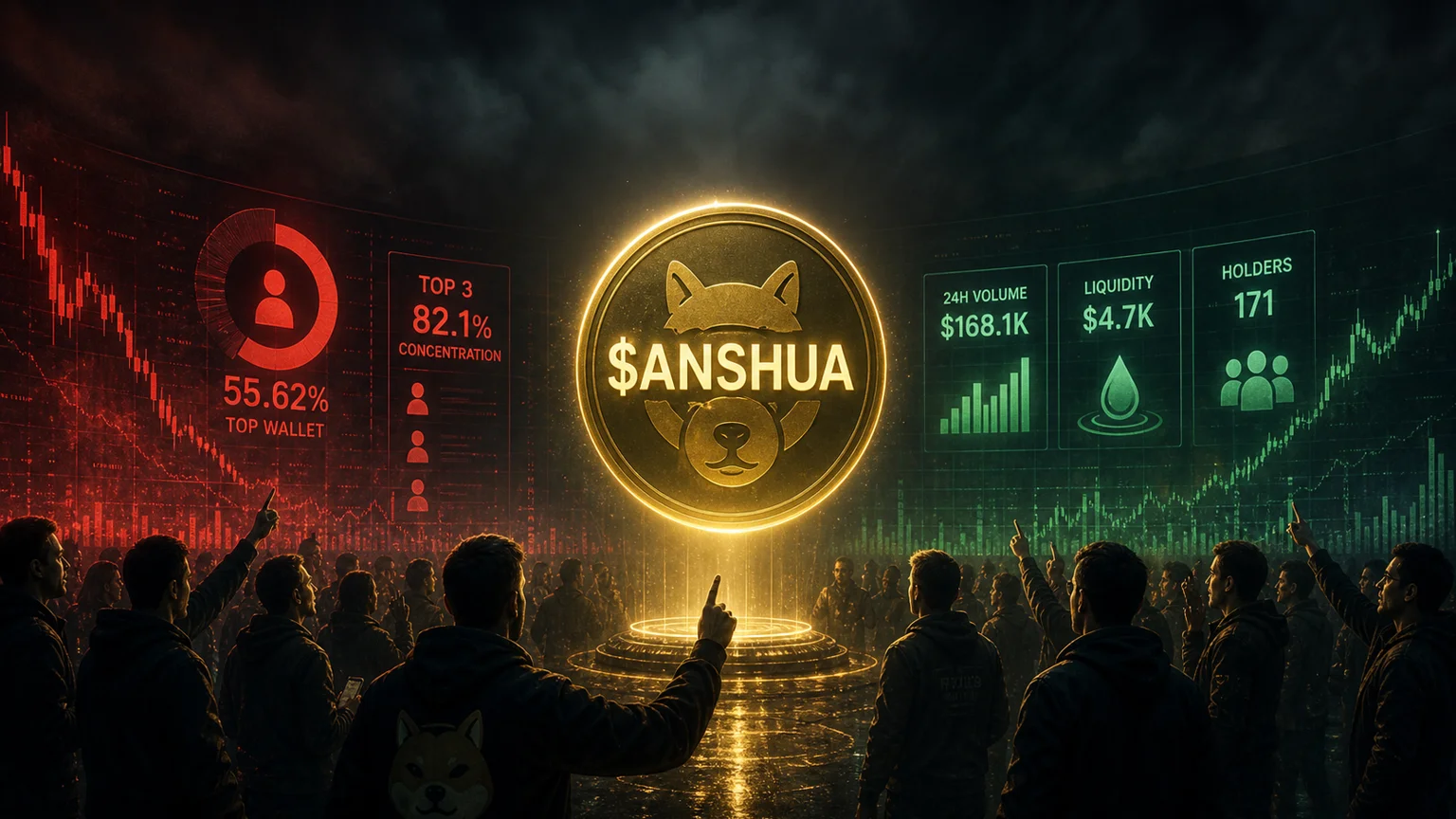
The contract profile is not the story. Freeze authority was off, mint authority was off, and Rugcheck only scored the token 17. The real pressure came from a tiny holder base and a top wallet controlling 55.62% of supply before the market had any chance to diversify.
There is a specific kind of first-day Solana failure that has nothing to do with scary permissions and everything to do with math. The meme gets a burst of interest, volume looks huge relative to the board, and traders convince themselves the market will distribute ownership on the fly. Then the board breaks before that distribution ever arrives. $ANSHUA looks like one of those launches. By the saved 2026-06-21 22:05 UTC snapshot, it had already pushed roughly $168.1K in 24-hour volume while the pair was only about 3.3 hours old. On paper, that sounds like a board the market cared about.
What the paper number hides is how little actual breadth sat under the move. Market cap was only around $4.1K. Liquidity was about $4.7K. Holder count was just 171. The 24-hour drawdown was already 86.58%, and the latest one-hour read was even uglier at down 95.6%. That combination is not a normal cool-off after discovery. It is a board that never built enough real ownership to survive the first wave of exits. $ANSHUA did not collapse because the contract read like a ticking bomb. It collapsed because too few wallets mattered too much for too long.
- → $ANSHUA processed about $168.1K in first-day turnover while the pair was only around 3.3 hours old, which is exactly the kind of loud launch activity that can make a tiny board look healthier than it really is.
- → The board then unraveled fast: market cap sat near $4.1K, liquidity was only about $4.7K, the 24-hour move was down 86.58%, and the latest one-hour tape was down 95.6%.
- → Freeze authority was off, mint authority was off, and Rugcheck scored the token 17, but a top wallet at 55.62%, top-three concentration near 82.1%, and only 171 holders made the structure far too narrow for the first-day hype to hold.
The Board Moved Before The Ownership Did
That sequencing problem is the whole story. Meme launches do not need perfect decentralization on minute one, but they do need evidence that the float is spreading while interest is growing. $ANSHUA never showed enough of that. When a token can register real turnover yet still sit with only 171 holders, it usually means the market is recycling attention inside a very small group. Price may still travel for a moment, especially if early buyers keep leaning. The issue is that the trade becomes reflexive in the wrong way. Once one or two large positions decide the first spike is good enough, there are not enough secondary hands to absorb the decision gracefully.
That is also why the 20.3% five-minute bounce in the saved snapshot should not be romanticized. Thin boards always flash small green recoveries because it does not take much size to force a local reversal. The real question is whether those reversals are happening inside a market that is broadening. Here, the answer looked like no. The board was still tiny, still shallow, and still dependent on a narrow ownership map. Without more real participants, every bounce just becomes another test of whether earlier holders are done selling yet.
What the On-Chain Data Shows
The concentration profile is severe even by fast-launch standards. The largest visible wallet held 55.62% of supply in the saved read. The second-largest held another 21.18%. Add the third wallet and the top three controlled about 82.1% combined. That is the sort of distribution that can make price action look dramatically alive while the market is still effectively negotiating with a handful of addresses. If those addresses behave well, the token can look stable for longer than it deserves. If they do not, the downside becomes immediate because there is no broad holder base underneath them.
The contract profile itself is not screaming for a panic headline. Freeze authority was off. Mint authority was off. Rugcheck scored the token 17, which is not pristine but also not the sort of number that automatically turns a board into a hard avoid. That distinction matters because it forces a more honest read. $ANSHUA was not undone by some exotic code-level ambush in the saved profile. It was undone by the fact that ownership concentration and liquidity thinness were already too intense for the amount of narrative the token actually had.
Why Tiny Holder Counts Change Everything
Holder count is one of the most underappreciated first-day signals in Solana meme trading because it tells you whether attention has become distribution yet. A token can survive top-heavy early ownership if the market is rapidly recruiting new hands who are willing to hold through noise. With only 171 holders in the saved read, $ANSHUA was nowhere near that stage. The board was still functioning like a tight private game with public screenshots layered on top. That is fine when price is going up. It is awful once a few participants decide they are done underwriting the excitement.
This is also why the raw turnover number should be treated with suspicion rather than awe. About $168.1K in volume against a $4.1K market cap sounds explosive, but on boards like this it can reflect the same supply changing hands repeatedly among a very limited audience. That kind of churn can produce incredible-looking candles without creating any genuine resilience. In other words, the board can look busy while still being structurally lonely. $ANSHUA had exactly that feel by the time the saved snapshot hit.
The Exhaustion Came Faster Than The Story
The pair age being only about 3.3 hours old makes the collapse even more revealing. When a token is already down 86.58% on the day and 95.6% in the latest hour that early, the market is telling you the narrative never got enough depth to outrun the first unwind. There was no second chapter here yet, just a first chapter that ended before the crowd had time to decide what the token was supposed to represent. That is the danger with meme launches that rely too heavily on the chart itself as the story. Once the chart stops flattering them, nothing else is left to stabilize demand.
A rebound is still possible because tiny Solana boards can move violently on very little money, and traders are always tempted by anything that has already shown it can print percentages. But a rebound in this setup would be a trade against the same structural weakness that caused the first collapse. Unless holder count expands materially and the concentration profile softens, the token is still asking new buyers to trust a market that already proved it can implode before breakfast.
What Would Need To Improve
For $ANSHUA to earn a cleaner read from here, the board would need broader ownership before it needs another story. That means more than a quick green candle. It means a much larger holder base than 171, liquidity meaningfully beyond the current roughly $4.7K stack, and evidence that top-wallet control is no longer defining every important decision. Until those changes show up, the best way to read $ANSHUA is as a holder-map collapse that arrived before distribution did.
🟡 $ANSHUA stays speculative because the contract shell was not the immediate problem, but the market structure absolutely was. A top wallet at 55.62%, top-three concentration near 82.1%, only 171 holders, and an 86.58% daily drawdown are enough to treat the board as a first-day holder-map trap rather than a stable launch setup.
What is $ANSHUA on Solana?
$ANSHUA is a Solana meme token trading under contract address 4narUe9SFJegphpEpQJunCLnHQaozPrjeACzugE6pump. In the saved 2026-06-21 22:05 UTC snapshot, it was trading near a $4.1K market cap after roughly $168.1K in 24-hour volume.
Why did $ANSHUA fall so quickly?
$ANSHUA looked like a board where activity arrived faster than distribution. The saved read showed only 171 holders, roughly $4.7K in liquidity, a top wallet controlling 55.62% of supply, and top-three concentration near 82.1%, which left the token too narrow to absorb first-day selling pressure.
Did $ANSHUA have obvious contract red flags?
Not the most dramatic kind. Freeze authority was off, mint authority was off, and Rugcheck scored the token 17. The main weakness in the saved profile was not code-level permissions but the combination of shallow liquidity and highly concentrated ownership.
What would make the $ANSHUA setup look better from here?
A larger holder base, deeper liquidity, and a softer concentration profile would all help. Without those changes, any rebound still depends on too few wallets behaving well for too long.