$🐂🀄️ Drew Two Watched Wallets, but Ansem Army Still Trades Like a Crowded Exit Door
$🐂🀄️ pushed roughly $2.0M in 24-hour volume inside its first few hours on Solana and pulled in tracked buying from both Zrool and ozark before the ticker fully settled into public timeline chatter. The contract profile is unusually clean on permissions, yet the board still sits under a top-three visible holder stack near 48%, which means this is less a clean breakout than a watched-wallet pile-in trying to outrun a very narrow exit.
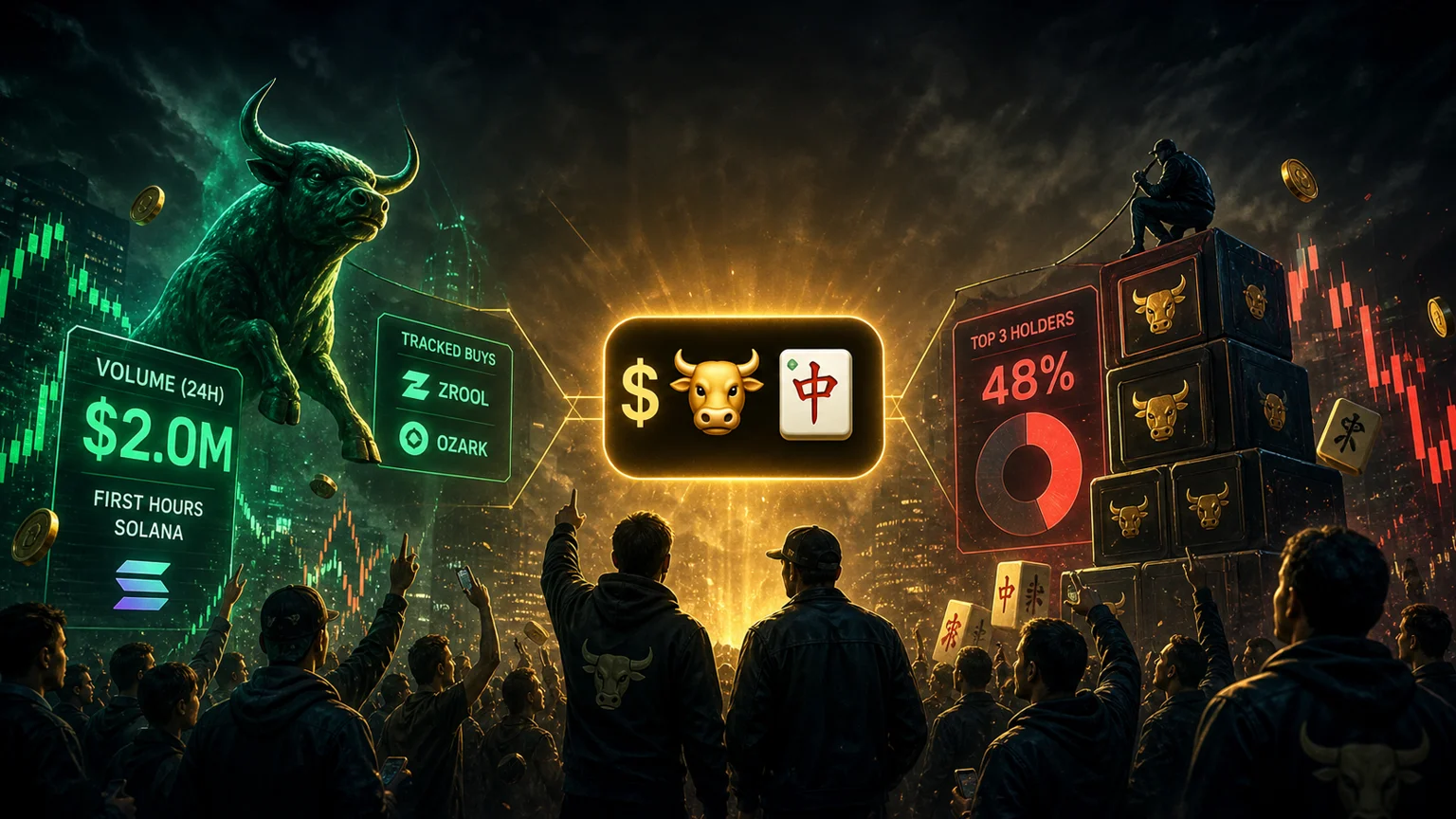
Freeze authority is off, mint authority is off, and Rugcheck scores the contract at 1, but the top three visible holders still control about 48.0% of supply.
$🐂🀄️ is the kind of first-session Solana board that can bait people into telling themselves two bullish stories at once. The first story is the fun one: Ansem Army already pushed roughly $2.0M in 24-hour volume by the saved 2026-06-28 10:05 UTC selection read, which is serious turnover for a token carrying only about a $223.9K market cap and roughly $37.9K in liquidity. The second story is the one that actually matters: two watched wallets showed up before the ticker looked fully domesticated to the broader crowd. That combination is why this launch is on the radar. But it is also why the downside can get violent if the next buyers hesitate.
The temptation is to look at the wallet names, the 703% daily move, and the raw tape speed and call the board blessed. That would be lazy. $🐂🀄️ does have an early-momentum case because Zrool and ozark were not merely reacting to a finished move. They were participating while the board was still being priced. Yet the structure under the surface is much tighter than the headline volume makes it sound. The top visible wallet holds 20.69% of supply, the second-largest visible wallet holds another 15%, and the leading AMM wallet adds 12.28% more. Add those together and the top three visible buckets still control about 48% of the token. That is the part degens need to care about more than the green candle.
- → $🐂🀄️ was sitting near a $223.9K market cap with about $37.9K in liquidity and roughly $2.0M in 24-hour volume at the saved 2026-06-28 10:05 UTC DexScreener snapshot.
- → Zrool built first between 2026-06-28 07:35:21 UTC and 2026-06-28 07:35:44 UTC, and ozark followed between 2026-06-28 07:35:26 UTC and 2026-06-28 07:36:18 UTC, which makes the watched-wallet footprint meaningful rather than ceremonial.
- → The contract permissions look clean, but the market structure does not: freeze authority is off, mint authority is off, Rugcheck scores the token at 1, and the top three visible holders still control about 48% of supply.
Why This Board Got Attention
Ansem Army did not need a complicated lore packet to get moving. The ticker itself already speaks fluent timeline. It borrows social gravity from a name that CT instantly recognizes, which means the board can pick up speed before anyone bothers to explain it. That matters in meme markets because recognizability lowers the friction for the next buyer. Degens do not need to debate what the joke is. They only need to decide whether the joke is early enough to monetize.
What separated $🐂🀄️ from generic launch noise was not just the cultural shorthand. It was the way the volume stacked against the size of the board. Roughly $2.0M in 24-hour turnover on a market cap barely above $200K tells you the float was actually changing hands instead of sitting in a dead shell with one clever screenshot. Even the one-hour volume, around $564.3K, is large enough to say this was a live repricing event rather than a sleepy afterglow from the deploy. That is exactly the kind of tape that can pull in wallet watchers before the broader room fully catches on.
Where the Early Money Showed Up
The wallet sequence is what turns the board from a chart into a narrative. Zrool's main clip landed at 2026-06-28 07:35:21 UTC with roughly $156.60 deployed for more than 554K tokens while price was still around $0.000282. That was not a late chase. It was an attempt to define the early zone. Smaller adds came immediately afterward between 2026-06-28 07:35:39 UTC and 2026-06-28 07:35:44 UTC, which matters because repeated entries tell a more serious story than one screenshot fill posted for social theater.
Ozark then arrived with a much larger statement trade. A roughly $3,468 buy hit at 2026-06-28 07:35:26 UTC for more than 9.5M tokens, and another add came at 2026-06-28 07:36:18 UTC. Together, those flows tell you this was not one wallet forcing a board into relevance by itself. There was at least a small cluster of watched participation early enough to matter. The problem is that the board has already churned so hard that a lot of the easy asymmetry may have been spent on creating the initial screenshot.
What the On-Chain Data Shows
On-chain, $🐂🀄️ gets the kind of first pass most Solana memes would kill for. Freeze authority is off. Mint authority is off. Rugcheck scores the contract at 1. The creator wallet, 5JsPz9a717BWzgyszdupYFNvYh2ebEW8cCxmSSfxq23U, shows a zero token balance in the saved report, and the Rugcheck snapshot counted about 1,500 holders. Those are all real positives because they remove some of the laziest rug vectors and suggest the token is already broad enough to be tradable rather than purely internal.
The reason the article still stops short of a clean rating is that permission risk is only one layer of the game. Holder concentration is the other layer, and here it is still heavy. The top visible wallet sits at 20.69%. The second-largest visible wallet adds another 15%. The Pump Fun AMM wallet holds 12.28%, which is functional liquidity but still part of a narrow visible stack. When the top three visible buckets collectively sit around 48%, the board can remain mathematically fragile even with freeze and mint authority both neutralized. In meme terms, that means the contract may be cleaner than average while the actual exit door is still uncomfortably thin.
Why the Volume Cuts Both Ways
At first glance, a token doing nearly nine times its market cap in 24-hour turnover looks like the strongest possible confirmation. Sometimes it is. Other times it is exactly what a crowded microcap looks like right before the crowd realizes it all tried to fit through the same doorway. $🐂🀄️ sits somewhere in that tension. The board has clearly been interesting enough to recycle size. But the 47.7% buy ratio says the tape is not one-way demand anymore. Sellers are already present in force, which is normal after a 703% day and dangerous when the liquidity base is still under $40K.
That does not make the move fake. It makes the setup conditional. A real runner can survive profit-taking if the next wave of buyers shows up fast enough and if the large holders do not start leaning on the book at the same moment. A board with thin liquidity and concentrated supply cannot survive much indecision. That is why this angle is not really about whether the watched wallets were smart to arrive. It is about whether the rest of the market is willing to pay up after them without getting trapped into donating liquidity back to the same concentrated holder map.
What Needs to Happen Next
For $🐂🀄️ to stay interesting from here, the next round of trade has to broaden the board instead of merely recycling the same believers. That means more holders, steadier liquidity, and enough buy-side appetite to absorb trims from oversized wallets without immediately collapsing the mood. If the token can keep volume firm while the holder map gradually spreads out, then the early Zrool and ozark participation starts to look like genuine discovery instead of simply another fast Solana pile-in.
$🐂🀄️ does not need a hidden mint switch to hurt late buyers. The obvious risk is structural.
With roughly $37.9K in liquidity at the saved read, the board does not have much room for concentrated holders to test exits before price starts slipping.
If the wallets that own 20.69% and 15% decide to feed the bid while the crowd is still celebrating the watched-wallet story, the same volume that looked exciting on the way up can become proof that the board already spent most of its easy attention.
That is why the correct posture remains speculative. The early wallet footprint is real, the cultural shorthand is obvious, and the contract checks are cleaner than average. But none of that changes the fact that this is still a microcap Solana board with a narrow visible holder stack and a surprisingly small liquidity cushion for how much turnover it has already done.
🟡 $🐂🀄️ earns the speculative tag because the signal is real but the structure is still fragile. Two watched wallets showed up early enough to matter, and roughly $2.0M in 24-hour volume on a $223.9K market cap proves the board has already forced a reprice. The contract profile also reads better than most first-day Solana memes: freeze authority off, mint authority off, creator balance at zero, and a Rugcheck score of 1. But the top visible holder map is simply too tight to ignore, with about 48% of supply clustered in the top three visible buckets. $🐂🀄️ is worth watching if fresh participation broadens the board. It is not broad enough yet to call clean.
What is $🐂🀄️ on Solana?
$🐂🀄️ is the ticker for Ansem Army on Solana, trading under contract address 2hci7YELD2n8JREvP3LXbPJSx1rJnDb9fBZyP6iUpump. At the saved 2026-06-28 10:05 UTC snapshot, DexScreener had it near a $223.9K market cap with about $37.9K in liquidity.
Why do the Zrool and ozark buys matter on $🐂🀄️?
Because they happened early enough to help define the range instead of simply celebrating a completed breakout. Zrool began buying at 2026-06-28 07:35:21 UTC, and ozark followed with a larger clip at 2026-06-28 07:35:26 UTC while the token was still being repriced.
Does $🐂🀄️ look clean on-chain?
Cleaner than average on permissions, yes, but not clean enough to remove trade risk. Freeze authority is off, mint authority is off, the creator wallet shows no current token balance in the saved Rugcheck report, and the Rugcheck score is 1. The bigger concern is holder concentration, not contract permissions.
What is the main risk on $🐂🀄️ right now?
The main risk is that the top visible holder map is still narrow. One wallet holds 20.69%, another holds 15%, and the top three visible buckets control about 48% of supply while liquidity is still only around $37.9K.
What would improve the $🐂🀄️ setup from here?
A better read would show more holders arriving, liquidity building, and the board absorbing trimming from larger wallets without losing the bid. If volume stays strong while concentration starts to loosen, the watched-wallet pile-in will look much healthier.