$ANIMEBULL Is the Cleanest Ansem Derivative on Solana So Far, but the Hard Part Starts After the Joke Lands
At roughly 10:15 PM UTC, $ANIMEBULL was trading near a $523.3K market cap on about $987.7K in 24-hour volume with $57.7K of liquidity. The contract shell reads unusually clean, the top three visible wallets control only 6.81% of supply, and the buy side still dominates the tape, but derivative memes only stay special if they keep attracting demand after the first laugh is over.
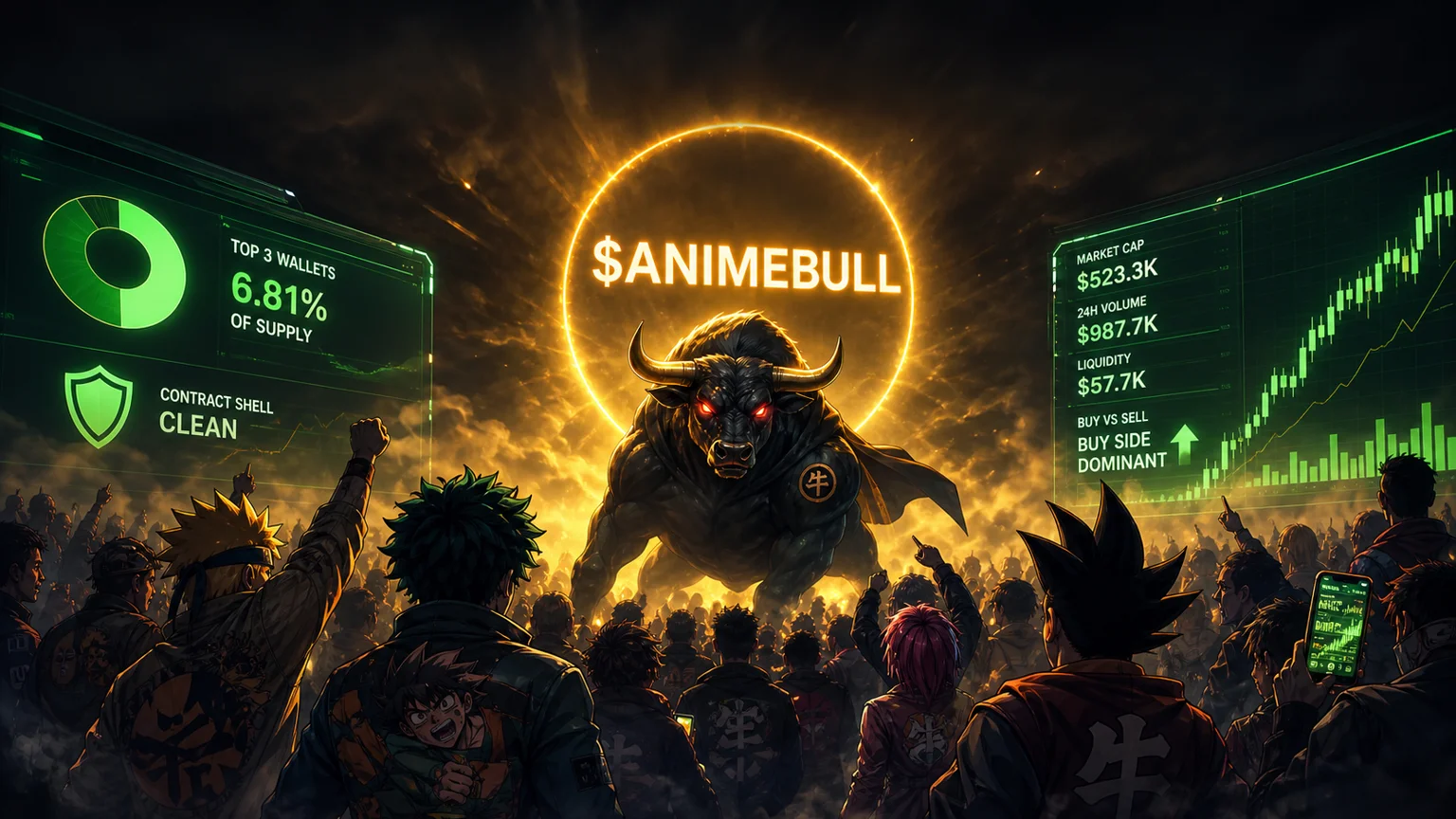
Rugcheck scored $ANIMEBULL a 1 with freeze and mint authority both off, and the top three visible wallets control only 6.81% of supply, which is unusually open distribution for a Solana launch moving this quickly.
$ANIMEBULL is doing something most derivative launches fail to do: it is making the joke feel tradeable for longer than one candle. Around 10:15 PM UTC, the token was sitting near a $523.3K market cap with roughly $987.7K in 24-hour volume and about $57.7K of liquidity. That is already large enough to matter on a crowded Solana night, especially because the chart had not immediately given the move back. The daily gain still read 626%, but the more useful detail was the latest-hour action. Instead of straight-up panic or straight-up exhaustion, the board had flattened out near breakeven, which is usually what a launch looks like when the first mania burst is trying to turn into a real market.
The temptation is to dismiss $ANIMEBULL as just another derivative board piggybacking on a familiar CT character. That is exactly why the launch matters. Derivative memes are not valuable because they are original. They are valuable because they compress recognition. If the market already understands the reference, traders can spend less time learning the story and more time deciding whether the chart deserves another leg. $ANIMEBULL landed in that sweet spot. The meme is obvious, the ticker is readable, and the name carries just enough insider humor to travel without becoming incoherent to outsiders.
- → At roughly 10:15 PM UTC, $ANIMEBULL was trading near a $523.3K market cap on about $987.7K in 24-hour volume with $57.7K of liquidity, which is real size for a sub-two-hour Solana launch.
- → The buy side is still doing the heavy lifting: 16,014 buys against 3,227 sells implies an 83.2% buy ratio, while the latest hour sitting near flat suggests the board is consolidating rather than instantly breaking down.
- → On-chain, the setup looks cleaner than most first-wave derivatives. Rugcheck scored it 1, freeze authority is off, mint authority is off, and the top three visible wallets control only 6.81% of supply.
Why the Ansem Derivative Worked
The best meme launches solve for speed of understanding. $ANIMEBULL did that immediately. You do not need a wiki page or a white paper to understand the reference. The board plugs into an existing Solana-native personality frame, adds a more absurd visual twist, and lets the ticker do the rest. That is enough to get traders to open the chart. From there, the numbers did the conversion work. A derivative can draw curiosity with branding, but it only graduates to a real board when the tape starts proving that the curiosity is translating into repeated buys rather than one-off clicks.
There is another reason this version traveled. The project came to market looking packaged rather than accidental. The token has an active social profile, a live website, and even visible DexScreener boost spend supporting discovery. Normally that last detail would be a warning sign by itself, but on this chart it reads more like fuel than camouflage. Paid visibility can buy the first look. It cannot manufacture a nearly million-dollar turnover day, a 16,000-plus buy count, or a holder base that is already nearing 7,000 wallets. Those numbers tell you the board got well past pure promotion and into genuine participation.
The Buy Side Is Still Doing the Heavy Lifting
The raw stat line is strong, but the relationship between the stats is even stronger. A board near a half-million dollars in market cap printing almost a million dollars in turnover is already proving that people are not treating it like a one-minute novelty. More importantly, the pool is not paper-thin. About $57.7K of liquidity is still dangerous in absolute terms, because every meme coin launch is dangerous in absolute terms, but it is a completely different environment from the micro boards that try to survive on four-figure depth. There is enough actual market here for consolidation to mean something.
The buy-sell split matters too. An 83.2% buy ratio built from 16,014 buys against 3,227 sells tells you the chart has not yet entered the phase where late money is only financing early exits. That does not mean everyone holding is smart money. It means the demand profile still looks broader than the supply profile. The latest hour being almost flat instead of sharply negative supports the same read. After a 626% day, the first healthy question is whether the chart can stop going vertical without immediately dying. So far, $ANIMEBULL has answered that question better than most derivative launches ever do.
What the On-Chain Data Shows
This is where $ANIMEBULL separates itself from the average fast meme copy. Rugcheck scores the token a 1. Freeze authority is off, so there is no obvious transfer-freeze threat hanging over the board. Mint authority is off as well, which removes the supply-expansion nightmare that can instantly invalidate a hot chart. The creator wallet balance reads zero, and there is no visible serial-deployer pattern complicating the story. None of that guarantees success, but it does remove the easy reasons to dismiss the launch outright.
Distribution is even more impressive than the permissions layer. The largest visible wallet holds 5.49% of supply. The next two visible wallets sit at 0.73% and 0.59%, leaving top-three concentration at just 6.81%. On Solana, that is unusually open for a board moving this quickly. Most first-wave launches that rip this hard carry a hidden tax in the holder map, where one or two wallets can still dictate the entire future. $ANIMEBULL instead looks like a board that distributed early enough to let the market actually negotiate price rather than merely inherit it from insiders.
The holder count reinforces the same point. Nearly 7,000 holders in under two hours does not make the token mature, but it does make it harder for one cluster of wallets to dominate every mood swing. That is the real reason the chart deserves a cleaner label than the usual derivative board. The risk is still there, because all meme launches are risky, yet the risk is shifting away from hidden contract powers and extreme holder concentration. Here the bigger challenge becomes whether the story can keep refreshing itself once the first wave of recognition has already been priced in.
The Hard Part Starts After the Joke Lands
The bull case is straightforward: $ANIMEBULL has already done the two hardest things a derivative board needs to do. It got attention immediately, and it converted that attention into a cleaner-than-average market structure. The bear case is more interesting. Derivative memes tend to peak when the audience realizes there is nothing left to discover. Once everyone gets the joke, the board has to survive on execution, social persistence, and fresh buyers who were not needed for the first burst. That is where most copycats die. They are legible enough to launch and too thin conceptually to live.
For $ANIMEBULL, the upgrade path is not mysterious. Liquidity has to keep expanding. The holder map has to stay this diffuse instead of reclustering into a few aggressive wallets. And the chart has to prove it can trade sideways without losing all urgency. If those conditions hold, the board can stop being just the cleanest version of an existing meme and start becoming a real Solana ticker in its own right. If they fail, the same clean structure that looks impressive now will only soften the downside rather than prevent it.
Verdict
🟢 Clean. $ANIMEBULL has one of the better early-launch reads on the board right now because the market structure is backing up the meme instead of undermining it. Roughly $987.7K in turnover, about $57.7K in liquidity, a Rugcheck score of 1, no freeze or mint authority, and only 6.81% in the top three visible wallets is a materially cleaner package than most derivative launches ever show. The caution is not hidden on-chain rot. It is simple lifecycle risk: once the first recognition trade is over, the board still needs to prove it can keep earning attention.
FAQ
What is $ANIMEBULL on Solana?
$ANIMEBULL is a Solana meme token trading under contract 5UQNY2hk4fgaDYL8Cq2SgVZ97q7Uvb95aAuSG18dpump. Around 10:15 PM UTC it was trading near a $523.3K market cap on almost $987.7K in 24-hour volume.
Why does $ANIMEBULL stand out from other derivative memes?
Because the market structure is cleaner than the usual copycat launch. The board already has meaningful liquidity, broad participation, and a holder map that is far less concentrated than most first-wave derivatives.
Does $ANIMEBULL look safe on-chain?
Nothing in meme coins is safe in the absolute sense, but the current on-chain read is unusually clean. Rugcheck scores it 1, freeze authority is off, mint authority is off, and the top three visible wallets control only 6.81% of supply.
What is the biggest risk on $ANIMEBULL now?
Lifecycle risk. Derivative memes often fade once the first wave of recognition is priced in, so the next test is whether the board can keep attracting real demand after the novelty trade cools.
What would keep the $ANIMEBULL setup healthy from here?
A deeper liquidity pool, continued broad distribution, and price action that can consolidate without turning into a sharp supply-led unwind. If those three things hold, the board has a chance to keep graduating instead of peaking early.