$ANCHUA Rips 439%, But the Holder Map Is the Whole Warning
$ANCHUA has the kind of pump.fun velocity that gets traders staring, yet one listed wallet near 97% of supply turns this from a clean chase into a concentration-risk memo.
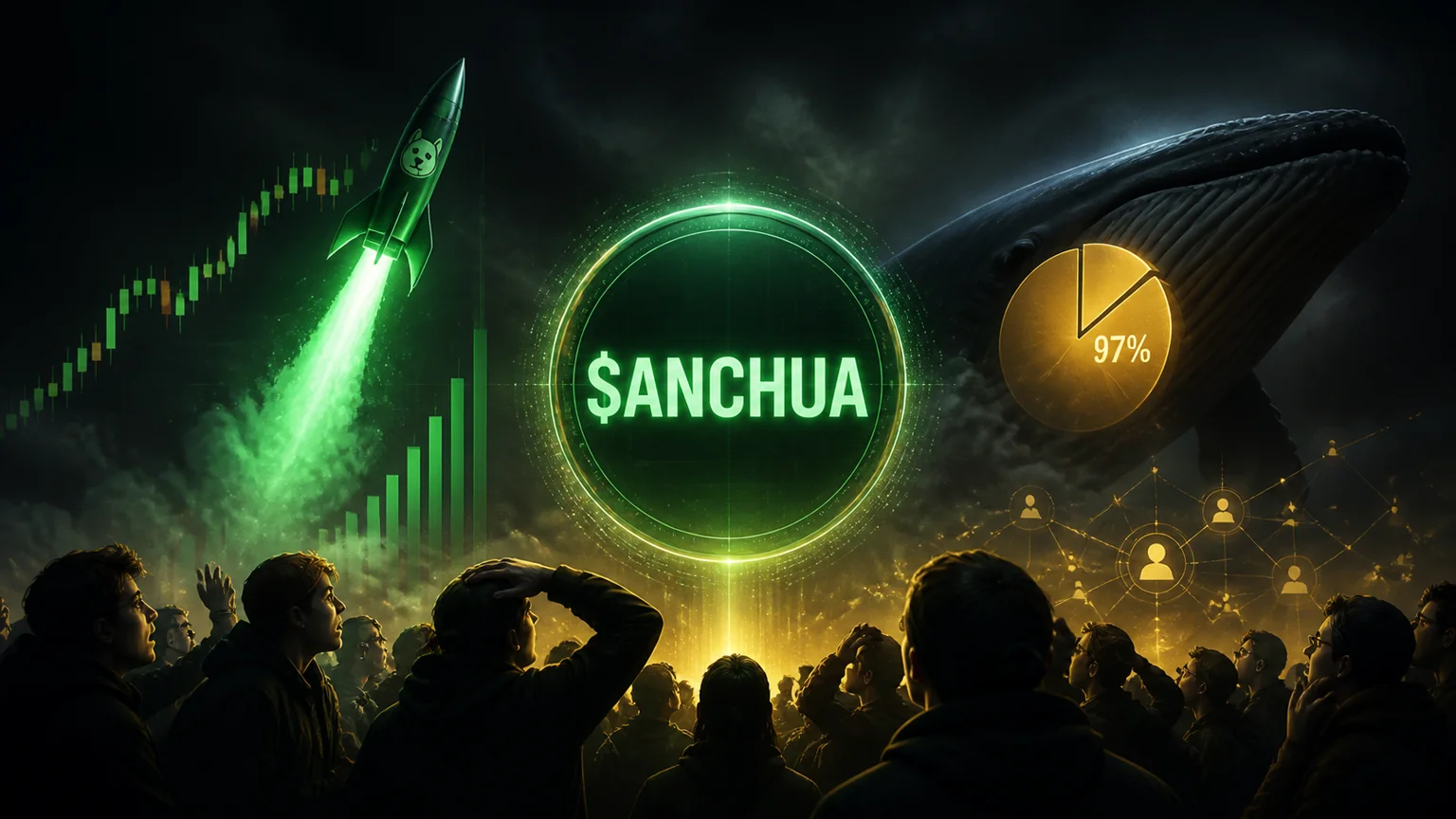
Low liquidity warning with top holder at 97.28% and top-three concentration near 98.7%.
$ANCHUA is the kind of Solana launch that can fool a dashboard at first glance. The Black Jotchua was about 58 minutes old in the latest UTC snapshot, up 439.1% over the tracked hour, and doing roughly $372.39K in 24-hour volume against a market cap near $36.02K. Those are attention-grabbing numbers for a pump.fun meme. They are also exactly the kind of numbers that can make traders forget to ask who controls the supply.
That is the entire angle here. $ANCHUA has velocity, but the holder map is not a footnote. Rugcheck's available holder list shows the largest listed holder at 97.28% of supply, with the top three near 98.7%. Even if some of that reflects launch mechanics, pool custody, or indexing weirdness that can update later, the current reader-facing risk is too large to soften. A token can pump 439% and still be structurally hostile if one address dominates the map.
- → $ANCHUA traded around a $36.02K market cap after a 439.1% one-hour move and about $372.39K in 24-hour volume.
- → Liquidity is only about $7.09K, so even modest selling can move the chart harder than the headline volume implies.
- → Freeze authority and mint authority are disabled, but Rugcheck shows a low-liquidity danger flag and a top listed holder at 97.28%.
The Candle Is Loud
The bullish surface case is easy to understand. $ANCHUA is a sub-$50K market-cap meme that ripped more than four times in its first tracked hour, pulled in 3,361 transactions, and posted more than ten times its market cap in volume. The buy side was also active, with 1,774 buys against 1,587 sells in the signal window. That is not a dead token with one spoofed trade. The launch had real motion, real churn, and enough activity to reach traders scanning for violent early Solana moves.
But loud candles are not the same as healthy structure. At this size, the chart can move because the pool is tiny and traders are firing small orders into a meme that already looks alive. $ANCHUA's price action says attention arrived. It does not say the attention is durable, fair, or deep enough to support late entries. That difference matters because meme tokens do not fail only when nobody buys them. They also fail when everyone buys the same thin setup after the easy move has already printed.
Volume Cannot Fix a Broken Map
The most tempting number is $372.39K in 24-hour volume. Against a $36.02K market cap, that looks like a market discovering a tiny meme at speed. It can be that. It can also be a warning that the float is being recycled through a narrow pool while the underlying ownership picture remains wildly uneven. $ANCHUA has the activity profile of a token people want to trade, but activity does not automatically distribute risk. A thousand small trades can still orbit one dominant supply holder.
The organic score makes the caution louder. The snapshot shows an organic score of 0 with a low label. That does not prove malicious intent by itself, but it does mean the launch is not giving the kind of broad, clean participation signal that would offset the concentration issue. For $ANCHUA, the best possible bull case needs organic demand to outrun the holder risk. The current data does the opposite: it shows price velocity first, then a holder profile that demands skepticism.
What the On-Chain Data Shows
The authority check is the one cleaner part of $ANCHUA. Rugcheck lists freeze authority as false and mint authority as false, so the available data does not show a live freeze lever or an active mint-expansion lever. That matters because those controls are two of the simplest ways a Solana token can become abusive. The problem is that clean authorities do not rescue a token when the supply map is this lopsided. Authority risk is only one category. Holder risk is another, and $ANCHUA's holder risk is the center of the story.
The top listed holder is the number that changes the read: 97.28%. The next two listed holders are around 0.90% and 0.49%, putting top-three concentration near 98.7%. In a normal launch-radar piece, a top holder under 20% might still be workable if liquidity is improving and the organic score is strong. This is not that setup. At $7.09K of liquidity, a holder map this concentrated can turn any green candle into an exit-liquidity event if the dominant balance becomes active.
Rugcheck also flags low liquidity as a danger-level risk, and the normalized score is 33. That score is not the highest-risk read possible, but it is meaningfully worse than the clean one-point profiles that sometimes appear in early pump.fun names. The listed dev wallet is CsKVhNoiJG8a9RGt1hBLQG7ni5YJsiY19NorUaXCyPTJ, with creator token count shown as zero in the available profile. That avoids a serial-deployer accusation from this dataset, but it does not change the practical issue: a tiny pool plus extreme holder concentration leaves traders exposed.
Why This Is a Warning, Not a Victory Lap
A lot of launch traders are trained to chase the first huge percentage move and ask questions later. $ANCHUA is a reminder that the question has to come first. A 439.1% move from a tiny base can be produced with less real capital than the number suggests. If the pool has only $7.09K in liquidity, price can travel a long way before the market proves it can absorb exits. That is why the volume number should be read beside the liquidity number, not above it.
The holder map also changes how to interpret every bounce. With $ANCHUA, a green continuation candle would not automatically mean the market has accepted the meme. It could simply mean buyers are still willing to bid into a concentrated structure. The healthier version would require visible redistribution, rising holder count, deeper liquidity, and an organic score that stops reading like a dead zone. Without those changes, the token remains a sharp chart wrapped around an ugly ownership problem.
$ANCHUA has disabled freeze and mint authority, but that is not enough. A top listed holder near 97.28% and liquidity near $7.09K make the current setup structurally fragile.
The Only Upgrade Path That Matters
$ANCHUA can improve, but the bar is high. The market would need to see the dominant holder percentage fall materially, the top-three concentration normalize, and liquidity deepen beyond the current micro-pool. Holder count is only 179 in the snapshot, so there is not yet a broad crowd to absorb supply. The token also needs more organic-looking activity. A low organic score paired with extreme concentration is not a setup that deserves generous interpretation.
If those changes happen, $ANCHUA could move from warning label to speculative watch. Until then, the cleaner authority data should be treated as a narrow positive inside a much bigger risk picture. The market has already shown that it can move the price. It has not shown that the ownership structure is acceptable, that exits can be absorbed, or that the meme has durable demand beyond the first violent move.
$ANCHUA gets a shill-risk rating despite the 439.1% pump. The token has attention, activity, and disabled freeze and mint authority, but the holder map overwhelms the bull case. A top listed holder near 97.28%, top-three concentration near 98.7%, a low-liquidity danger flag, and only about $7.09K in the pool make this a dangerous structure. Until distribution and liquidity materially improve, $ANCHUA is better read as a concentration warning than a clean Solana runner.
What is $ANCHUA?
$ANCHUA is The Black Jotchua, a new Solana meme token launched through pump.fun with the contract address 3bcopT3qoqL59QRzjnEUkVfg2zqnwZFRdNfUkdpspump.
Why did $ANCHUA get attention?
$ANCHUA showed a 439.1% one-hour move with about $372.39K in 24-hour volume against a market cap near $36.02K.
What is the biggest issue with $ANCHUA?
$ANCHUA's biggest issue is holder concentration. The available Rugcheck profile lists one holder near 97.28% and top-three concentration near 98.7%.